Afonso of Kongo: "our country is being completely depopulated"
- Dated
- Place
- Mbanza Kongo, Zaire Province, Angola · Kingdom of Kongo, the court of Afonso I (Mvemba a Nzinga) at Mbanza Kongo
- Coordinates
- 6° 16′ S · 14° 15′ E (approximate)
- Remains
- Intact
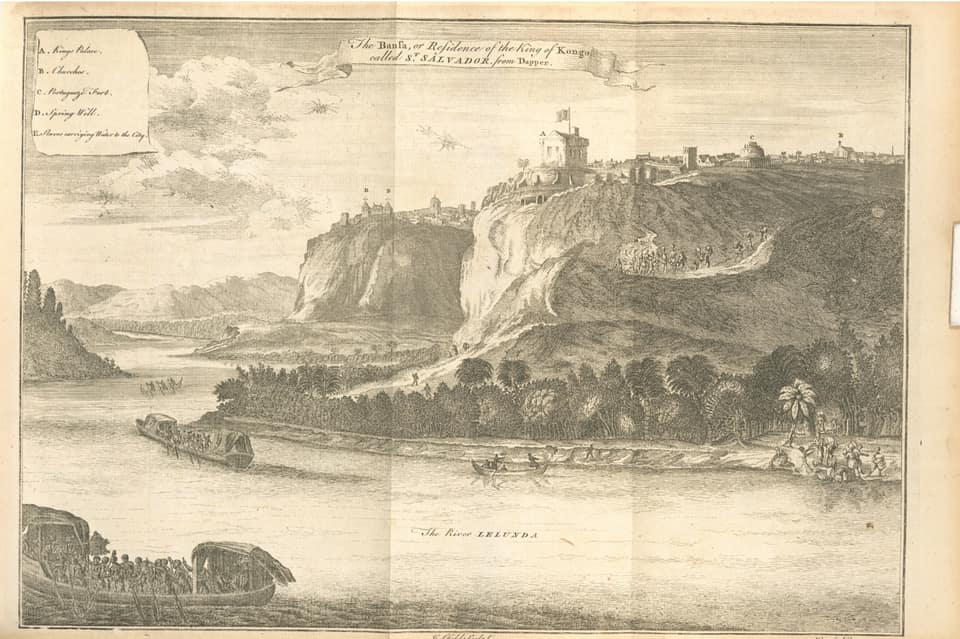
Thomas Astley, A New General Collection of Voyages and Travels (London, 1745), after Dapper, public domain, via Wikimedia Commons (New York Public Library)PDMOriginal record
Data saver is on. Images load only when you ask. You can change this in Settings at any time.
From the archivist
In July 1526 the king of Kongo had a letter written to the king of Portugal. His name was Mvemba a Nzinga; he had been baptised Afonso. He had welcomed the Portuguese, their priests and their trade. Now he wrote as a man watching something slip out of his hands.
The merchants, he said, had spread through his kingdoms with goods he had forbidden, and his own vassals no longer obeyed him. That was bad. What came next was worse. Every day, he wrote, people were being seized and sold to the white men: free men, the sons of nobles, members of his own family, some brought in at night so that no one would recognise them. The thieves did it for the goods and wares of Portugal. Our country, he wrote, is being completely depopulated.
He asked for very little: some priests, a few teachers for the schools, wine and flour for the Mass. And he asked that no more traders be sent, because it was his will that there should be no trade in slaves in his kingdoms.
The trade did not stop. What remains is the voice of a king who saw what was coming, had it written down, and was not heard.
Established
- Mvemba a Nzinga, baptised Afonso, was king of Kongo as Afonso I; he welcomed Portuguese missionaries and trade, and in 1526 wrote to King João III of Portugal to limit and control that trade (Dunn and Willoughby, after Thornton 2023).
- In the letter dated 6 July 1526 he complains that the merchants allowed into his kingdoms set up shops with goods he has forbidden, so that vassals who used to obey him no longer do (1619 Education, Davidson translation; Thornton 2023).
- He writes that the merchants are taking every day 'our natives, sons of the land and the sons of our noblemen and vassals and our relatives', seized by thieves greedy for the wares of Portugal, sometimes brought at night so as not to be recognised, and that 'our country is being completely depopulated' (1619 Education, Davidson translation).
- He asks Portugal for nothing but some priests, a few people to teach in schools, and wine and flour for the sacrament, and declares that 'it is our will that in these Kingdoms there should not be any trade of slaves nor outlet for them' (1619 Education, Davidson translation; Religion and Slavery project).
- In John Thornton's 2023 translation the same sentence reads: 'our homeland is becoming completely depopulated' (Thornton 2023, p. 203).
- The letter closes: 'At our town of Congo, written on the sixth day of July. João Teixeira did it in 1526. The King. Dom Affonso.' (Religion and Slavery project, same translation)
- Kongo's kings at first distinguished foreign-born captives, who could be enslaved and sold into the Atlantic trade, from freeborn Kongolese, who were largely protected; later rulers stopped respecting that distinction (Heywood 2009).
Interpretation
Afonso's letters are often read as a protest against the slave trade as such. Historians such as Linda Heywood and John Thornton read them more narrowly: the king objected to the seizure of free Kongolese and to traders slipping out of royal control, while Kongo itself held slaves and sold foreign captives. In 1981 Thornton called the familiar story of a Kongo quickly subverted by the Portuguese a myth to be re-examined. The letter was written in Portuguese by a secretary in the king's name, so its wording is not necessarily Afonso's own. The English quotations come from a translation first published in the 1960s and usually credited to Basil Davidson; Thornton's translation words the same passages differently, and the French renderings in this fragment are ours.
Looking ahead
A century from now, which of our letters of protest will still be read, by whom, and will it be too late for the people we wrote them for?
Sources (6)
- Thornton, J. K. Afonso I Mvemba a Nzinga, King of Kongo: His Life and Correspondence. Indianapolis and Cambridge, Hackett, 2023, p. 203 (translation of the letter; consulted through the excerpt reproduced in Dunn and Willoughby 2026).
- Dunn, R. E., Willoughby, U. E. Panorama: A World History, vol. 2, Source 3.1: Letter from King Afonso I of Kongo (Nzinga Mbemba) to King João III of Portugal (1526), excerpt from Thornton 2023. · res.cloudinary.com
- Heywood, L. M. Slavery and its Transformation in the Kingdom of Kongo: 1491-1800. The Journal of African History 50 (1), 2009, p. 1-22. · doi.org
- Thornton, J. K. Early Kongo-Portuguese Relations: A New Interpretation. History in Africa 8, 1981, p. 183-204. · doi.org
- 1619 Education. King Afonso I, Letter to King John III of Portugal (1526), classroom reprint of the English translation usually credited to Basil Davidson, The African Past (1964). · 1619education.org
- Religion and Slavery project. Primary source: Afonso I to Portugal (1526). · religionandslavery.org
Related fragments
1586
Won-i's mother: a letter to a husband in his grave
Jeongsang-dong, Andong, North Gyeongsang Province, South Korea · Asia
1500 to 1897
The Benin Bronzes
Benin City, Edo State, Nigeria · Africa
after 1200 CE
The Timbuktu manuscripts
Timbuktu, Mali · Africa