Won-i's mother: a letter to a husband in his grave
- Dated
- Place
- Jeongsang-dong, Andong, North Gyeongsang Province, South Korea · Joseon Korea, an elite family of Andong (Goseong Yi clan)
- Coordinates
- 36° 33′ N · 128° 43′ E (approximate)
- Remains
- Intact
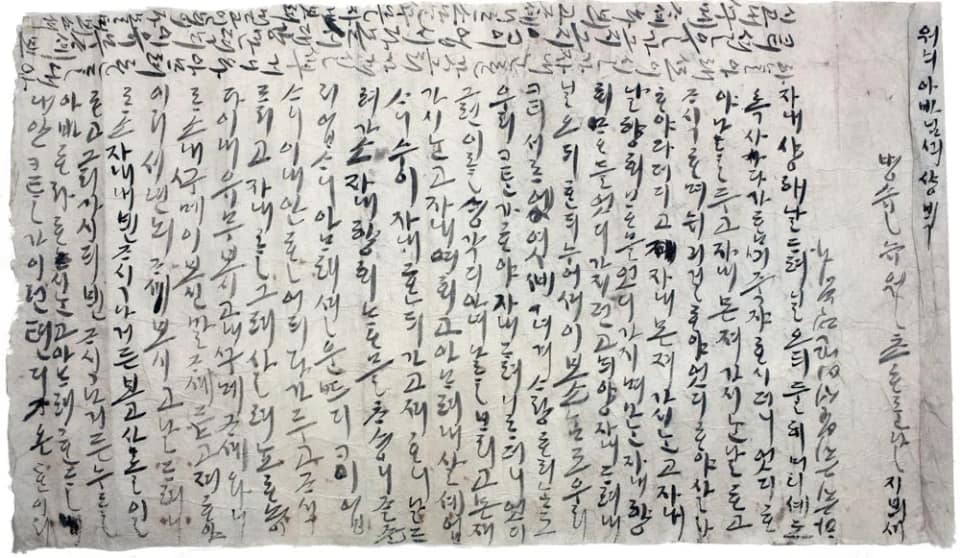
Letter of Won-i's mother to Yi Eung-tae, 1586, public domain, via Wikimedia CommonsPDMOriginal record
Data saver is on. Images load only when you ask. You can change this in Settings at any time.
From the archivist
She wrote to him after he had died. Her name was not kept; we know her only as the mother of Won-i, their child. Her husband, Yi Eung-tae, had died at thirty-one, in Andong, in 1586, and she was expecting another child.
She did not write in the classical Chinese of learned men, but in hangeul, the alphabet of ordinary Korean speech, the words she would have said aloud. You always told me, she writes, that we would live until our hair turned white and die together. How could you go first?
She asks how each of them had held the other in their heart. She asks whom the child in her belly should call father. She asks him to read what she has written and to come to her in a dream and answer. When she reached the edge of the paper she turned it and kept writing in the margin, because there was no more room and she was not finished.
The letter was laid in his grave. So were a pair of sandals, woven from hemp and from her own hair.
Four hundred and twelve years later, a housing development reached the tomb, and the paper came back into the light.
Established
- Yi Eung-tae, of the Goseong Yi clan of Andong, died in 1586 at thirty-one by the Korean count of age; his wife, whose own name is not recorded, is known from the letter as the mother of Won-i (National Institute of Korean History).
- The letter is written in hangeul, the Korean alphabet, and dated at home on the first day of the sixth lunar month of the byeongsul year, 1586; it is addressed to Won-i's father (National Institute of Korean History).
- In it she recalls that he always said the two of them should live until their hair turned white and then die together, asks him to read the letter and come to tell her in a dream, and asks whom the child she is carrying should call father (National Institute of Korean History, modern Korean rendering; our translation).
- The letter was found on 24 April 1998 by a team of the Andong National University Museum, during construction work in Jeongsang-dong, Andong, with some fifty pieces of clothing (National Institute of Korean History).
- Burials of this kind were sealed in a hard, concrete-like layer that preserved organic materials; this one kept letters written to Yi Eung-tae by those who loved him (Lee et al. 2009).
- A pair of mituri, sandals woven of hemp and of a woman's own hair, lay wrapped in hanji, Korean paper, at the head of the dead man (Encyclopedia of Andong Culture; Bae 2023).
Interpretation
The sandals are thought to have been made while Yi Eung-tae was ill, as a wish for his recovery, before they became a farewell; that reading rests on Korean traditions about shoes of hair and on the wrapping paper, and it is argued rather than recorded (National Institute of Korean History; Bae 2023). The quotations given here are translations of a modern Korean rendering of sixteenth-century Korean, and other translations word them differently. Sources differ on his birth year, 1555 or 1556. Scholars also read the intimate forms of address she uses as a sign of the standing of women in the household at that time.
Looking ahead
What will the last message we write to someone we love be written on, and will it still be readable in a thousand years?
Sources (4)
- National Institute of Korean History (Guksa Pyeonchan Wiwonhoe). The hangeul letter of Yi Eung-tae's wife, in Korean history through primary sources (Saryo ro bon Hanguksa). · contents.history.go.kr
- Academy of Korean Studies and Andong City. Mituri excavated from the tomb of Yi Eung-tae, Encyclopedia of Andong Culture (Digital Andong Munhwa Daejeon). · andong.grandculture.net
- Lee, E.-J., Shin, D. H., Yang, H. Y., Spigelman, M., Yim, S. G. Eung Tae's tomb: a Joseon ancestor and the letters of those that loved him. Antiquity 83 (319), 2009, p. 145-156. · doi.org
- Bae, Y.-D. Cultural interpretation of the mituri made of hair by Won-i's mother in Korea (1586). Korean Folklore Studies (Minsokhak yeongu) 53, 2023, p. 121-151. · www.kci.go.kr
Related fragments
1377 CE
The Jikji
Cheongju, North Chungcheong, Republic of Korea; the book is in Paris · Asia
c. 650 BCE
The Epic of Gilgamesh (Flood Tablet)
Mosul, Iraq · Asia