The Jikji
- Dated
- Place
- Cheongju, North Chungcheong, Republic of Korea; the book is in Paris · Goryeo Korea; Seon Buddhist monks of Heungdeok temple
- Coordinates
- 36° 39′ N · 127° 28′ E (approximate)
- Remains
- Fragmentary
Zythème, CC0, via Wikimedia CommonsCC0-1.0Original record
Data saver is on. Images load only when you ask. You can change this in Settings at any time.
From the archivist
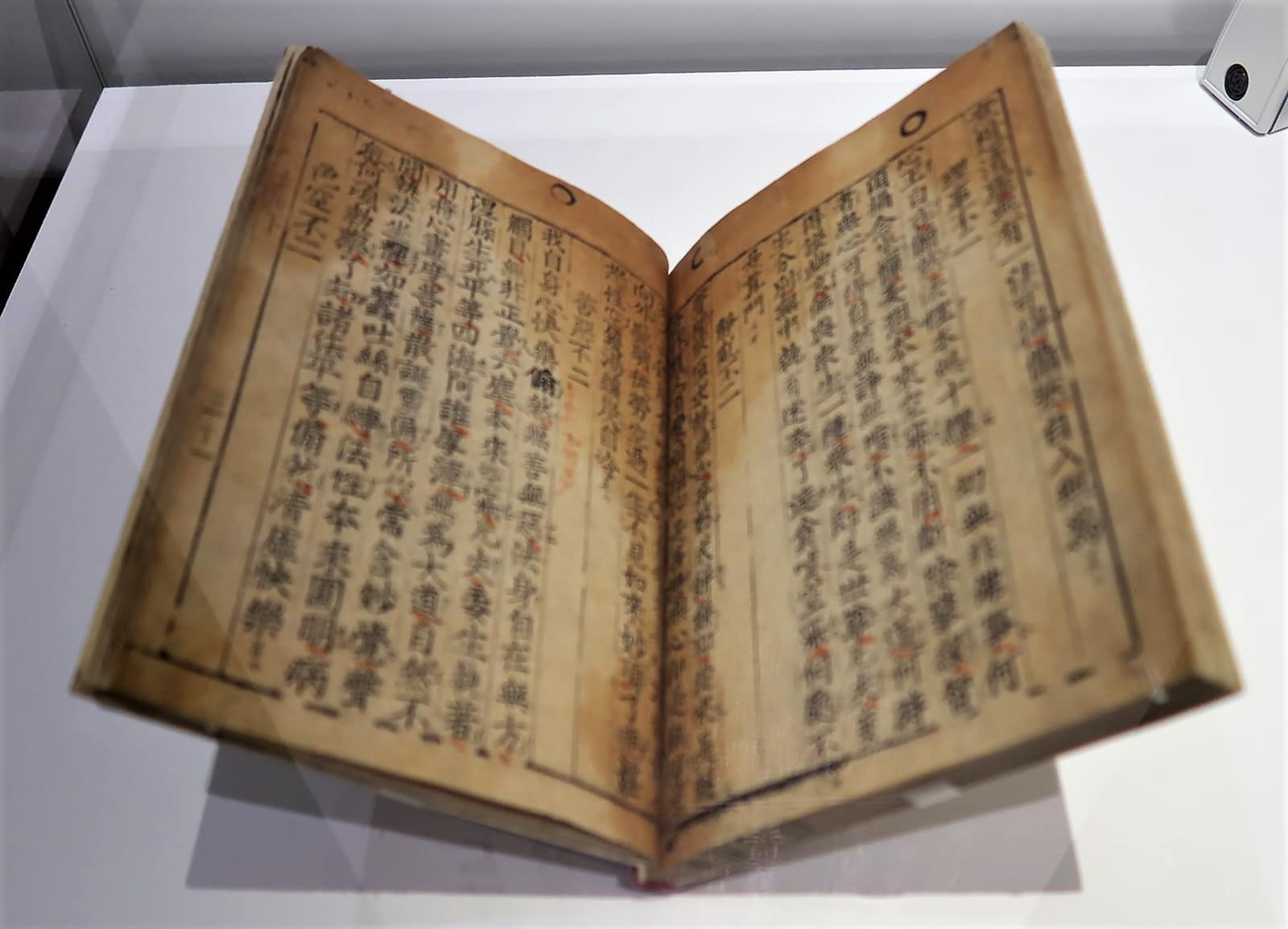
Each character was cast. The printers of Heungdeok temple shaped the signs one by one, poured molten metal into moulds, and set the small blocks in a frame, line after line, to print a book of their teacher's selected sayings. Then they took the frame apart and used the characters again for other pages.
It shows. Some characters lean a little; some are inked more heavily or more faintly than their neighbours; the lines do not always run straight. These are the marks of separate pieces of type, not of a carved wooden block.
The book was printed in 1377, according to its last page, at a temple outside Cheongju. Of its two volumes, only the second is known to survive. A French diplomat took it to Paris at the end of the nineteenth century. It was recognised for what it was in 1972, in a library exhibition for the International Book Year.
It has not returned to Korea. Cheongju has built a museum of early printing on the site of the temple where it was made.
Established
- The Jikji, whose full title is Baegun hwasang chorok buljo jikji simche yojeol, is an anthology of Seon (Zen) Buddhist teachings compiled by the monk Baegun (1298 to 1374) and printed after his death by his disciples (BnF; UNESCO).
- It was printed with cast metal movable type at Heungdeok temple, outside Cheongju, in 1377 (BnF; UNESCO).
- Only the second of its two volumes is known to survive, without its first leaf; it is kept in the Bibliothèque nationale de France as Coréen 109 (BnF).
- It is the oldest surviving book printed with movable metal type, 78 years earlier than the Gutenberg Bible (BnF).
- It was inscribed on UNESCO's Memory of the World Register on 4 September 2001 (BnF; UNESCO).
- Victor Collin de Plancy, French diplomat in Seoul, took it to France; it was sold in 1911 to Henri Vever, who bequeathed it to the national library, where it entered the collections in 1952 (BnF).
Interpretation
Where the Jikji should be kept is disputed. For many in Korea it is a national treasure that left the country in a period of foreign pressure and should return; the French position is that it was acquired lawfully and belongs to public collections, which French law makes inalienable. The scholar Park Byeong-seon, who identified its significance while working at the library in 1972, spent her life seeking the return of Korean books held in France.
In 10,000 years
In 10,000 years, will it matter which city keeps the oldest book printed from metal, or only that it was kept?
Sources (4)
- Bibliothèque nationale de France. Le Jikji, un trésor de l'imprimerie (Coréen 109). · www.bnf.fr
- UNESCO Memory of the World. Baegun hwasang chorok buljo jikji simche yojeol (vol. II), the second volume of Anthology of Great Buddhist Priests' Zen Teachings, inscribed 2001. · www.unesco.org
- Bibliothèque nationale de France, Gallica. Paegun hwasang ch'orok pulcho chikchi simch'e yojol, Coréen 109, numérisation. · gallica.bnf.fr
- Korea Times. Jikji to be shown to public in France for first time in half-century, 11 April 2023. · www.koreatimes.co.kr