The hours struck by iron: the mechanical clock of Salisbury
Before the mechanical clock, the hours were read from the sun, from water, sand or burning candles, and rung by hand; after it, a machine of wheels and weights divided day and night into equal hours and struck them for a whole town.
- Dated
- Place
- Salisbury Cathedral, Salisbury, Wiltshire, United Kingdom · Unnamed clockmakers and smiths of late medieval Europe, working for cathedrals, monasteries and towns; the chapter of Salisbury Cathedral
- Coordinates
- 51° 04′ N · 1° 48′ W (approximate)
- Remains
- Intact

Rwendland, CC BY-SA 3.0, via Wikimedia CommonsCC-BY-SA-3.0Original record
Data saver is on. Images load only when you ask. You can change this in Settings at any time.
From the archivist
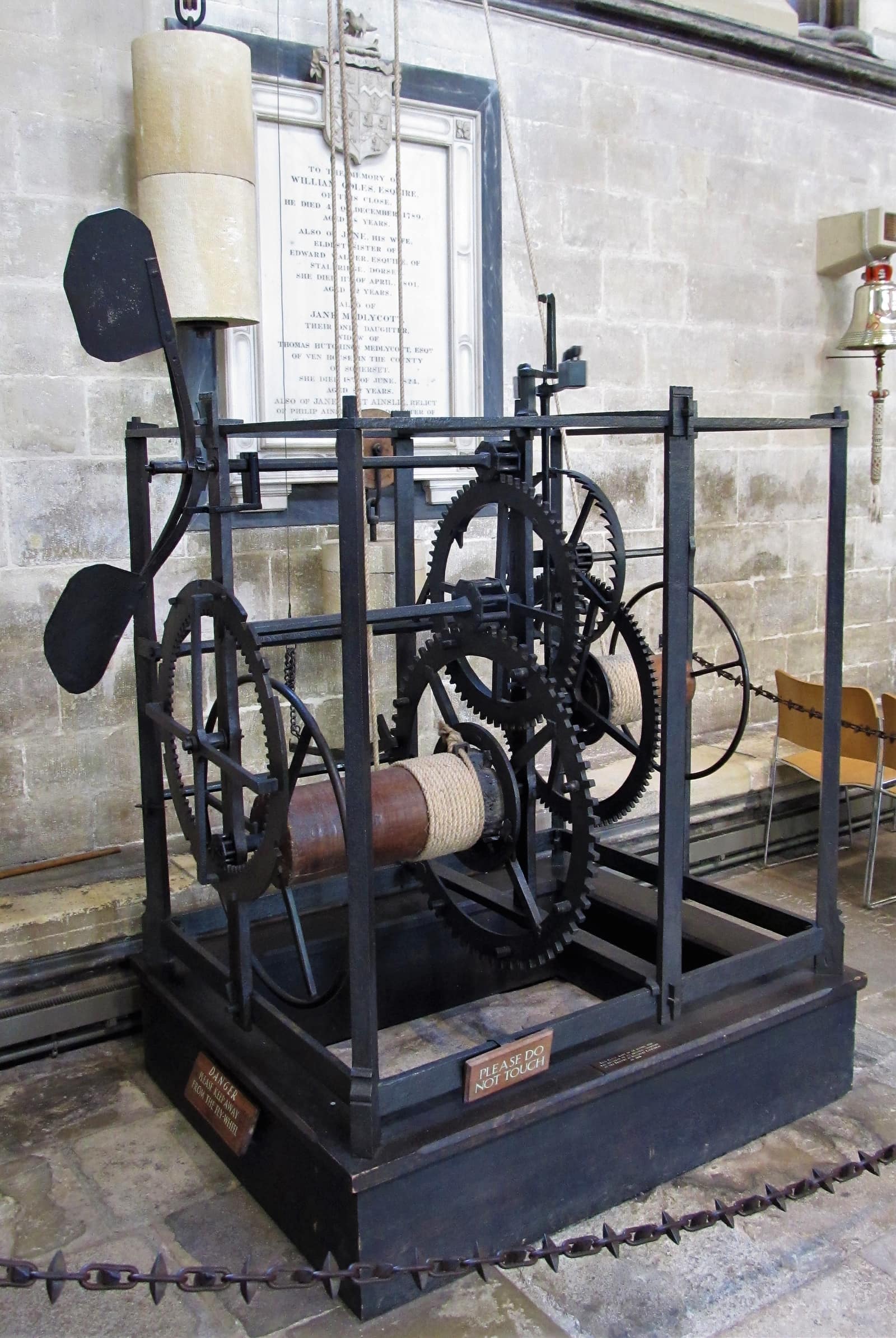
In the nave of a cathedral in the south of England stands a cage of black iron, the size of a large chest, with no face and no hands. It was made to be heard, not seen.
Its wheels were forged by smiths whose names were never written down. Heavy stones, wound up once a day, pulled on ropes; the wheels wanted to turn all at once, and a small rocking piece of iron let them go one tooth at a time, back and forth, back and forth. At each hour the machine released a hammer, and a bell rang across the close for the clergy, the servants and the town.
Before such clocks, the hours of this civilization were long in summer and short in winter, read from the sun, from dripping water or burning candles. In China, centuries earlier, astronomers had made great towers of water and wheels that turned with the sky. In Europe, around 1300, someone found how to do it with iron and a falling weight.
This one was probably at work by 1386. It was taken down, forgotten in a corner, found again, and set going once more in 1956. It still ticks.
Established
- Weight-driven mechanical clocks regulated by a verge and foliot escapement appeared in western Europe around 1300 or in the first half of the fourteenth century; their inventors are unknown (Needham, Wang and Price 1960; Linda Hall Library 2026).
- Records show that a mechanical clock was installed at Salisbury Cathedral in 1386, and most specialists believe the surviving clock is that one, with some parts replaced (Linda Hall Library 2026).
- The Salisbury clock has no face and no hands: it was made to strike the hours on a bell, driven by falling weights that had to be wound up once a day (Salisbury Cathedral).
- It first stood in the cathedral's detached bell tower; replaced in 1884 by a newer clock, it was rediscovered in the late 1920s, restored in 1956 and set up in the nave, where it still works (Salisbury Cathedral; Linda Hall Library 2026).
- The clock of Wells Cathedral, dated 1392 and now in the Science Museum in London, was first regulated by a foliot and, like many tower clocks, converted to a pendulum at some point after 1657 (Science Museum Group).
- Far earlier, in China, the monk Yi Xing and the official Liang Lingzan built in the 720s a water-powered celestial globe regulated by a waterwheel escapement; Su Song's astronomical clock tower, begun at Kaifeng in 1088, about 12 metres high and driven by water, used the same principle and was described in his treatise Xin Yixiang Fayao (Needham, Wang and Price 1960; Hwang, Lin and Yan 2021; Hong Kong Space Museum 2020).
Interpretation
Whether the Salisbury clock is really the one recorded in 1386, and whether it is the oldest working clock in the world, is argued: surviving clocks of this age are hard to date, similar claims are made for others, and parts of this one were replaced over the centuries before the restoration of 1956. The Chinese water-wheel escapements, first set out for western readers by Needham, Wang and Price in 1960, precede the European verge by centuries, and Needham and his colleagues discussed whether the idea could have travelled west; no route of transmission has been shown, and the European verge may have been found independently. Dates for Su Song's tower differ between sources, from 1088 for its first model to 1092 or 1094 for its completion; it was lost after the Jurchen capture of Kaifeng in 1126 and 1127.
In 10,000 years
In 10,000 years, will anyone remember that the hours were once cut into equal pieces by a rocking bar of iron, and that before that the day had been shaped by the light?
Sources (6)
- Needham, J., Wang Ling, Price, D. J. de Solla. Heavenly Clockwork: The Great Astronomical Clocks of Medieval China. Cambridge, Cambridge University Press, 1960 (reissued with a supplement, 1986). · archive.org
- Hwang, Z.-H., Lin, T.-Y., Yan, H.-S. Reconstruction designs of an early Chinese astronomical clock with a waterwheel steelyard clepsydra. Mechanical Sciences 12, 2021, p. 891-911. · doi.org
- Salisbury Cathedral. What to see: the world's oldest clock. · www.salisburycathedral.org.uk
- Ashworth, W. B., Jr. Salisbury Cathedral Clock. Scientist of the Day, Linda Hall Library, 6 July 2026. · www.lindahall.org
- Science Museum Group. Wells Cathedral clock, 1392, object number 1884-77 Pt1. · collection.sciencemuseumgroup.org.uk
- Hong Kong Space Museum. Su Song and the Water-driven Astronomical Clock-tower, Curator's Blog, 28 December 2020. · hk.space.museum
Related fragments
205 to 60 BCE
The Antikythera mechanism
Antikythera, Greece (find spot); National Archaeological Museum, Athens · Europe
1978 to 2000
A place for everyone on Earth: the Global Positioning System
Vandenberg Space Force Base, California, United States · Americas
1712 to 1769
Fire made to work: from Newcomen's engine to Watt's condenser
Coneygree, Tipton, near Dudley, West Midlands, United Kingdom · Europe