The fire drug: the first written formulas for gunpowder
Before, fire was carried into war as burning oil, pitch or naphtha; after these recipes, a mixture whose saltpetre fed its own flame could burn, burst and propel, and over the following centuries it changed fortifications, armies and states, and later mining and road building.
- Dated
- Place
- Kaifeng, Henan, China · Scholars and officials of the Northern Song court, among them Zeng Gongliang and Ding Du, compiling a military manual for the emperor Renzong; before them, Daoist alchemists of Tang and Five Dynasties China
- Coordinates
- 34° 48′ N · 114° 19′ E (approximate)
- Remains
- Fragmentary
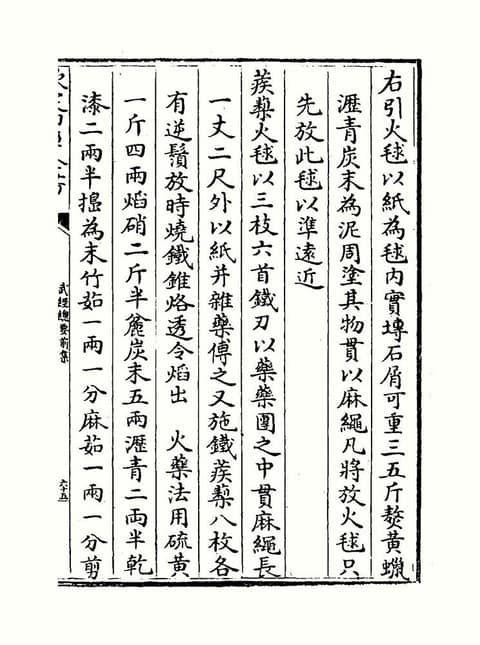

Wujing zongyao (1044), later edition, public domain, via Wikimedia CommonsPDMOriginal record
Data saver is on. Images load only when you ask. You can change this in Settings at any time.
From the archivist
It is written as a recipe. Sulphur, one catty four ounces. Saltpetre, two and a half catties. Coarse charcoal, five ounces. Then pitch, dry lacquer, wax, oils, each weighed, pounded and mixed, and wrapped in paper.
The court of the Song, which ruled much of China from its capital at Kaifeng, had ordered its scholars to set down everything an army should know. In 1044 they finished. Among the siege engines and the formations, they described a powder they called fire drug, to be tied to arrows or packed into balls and hurled over walls.
It was not new to them. For generations, alchemists had warned one another that certain mixtures flared up without warning, burning hands and faces and sometimes whole houses.
The page kept here is from a later copy; the Song book itself was lost when the capital fell. The recipe travelled without it, west across Asia and into Europe. In later centuries, this civilization learned to use the same powder to blast rock, to open mines and to fill the sky with light at festivals. It went on using it to kill.
Established
- The Wujing zongyao, Collection of the Most Important Military Techniques, was compiled by order of the Song emperor Renzong under the direction of Zeng Gongliang and Ding Du and completed in 1044; it records the earliest known written formulas for gunpowder (Columbia University, Asia for Educators; Needham 1986).
- Its fire drug recipes mix saltpetre, sulphur and charcoal with other ingredients such as pitch, dry lacquer, wax and oils; in the recipe pictured, saltpetre makes up about half of the weight (Needham 1986).
- The manual describes the powder used mainly as an incendiary: packets wrapped in paper or bamboo tied to arrows, and bombs thrown by catapult (Columbia University, Asia for Educators).
- Earlier, a Daoist alchemical text, the Zhenyuan miaodao yaolüe, usually dated to the 9th or 10th century, warned that some who had heated sulphur, realgar and saltpetre with honey had burnt their hands and faces, and even burnt down their houses (Needham 1986).
- The Song original was lost during the Jurchen conquest of Kaifeng in 1126 and 1127; the oldest complete surviving edition was printed in 1510 (Needham 1986; ChinaKnowledge.de).
- Gunpowder weapons were used by Song, Jin and Mongol armies in the 13th century; recipes appear in Arabic and Latin writings in the second half of that century, and the first known European pictures of a gun date from 1326 (Columbia University, Asia for Educators; Andrade 2016).
Interpretation
The story that gunpowder was discovered by alchemists seeking an elixir of long life rests on a few warnings in their texts, and the dating of those texts is uncertain. How the knowledge reached the Islamic world and Europe, whether through the Mongol conquests, trade or several routes, is not settled, and a few historians once argued for independent invention. Historians also debate how far gunpowder weapons explain the later rise of some states and empires over others.
In 10,000 years
In 10,000 years, will this civilization be remembered for what it made fire do in celebration, or in war?
Sources (4)
- Needham, J., with Ho Ping-Yü, Lu Gwei-Djen, Wang Ling. Science and Civilisation in China, vol. 5, part 7: Military Technology, the Gunpowder Epic. Cambridge, Cambridge University Press, 1986.
- Andrade, T. The Gunpowder Age: China, Military Innovation, and the Rise of the West in World History. Princeton, Princeton University Press, 2016.
- Columbia University, Asia for Educators. Gunpowder, in The Song dynasty in China (960 to 1279). · afe.easia.columbia.edu
- Theobald, U. Wujing zongyao. ChinaKnowledge.de, an encyclopaedia on Chinese history, literature and art. · www.chinaknowledge.de
Related fragments
200 BCE to 105 CE
Paper: a sheet of pounded rags and bark
Luoyang, Henan, China · Asia
1945
Trinity: the first nuclear explosion
Trinity Site, White Sands Missile Range, New Mexico, United States · Americas