The Diamond Sutra of 868
- Dated
- Place
- Mogao Caves, Dunhuang, Gansu, China · Tang dynasty China
- Coordinates
- 40° 02′ N · 94° 48′ E (approximate)
- Remains
- Intact
This fragment shows an object held as sacred.
It is shown here as the institution that holds it presents it. Some communities connected to it ask that it be viewed with care. You may choose to see the image, or read the record without it.
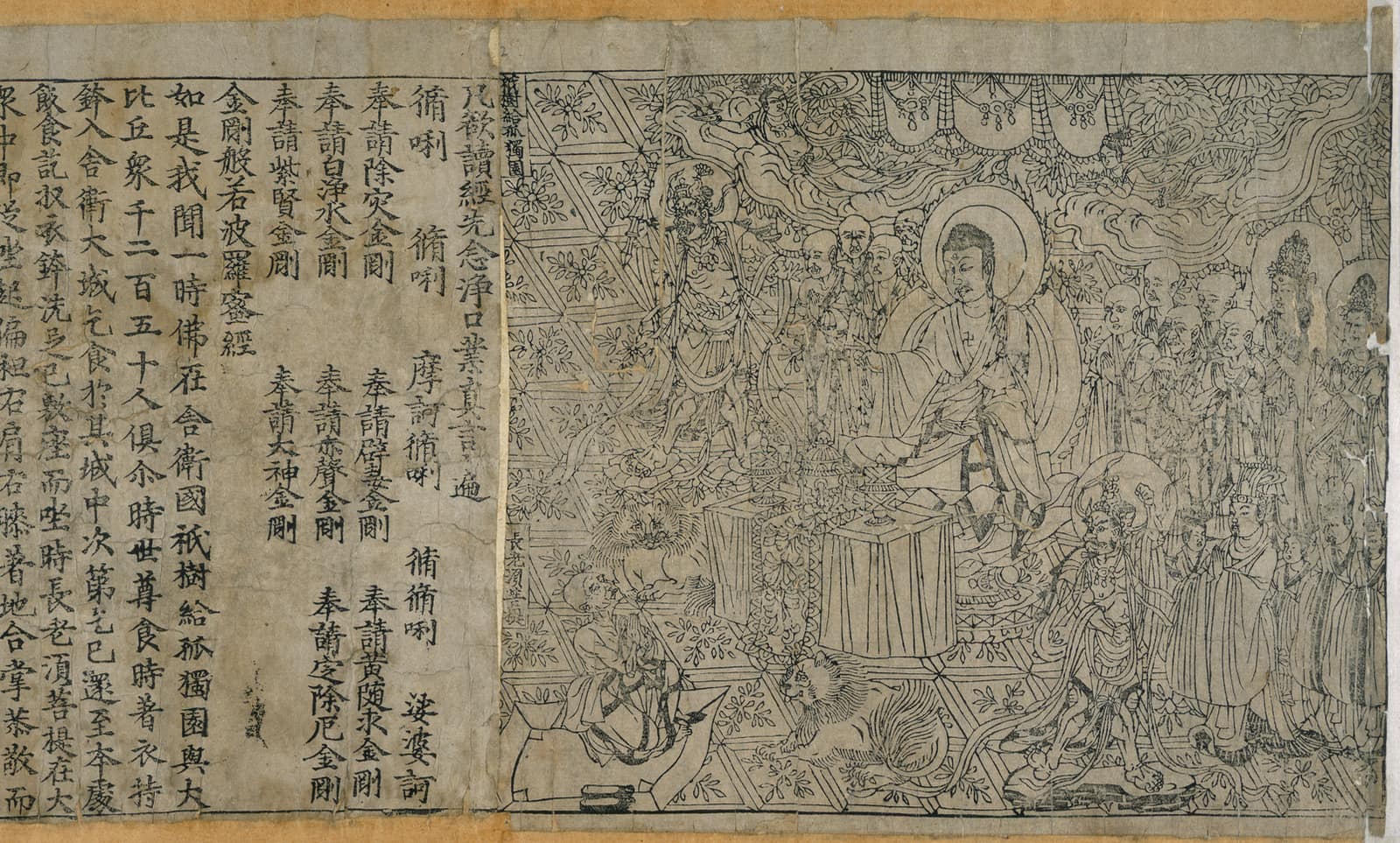
,_frontispiece_and_text_-_BL_Or._8210-P.2.jpg)
Image veiled by default
British Library, Or.8210/P.2 (CC0), via Wikimedia CommonsCC0-1.0Original record
Data saver is on. Images load only when you ask. You can change this in Settings at any time.
From the archivist
In the spring of 868, a man named Wang Jie paid for a text to be carved into wooden blocks, inked and pressed onto paper, so that it could be given away. He did it, the last lines say, on behalf of his two parents. The text was the Diamond Sutra, a Buddhist teaching on the passing nature of all appearances.
At its head, the carver cut an image: the Buddha seated behind an altar under a canopy, speaking to an old disciple kneeling on a mat, surrounded by monks, guardians and a lion. Every line of that crowd was cut away from the wood with a blade, in reverse.
This civilization had understood that a word could be multiplied without a hand copying it each time, and that multiplying it was itself an act of devotion. One of those copies came to rest in a small chamber cut into the cliff at Mogao, among tens of thousands of scrolls. The chamber was walled up and forgotten, then reopened in 1900. Seven years later, the scroll left for London.
Established
- A scroll of the Diamond Sutra in Chinese, printed from carved woodblocks on joined sheets of paper, about five metres long, opening with a woodcut of the Buddha preaching to his elderly disciple Subhuti.
- Its colophon reads that it was reverently made for universal free distribution by Wang Jie on behalf of his two parents, on a date corresponding to 11 May 868.
- It is the earliest surviving printed book to bear a date (British Library).
- It was found in the Library Cave (cave 17) of the Mogao caves near Dunhuang, walled up around the beginning of the eleventh century and opened in 1900 by the Daoist priest Wang Yuanlu.
- Aurel Stein acquired it in 1907 with thousands of other manuscripts; it is kept at the British Library as Or.8210/P.2.
Interpretation
Printing did not begin with this scroll: the sure hand of the frontispiece shows a craft already mature, and undated printed fragments are thought to be older. What its date proves is use rather than invention: a son gaining merit for his parents through copies meant to be given away. The events of 1907 are read in different ways. Stein described his purchase as the saving of a neglected hoard; many in China see the dispersal of the Library Cave as a national loss, and calls for return have been made, without a formal request from the Chinese government. Digitisation and shared research now link the collections, but do not settle the question.
In 10,000 years
In 10,000 years, which of our words will have survived because someone chose to give them away?
Sources (4)
- British Library. The Diamond Sutra, Or.8210/P.2, woodblock-printed scroll, dated 868; image and description supplied by the British Library to Wikimedia Commons. · commons.wikimedia.org
- University of Washington Libraries, Dunhuang Project. Dunhuang manuscripts: discovery and dispersal (exhibition). · dunhuang.ds.lib.uw.edu
- Stein, M. A. Ruins of Desert Cathay: Personal Narrative of Explorations in Central Asia and Westernmost China. London, Macmillan, 1912.
- The Art Newspaper. The world's oldest printed book and rare ancient manuscripts from the Mogao caves in China to go on show in London, 5 August 2024. · www.theartnewspaper.com