Trinity: the first nuclear explosion
Before 16 July 1945 no human device had ever released the energy of the atomic nucleus as an explosion; after it, humanity possessed a weapon able to destroy a city in an instant, and learned to live under that possibility.
- Dated
- Place
- Trinity Site, White Sands Missile Range, New Mexico, United States · The scientists, engineers and soldiers of the Manhattan Project, a wartime programme of the United States with the United Kingdom and Canada
- Coordinates
- 33° 41′ N · 106° 29′ W (approximate)
- Remains
- Fragmentary
Berlyn Brixner / Los Alamos National LaboratoryPDMOriginal record
Data saver is on. Images load only when you ask. You can change this in Settings at any time.
From the archivist
The place had an old Spanish name, Jornada del Muerto, the dead man's journey. Before dawn, in rain that had delayed everything, a steel sphere sat at the top of a tower in the middle of it. Men waited in bunkers miles away, lying face down, their feet toward the tower.
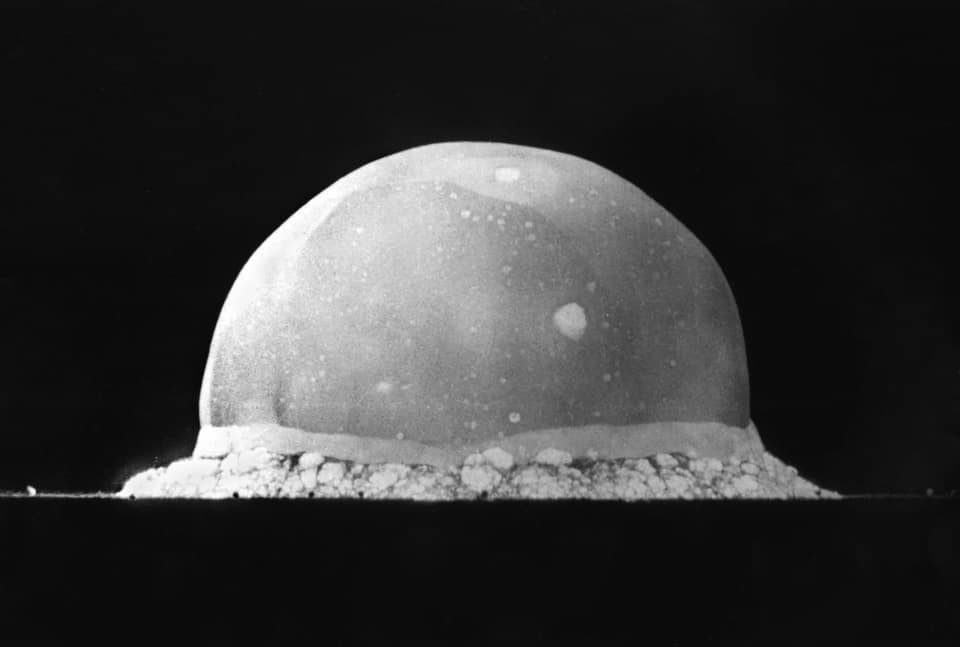
At 5:29 the desert was lit as no morning had ever lit it. The photograph kept here was made sixteen thousandths of a second later: a dome of fire already two hundred metres high, lifting the ground at its edge. The tower was gone. The sand beneath it turned to glass.
Newspapers reported an explosion at an ammunition dump. The families who lived downwind were told nothing at all; fine dust from the cloud drifted over their ranches and villages.
Three weeks later the same kind of energy was released over two cities. From that summer on, this civilization held in its hands the means of its own ending, and had to decide, every day, not to use it.
Established
- At 5:29 a.m. local time on 16 July 1945, a plutonium implosion device nicknamed the Gadget was exploded on top of a 100 foot steel tower in the New Mexico desert, about 210 miles south of Los Alamos (US DOE; Atomic Heritage Foundation).
- The blast vaporised the tower and fused the desert sand into a green glass later called trinitite (US DOE).
- Its yield has been estimated at between about 18.6 and 21 kilotons of TNT; a radiochemical reanalysis published in 2021 gave 24.8 kilotons, plus or minus 2 (US DOE; Selby et al. 2021).
- The public was told that a remote ammunition magazine had exploded; the test was revealed only after the bombing of Hiroshima on 6 August 1945 (Atomic Heritage Foundation).
- In July 2025 the United States extended its Radiation Exposure Compensation Act to people who had lived in New Mexico in the years of atmospheric testing and later developed certain cancers (US Department of Justice).
Interpretation
Whether the test and the bombings that followed three weeks later were necessary to end the war is still debated by historians. The health effects of the fallout on the ranching families and villages of the Tularosa Basin, who were neither warned nor evacuated, were long denied; how many people were harmed remains uncertain. Oppenheimer's often quoted words from the Bhagavad Gita were recalled by him years later, not recorded on the day.
In 10,000 years
In 10,000 years, will the green glass of this desert be read as the first mark of an age when a species could end itself?
Sources (4)
- U.S. Department of Energy, Office of Legacy Management. Trinity Site: World's First Nuclear Explosion. · www.energy.gov
- Atomic Heritage Foundation and National Museum of Nuclear Science and History. Trinity Test, 1945. · ahf.nuclearmuseum.org
- Selby, H. D., et al. A New Yield Assessment for the Trinity Nuclear Test, 75 Years Later. Nuclear Technology 207 (sup1), 2021, p. S321-S325. · doi.org
- U.S. Department of Justice, Civil Division. Radiation Exposure Compensation Act. · www.justice.gov