The Universal Declaration of Human Rights
Before December 1948 no text adopted by the nations of the world had declared rights belonging to every human being without distinction; after it, that common standard existed, cited in constitutions and treaties, even where it was not respected.
- Dated
- Place
- Palais de Chaillot, Paris, France · The General Assembly of the United Nations; a drafting commission whose members came from China, Lebanon, France, Canada, India, Chile, the United States and many other nations
- Coordinates
- 48° 52′ N · 2° 17′ E (approximate)
- Remains
- Intact
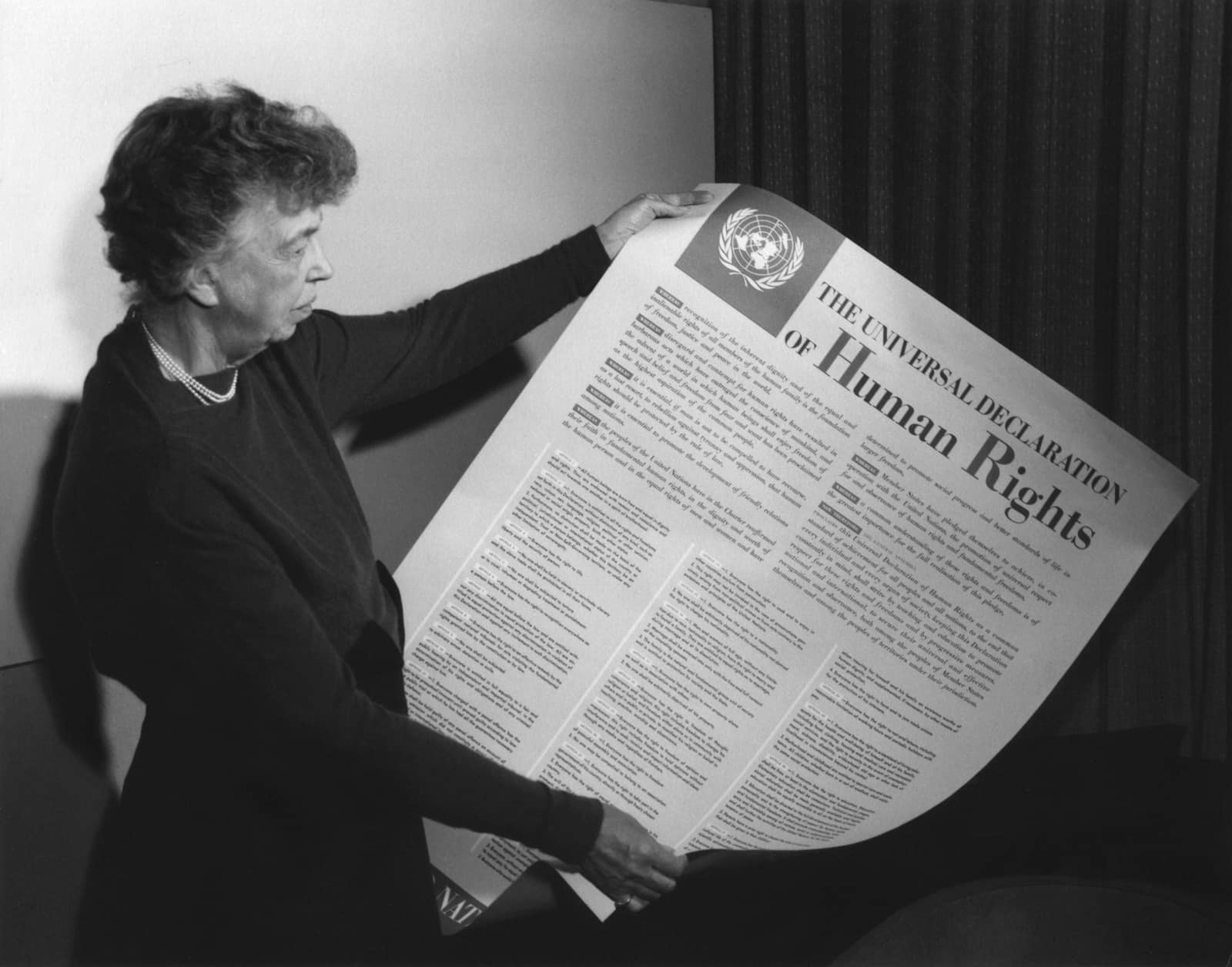

FDR Presidential Library & Museum, CC BY 2.0, via Wikimedia CommonsCC-BY-2.0Original record
Data saver is on. Images load only when you ask. You can change this in Settings at any time.
From the archivist
All human beings are born free and equal in dignity and rights. That is the first sentence. It had first been written about men only; a delegate from India asked that it be changed, and it was.
The text was written in less than two years, in the shadow of a war that had killed tens of millions and of camps built to erase whole peoples. Its drafters came from China and Lebanon, France and Canada, Chile and the United States. They argued over every word: about God and nature, about duties and property, about whether bread belonged beside liberty.
On 10 December 1948, in a palace on a hill in Paris facing the Eiffel Tower, the nations of the General Assembly voted. Forty eight for. None against. Eight abstained.
The document bound no one. It named, for the first time together, what every person could claim simply by being born. The photograph keeps a woman who chaired the drafting, a year later, holding the words at arm's length, as if to read them again.
Established
- The United Nations General Assembly adopted the Universal Declaration of Human Rights in Paris on 10 December 1948, as resolution 217 A (III) (United Nations).
- Forty eight member states voted in favour, none against, and eight abstained: the Soviet Union, the Byelorussian and Ukrainian Soviet republics, Poland, Czechoslovakia, Yugoslavia, Saudi Arabia and the Union of South Africa (UN Dag Hammarskjöld Library).
- The text was drafted in less than two years by the Commission on Human Rights, chaired by Eleanor Roosevelt, with Peng Chun Chang of China as vice chair, Charles Malik of Lebanon as rapporteur, a first draft by René Cassin of France and a blueprint prepared by John Humphrey of Canada (United Nations).
- Hansa Mehta of India is widely credited with changing the first article from 'All men are born free and equal' to 'All human beings are born free and equal' (United Nations).
- By 2016 the Declaration had been translated into more than 500 languages and dialects, the most translated document in the world (OHCHR).
Interpretation
The Declaration was adopted as a resolution, not a treaty, and was not binding in law; its principles became binding for the states that ratified the two international covenants of 1966. Whether its rights are truly universal or reflect the traditions of its drafters has been argued since 1948. When it was adopted, much of humanity lived under colonial rule and had no vote in the Assembly; some of the states that voted for it still practised segregation or held colonies.
In 10,000 years
In 10,000 years, will these thirty articles read as a promise that was kept, or as a record of what we knew we owed each other?
Sources (4)
- United Nations. History of the Declaration. · www.un.org
- United Nations. Drafters of the Declaration. · www.un.org
- United Nations Dag Hammarskjöld Library. Drafting of the Universal Declaration of Human Rights: General Assembly plenary, resolution 217 (III), 10 December 1948. · research.un.org
- Office of the United Nations High Commissioner for Human Rights. New record: translations of the Universal Declaration of Human Rights pass 500. · www.ohchr.org
Related fragments
1945
Trinity: the first nuclear explosion
Trinity Site, White Sands Missile Range, New Mexico, United States · Americas
1945
The Hiroshima Peace Memorial (Genbaku Dome)
Hiroshima Peace Memorial Park, Hiroshima, Japan · Asia