The Great Law of Peace: words woven into wampum
- Dated
- Place
- Onondaga Nation territory, south of Syracuse, New York, United States · The Haudenosaunee Confederacy (Mohawk, Oneida, Onondaga, Cayuga and Seneca nations, later Six Nations)
- Coordinates
- 42° 57′ N · 76° 09′ W (approximate)
- Remains
- Intact
This fragment shows an object held as sacred.
It is shown here as the institution that holds it presents it. Some communities connected to it ask that it be viewed with care. You may choose to see the image, or read the record without it.
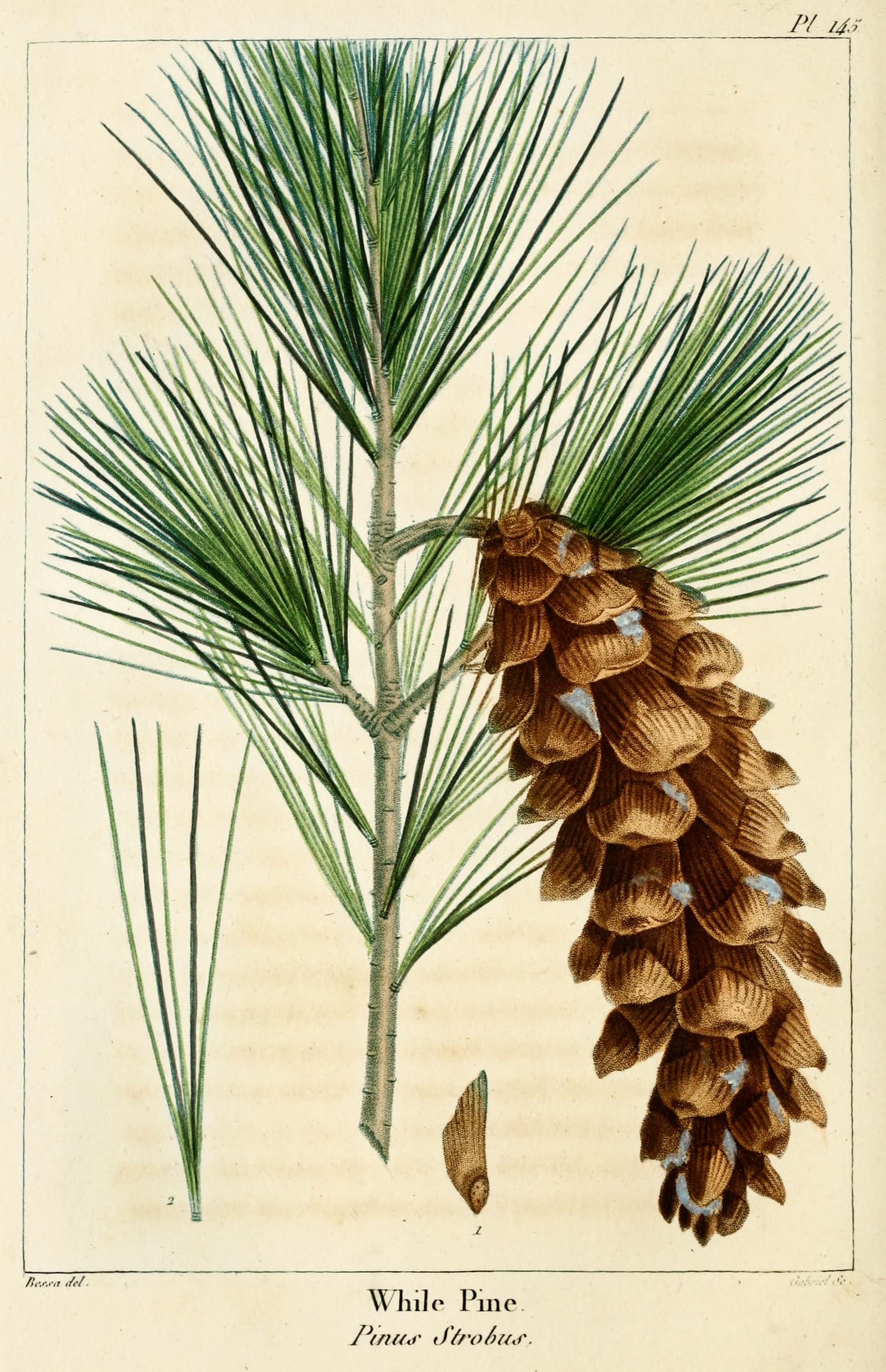
Image veiled by default
Pancrace Bessa and Gabriel, White Pine, Pinus strobus, plate 145 of F. A. Michaux, The North American Sylva (1819), public domain, via Wikimedia CommonsPDMOriginal record
Data saver is on. Images load only when you ask. You can change this in Settings at any time.
From the archivist
This law was not written on paper. It was spoken into shell. Beads cut from the white and the purple of clam shells were strung and woven while the words of an agreement were said aloud, and those who later held the strings could say the words again. A person holding wampum was understood to be telling the truth.
The law told how five nations at war had thrown their weapons beneath a white pine at Onondaga, how its white roots ran out in four directions so that others might follow them to the shade, how the women of each clan would choose the chiefs and could take the title away.
Belts kept in Onondaga's care were taken to a museum in Albany. On a cold October day in 1989, twelve of them came home. Some six hundred people waited at the longhouse, watching the road. A fire of apple sticks was lit outside, the Feather Dance went on until sweat ran down the dancers' faces, and when the vans arrived a silence fell. Someone whispered that the belts were here.
Then a Tree of Peace was planted, and the people stood in the brisk wind and came forward, one by one, to put a shovelful of earth around it.
Established
- The Haudenosaunee, the People of the Longhouse, were called the Iroquois Confederacy by the French and the League of Five Nations by the English; the Confederacy united the Mohawk, Oneida, Onondaga, Cayuga and Seneca nations (Haudenosaunee Confederacy).
- Haudenosaunee tradition holds that the Confederacy was founded by a prophet known as the Peacemaker, with the help of Aionwatha, better known as Hiawatha, an Onondaga; the exact date of the union is not known (Haudenosaunee Confederacy; Onondaga Nation).
- At Onondaga the Peacemaker planted the Great Tree of Peace, a white pine, under which the leaders threw their weapons; its Great White Roots reach north, south, east and west, so that any nation willing to follow them may come under its shade (Haudenosaunee Confederacy; Onondaga Nation).
- The Clan Mothers choose the chiefs and have the power to remove them; the Grand Council has fifty chiefs, nine Mohawk, nine Oneida, fourteen Onondaga, ten Cayuga and eight Seneca (Haudenosaunee Confederacy; Onondaga Nation).
- Wampum beads are cut from the white and purple parts of clam shells; as strings and belts are woven, the speaker puts the words of the agreement into them, and later speakers use them to recall it. A person holding a string of wampum is understood to be speaking truthfully (Onondaga Nation).
- Strings sent to invite the nations to council carried a wooden stick; a notch was cut off each day, and when the notches were gone the meeting took place (Onondaga Nation).
- The Hiawatha Belt, a national belt of the Haudenosaunee, records the union of the five nations in five joined symbols, read along the path of the sun from the east; it has been made into the Haudenosaunee flag (Onondaga Nation).
- In October 1989, twelve wampum belts held by the New York State Museum were returned to the Onondaga Nation, with the title and collar of Wampum Keeper; some six hundred people gathered at the longhouse, and Chief Jake Swamp of the Mohawk Nation planted a Tree of Peace (Powless 1989).
- On 21 October 1988, the United States Congress adopted a resolution stating that the confederation of the thirteen colonies into one republic was influenced by the political system of the Iroquois Confederacy (H. Con. Res. 331).
Interpretation
The founding date is debated. The Haudenosaunee describe it as time immemorial and the Onondaga Nation says the Hiawatha Belt is far older than the arrival of French, Dutch and English explorers; Mann and Fields (1997) have argued for 1142, from a solar eclipse they connect with the oral tradition; other researchers propose later dates, and the question remains open. The influence of the Great Law on the Constitution of the United States is also debated: the Haudenosaunee Confederacy and the 1988 congressional resolution affirm it, citing Benjamin Franklin's contacts with Haudenosaunee councils, while historians such as Tooker (1988) have argued that the records of the framers do not support it. The Great Law says the Peacemaker's name is to be called if the Peace should fail; following the practice of many Haudenosaunee, this archive refers to him only by his title. No wampum belt is shown here: belts are living records and, for many, sacred.
Looking ahead
Who, ten thousand years from now, will keep the words we agreed on, and who will still hold them in their hands to say them aloud?
Sources (6)
- Onondaga Nation. Wampum; Hiawatha Belt (Culture pages of the Onondaga Nation website). · www.onondaganation.org
- Powless, I., Jr. (Chief). The day that 12 wampum belts returned to Onondaga, 21 October 1989, Onondaga Nation website. · www.onondaganation.org
- Haudenosaunee Confederacy Chiefs Council. Who we are; Confederacy's creation; Influence on democracy (official website of the Haudenosaunee Confederacy, Ohsweken). · www.haudenosauneeconfederacy.com
- Mann, B. A., Fields, J. L. A sign in the sky: dating the League of the Haudenosaunee. American Indian Culture and Research Journal 21 (2), 1997, p. 105-163. · doi.org
- Tooker, E. The United States Constitution and the Iroquois League. Ethnohistory 35 (4), 1988, p. 305 and following. · doi.org
- United States Congress. H. Con. Res. 331 (100th Congress), concurrent resolution acknowledging the contribution of the Iroquois Confederacy of Nations to the development of the United States Constitution, agreed to 21 October 1988; 102 Stat. 4932. · www.govinfo.gov
Related fragments
1792 to 1750 BCE
The Code of Hammurabi
Made in present-day Iraq; found at Susa (Shush), Iran; now in the Louvre, Paris · Asia
479 to 59 BCE
The Analects of Confucius
Qufu, Shandong, China · Asia
1948
The Universal Declaration of Human Rights
Palais de Chaillot, Paris, France · Europe