Adwinasa: the kente of a weaver who used every pattern he knew
- Dated
- Place
- Bonwire, Ashanti Region, Ghana · Asante weavers of Bonwire and Adanwomase, Ghana
- Coordinates
- 6° 47′ N · 1° 29′ W (approximate)
- Remains
- Intact
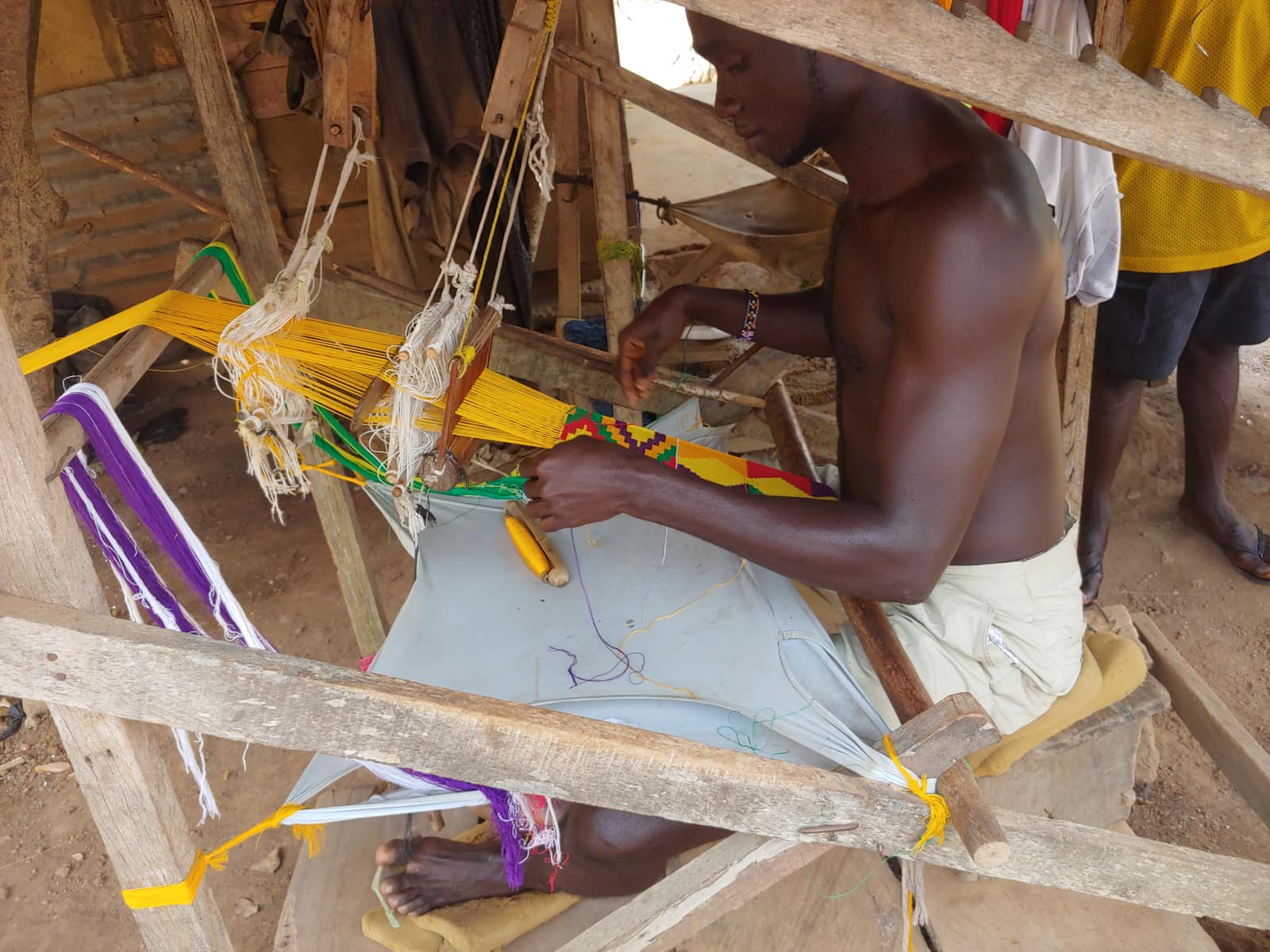
Sadads, CC BY-SA 4.0, via Wikimedia CommonsCC-BY-SA-4.0Original record
Data saver is on. Images load only when you ask. You can change this in Settings at any time.
From the archivist
In Bonwire, near Kumasi, men sat at narrow looms and wove cloth no wider than a hand. The feet moved the heddles, the hands threw the shuttle, and a strip of colour grew slowly toward the weaver. Only later were the strips sewn together, edge to edge, so that the patterns met and became a cloth.
Each cloth had a name, and often the name was a sentence. One was called Emaa da: it has never happened before. Another, Abusua ye dom: the family is a force. A cloth could praise, warn, remember a king or a marriage. People wore what they meant to say. Some weavers said the names came to them in dreams.
The weavers kept the story of one of their own. Wishing to please the king of Asante, he set into a single cloth every motif that the weavers of his day knew, all of them, until there were none left to add. The cloth was called Adwinasa: all the motifs are used up.
It is a strange kind of boast, and a very human one: to give everything you know, and then to say so. In this civilization a man could weave his pride into a piece of cloth, and the cloth went on saying it long after his name was forgotten.
Established
- Asante kente is woven in long narrow strips, in silk and cotton, on a locally built loom called nsadua Kofi; the strips are then sewn together edge to edge to make a cloth (Ayesu et al. 2021).
- The strips are about 7.5 cm wide and are woven by men; the bright silk threads were once unravelled from cloth imported from Europe and combined with cotton (Horniman Museum).
- Bonwire, near Kumasi, is described as the original home of the kente weavers; Bonwire and Adanwomase remain the main Asante weaving centres (Horniman Museum; Ayesu et al. 2021).
- Every cloth carries a name and a meaning, and its motifs have their own names. The names come from historical events, proverbs, the deeds of individuals, the behaviour of animals and philosophical sayings; they are given mostly by the weavers, who say that some come to them in dreams (Ayesu et al. 2021; Victoria and Albert Museum).
- Adwinasa means that all the motifs have been used up: according to the weavers, a weaver who wished to please the Asantehene, the king of Asante, put into one cloth every motif then known, and it was long reserved for kings and people of high rank (Ayesu et al. 2021).
- Among other names recorded from master weavers: Emaa da, 'it has never happened before'; Abusua ye dom, 'the family is a force'; Obaakofo mmu man, 'one person does not rule a nation', first called Fathia fata Nkrumah, 'Fathia is a fitting wife for Nkrumah' (Ayesu et al. 2021).
- A man's kente of cotton and silk, made in Kumasi in the 19th century, is in the Metropolitan Museum of Art, New York (1972.56.1).
Interpretation
The meanings given here were collected in 2021 from six master weavers and opinion leaders in Bonwire and Adanwomase; they are oral tradition, and other accounts word them differently (adwinasa is also glossed as 'fullness of ornament' or 'my skill is exhausted', and spelled adweneasa or adwini asa). The story of the weaver who exhausted every motif is a tradition, not a dated event, and his name is not recorded. The origins of kente weaving are told in several traditions and are not securely dated; the Ewe also weave a kente of their own, in a different style (Ayesu et al. 2021). The names of cloths also change: Obaakofo mmu man seems to have taken its present name after Kwame Nkrumah was overthrown.
Looking ahead
In a thousand years, will anyone remember that a cloth could carry a sentence, and that it could be read from across a courtyard?
Sources (4)
- Ayesu, S. M., Anokye, D., Fobiri, G. K., Acquaye, R., Godomey, B. Aesthetic and Philosophical Meanings of Indigenous Asante Kente. Textile & Leather Review 4 (4), 2021, p. 267-281. · doi.org
- Horniman Museum and Gardens. Kente cloth, Asante, HC.1999.273, collection record. · www.horniman.ac.uk
- The Metropolitan Museum of Art. Man's kente (prestige cloth), Asante-Akan peoples, Kumasi, 19th century, 1972.56.1, open access record. · collectionapi.metmuseum.org
- Victoria and Albert Museum. Kente cloth, O263818, collection record (summary description). · api.vam.ac.uk
Related fragments
1875 to 1925
Ère ìbejì: a figure for a twin who died
Southwestern Nigeria · Africa
1300 to 1500
The heads of Ifẹ
Ile-Ife, Osun State, Nigeria · Africa
after 1200 CE
The Timbuktu manuscripts
Timbuktu, Mali · Africa