Ère ìbejì: a figure for a twin who died
- Dated
- Place
- Southwestern Nigeria · Yorùbá families, carvers and diviners of southwestern Nigeria
- Coordinates
- 7° 24′ N · 3° 54′ E (approximate)
- Remains
- Intact
This fragment shows an object held as sacred.
It is shown here as the institution that holds it presents it. Some communities connected to it ask that it be viewed with care. You may choose to see the image, or read the record without it.
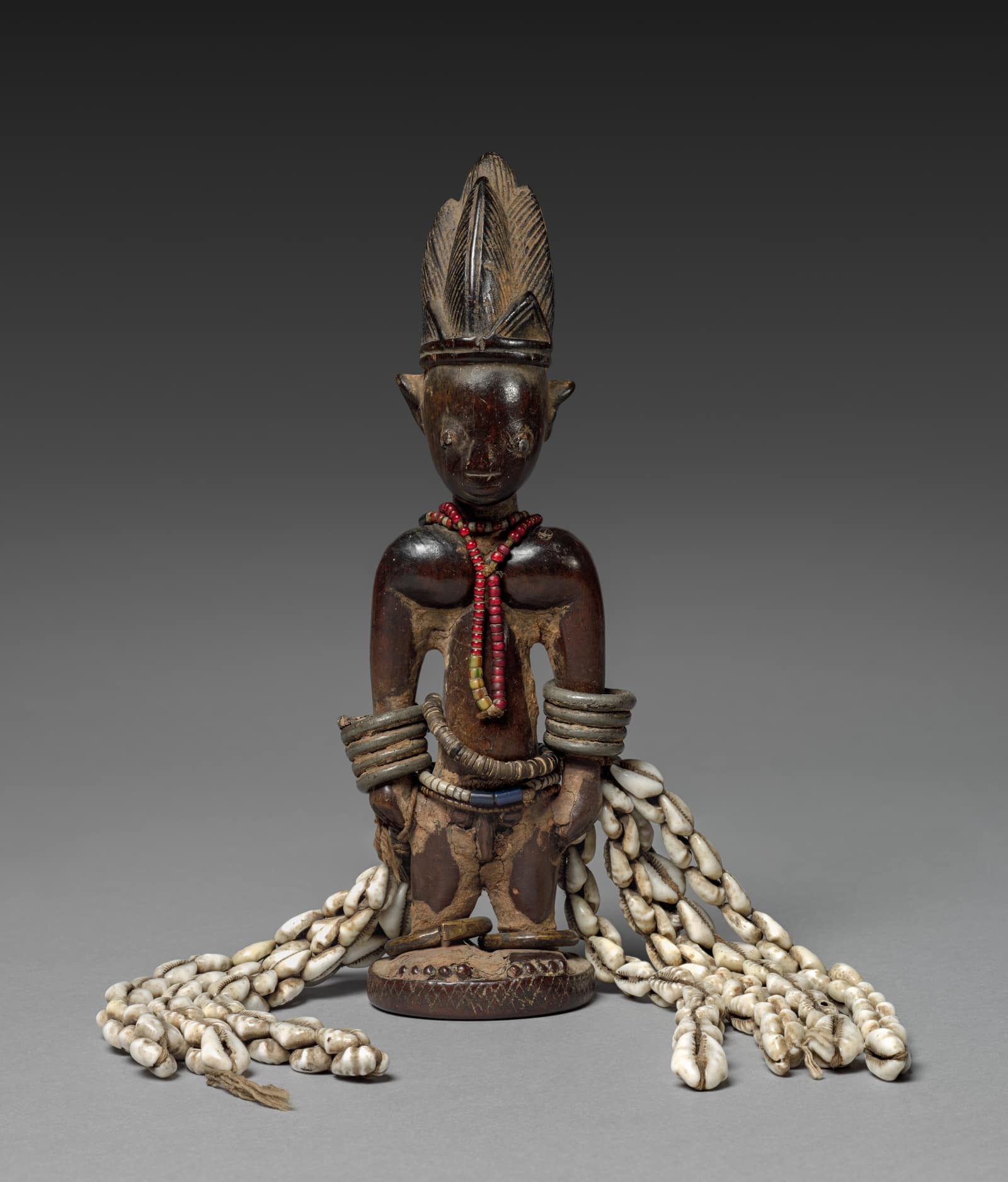
Image veiled by default
The Cleveland Museum of Art, Gift of Kim Sherwin, 2016.9, CC0CC0-1.0Original record
Data saver is on. Images load only when you ask. You can change this in Settings at any time.
From the archivist
When a twin died, among the Yorùbá, the family consulted a diviner, and a carver was asked for a figure small enough to hold in the palm. He did not carve an infant. He carved an adult, upright, with a high crest of hair, a person in the fullness of a life the child would not have.
For those who asked for it, the figure was not a portrait and not a toy. Twins were thought to share a single soul, and a twin left alone was in danger. The figure stood in for the one who had gone. So the mother took it home and cared for it as for a baby. She washed it, rubbed it with red camwood, touched food to its mouth, dressed it in beads and cowries. On feast days she danced with it in her hands or tucked into the cloth at her waist.
This one, now in a museum in Cleveland, still carries the trace of that care. Its face is worn smooth. The eyes, the nose, the mouth have been softened by years of washing and feeding, by fingers passing over them, again and again.
Nothing records the child's name. What remains is a grief that found something to do with its hands.
Established
- Twin figure (ère ìbejì) of wood with copper alloy, iron alloy, lead, glass beads, cowrie shells, twine and pigment, 25.6 cm high, made between the late 1800s and the early 1900s; Cleveland Museum of Art, 2016.9 (Cleveland Museum of Art).
- The Yorùbá of southwestern Nigeria have the highest recorded rate of dizygotic twin births in the world, 4.4 per cent of all maternities, and twin pregnancies carry a high risk of death around birth (Leroy et al. 2002).
- Twins are held to share one soul. When a newborn twin dies, a diviner is consulted and a carver is commissioned to make a figure as a substitute for the soul of the dead twin; two are made if both die (Leroy et al. 2002).
- The figures are symbolically washed, fed and clothed, by the parents and later by the surviving twin; many carry a crust of camwood powder and a face smoothed by ritual use (Leroy et al. 2002).
- Mothers of twins dance with the figures on annual occasions, holding them in their palms or tucking them into the wrapper at their waist (Bandama 2022; Spencer Museum of Art).
- The Cleveland museum reads the worn features of this figure as the trace of that washing and feeding (Cleveland Museum of Art).
- Photographs and plastic dolls often take the place of carved figures today (Spencer Museum of Art).
Interpretation
The word ère is usually glossed as 'sacred image'. Accounts differ on how the figure is understood, as the dwelling of the dead twin's soul, as its substitute or as a memorial, and practice varies by region, family and faith; most published descriptions were written by outside observers. The figures show adults in the prime of life rather than infants, which is usually read as giving the child the full life it did not have. For this figure, the carver, the town, the child it stood for and the circumstances in which it left its family are not recorded.
Looking ahead
A hundred years from now, what will a mother hold for a child she has lost: a photograph, a recorded voice, a face rebuilt by a machine?
Sources (4)
- The Cleveland Museum of Art. Twin Figure (Ère Ìbejì), late 1800s to early 1900s, Yorùbá-style maker, Nigeria, 2016.9, gift of Kim Sherwin (catalogue entry and open access record). · clevelandart.org
- Leroy, F., Olaleye-Oruene, T., Koeppen-Schomerus, G., Bryan, E. Yoruba customs and beliefs pertaining to twins. Twin Research 5 (2), 2002, p. 132-136. · doi.org
- Bandama, F. The Yorùbá ere ibeji: reincarnation of twins. In Williams, P. R., Feinman, G. M., Muro Ynoñán, L. (eds), Beyond Death: Beliefs, Practice, and Material Expression. Oxford, BAR Publishing, 2022, p. 57. · doi.org
- Spencer Museum of Art, University of Kansas. Ere ibeji (twin figure), collection record and label texts. · spencerart.ku.edu
Related fragments
1300 to 1500
The heads of Ifẹ
Ile-Ife, Osun State, Nigeria · Africa
1500 to 1897
The Benin Bronzes
Benin City, Edo State, Nigeria · Africa