The kula: to own a thing is to give it
- Dated
- Place
- Trobriand Islands, Milne Bay Province, Papua New Guinea · Kula partners of the Trobriand Islands and the Massim archipelagos, Papua New Guinea
- Coordinates
- 8° 33′ S · 151° 04′ E (approximate)
- Remains
- Intact
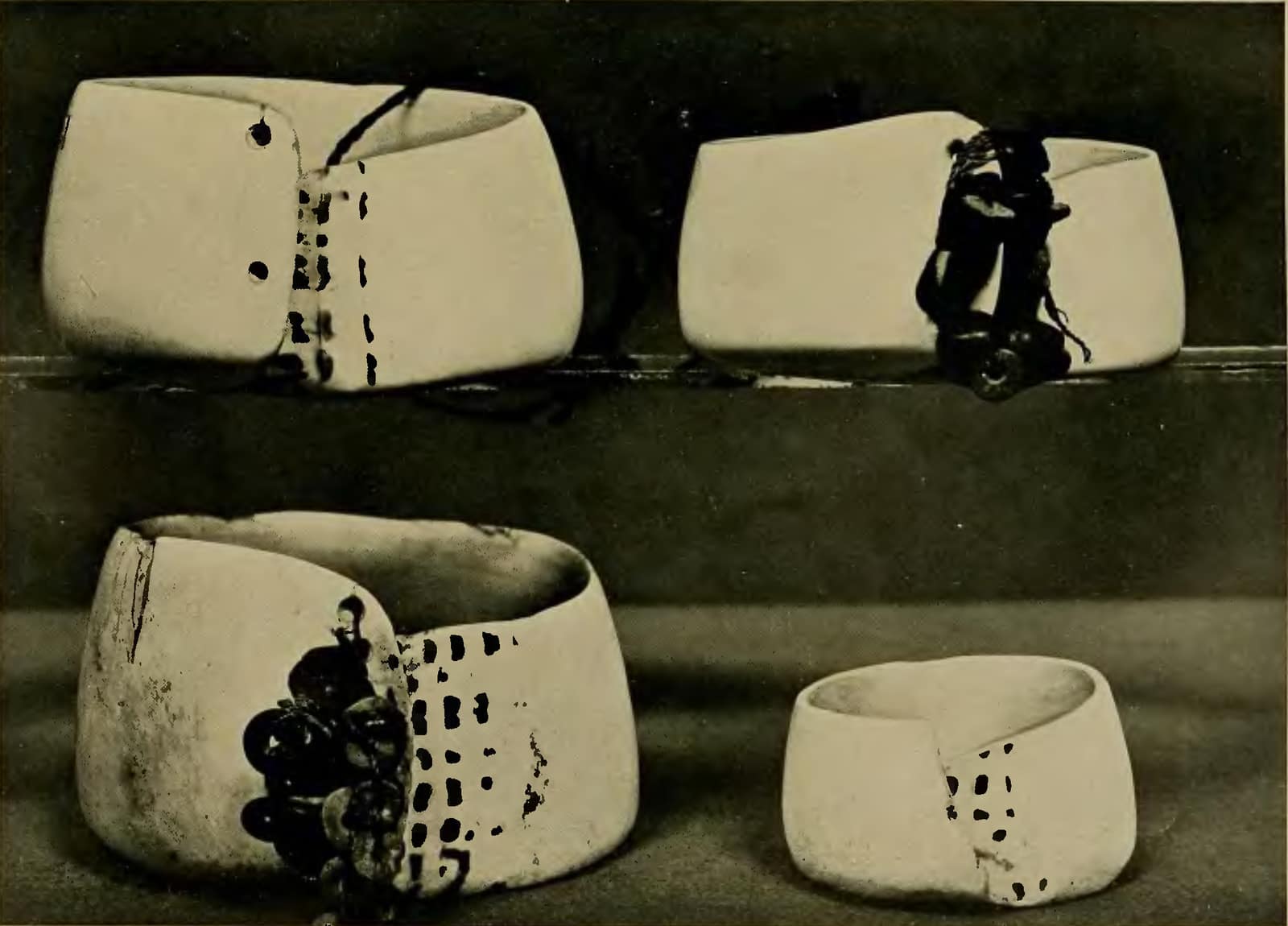
Bronisław Malinowski, Argonauts of the Western Pacific (1922), plate XVI, public domain, via Wikimedia CommonsPDMOriginal record
Data saver is on. Images load only when you ask. You can change this in Settings at any time.
From the archivist
In the islands east of New Guinea, a man might hold a white armshell for a year, perhaps two. He hardly wore it. He looked at it, handled it, told how it had come to him, and planned to whom he would give it next. Then he gave it away.
The armshells travelled one way around a wide ring of islands, the red necklaces the other, carried by canoe from a partner to a partner, and on again. A partnership, once made, was for life. The finest shells had names and histories of their own, and when one reached a village, people talked of nothing else. To keep a valuable too long was to be called mean. To give was to be great.
What a man owned, then, was a story: where the shell had been, and who had trusted him with it for a while.
When someone lay dying, his relatives brought their valuables and laid them on him. They put them on his forehead and on his chest, rubbed his ribs with them, held them before his face. Later they took them back. An anthropologist who watched this a century ago said they did it for hours.
The shells are still moving. Now some exchanges begin with a telephone call.
Established
- In the kula, two kinds of shell valuables travel around a wide ring of islands in opposite directions: long necklaces of red shell discs (soulava) clockwise, white armshells (mwali) the other way, each exchanged against the other between partners (Malinowski 1922).
- A partnership in the kula is lifelong. No one keeps a valuable for long: a man holds an article for perhaps a year or two, and keeping it longer earns the reproach of being niggardly; an article takes some two to ten years to go round (Malinowski 1922).
- Each first-class armshell and necklace has a personal name and a history of its own, and its arrival in a district causes a sensation (Malinowski 1922).
- Malinowski wrote that 'to possess is to give': a man who owns a thing is expected to share it, and meanness is the most despised vice (Malinowski 1922).
- A dying man was surrounded and covered with valuables lent by his relatives, who put them on his forehead and chest, rubbed his belly and ribs with them and held them before his face; the loans were taken back afterwards (Malinowski 1922).
- The kula was still practised in 2012; since 2010 mobile phones have allowed partners to talk without travelling, and some women are now active players (Kuehling 2012).
Interpretation
Malinowski's 'ring' has been revised: later anthropologists describe a regional system of paths (keda) between islands with different hierarchies and styles of exchange, and the gendered language of the shells is read today as a rhetoric of trust between partners rather than a fixed property of the objects (Kuehling 2012). How old the kula is remains uncertain. Malinowski described the Trobriand side of the exchange as an outsider, and his book uses the colonial vocabulary of 1922.
Looking ahead
Ten thousand years from now, will anyone remember that some of us measured wealth by what we had given away?
Sources (3)
- Malinowski, B. Argonauts of the Western Pacific: An Account of Native Enterprise and Adventure in the Archipelagoes of Melanesian New Guinea. London, George Routledge and Sons, 1922 (Project Gutenberg ebook 55822). · www.gutenberg.org
- Kuehling, S. They spear, hit again, bite, get engaged and sometimes marry: revisiting the gendering of kula shells. Anthropologica 54, 2012, p. 319-332. · cas-sca.journals.uvic.ca
- Pitt Rivers Museum, University of Oxford. Shell armlet (mwali), Papua New Guinea, 1933.40.18 (object record). · web.prm.ox.ac.uk
Related fragments
1920 to 1929
A map of the swell: Marshall Islands stick charts
Majuro, Marshall Islands · Oceania
1976
Hōkūleʻa
Hawaiʻi, United States, to Tahiti, French Polynesia · Oceania
c. 1000 BCE
Lapita pottery
Teouma, Efate, Shefa Province, Vanuatu · Oceania