The plastering of Djenné: a town that re-coats its mosque by hand
- Dated
- Place
- Djenné, Mali · The people of Djenné and its masons' association, the barey ton, Mali
- Coordinates
- 13° 54′ N · 4° 33′ W (approximate)
- Remains
- Intact
This fragment shows an object held as sacred.
It is shown here as the institution that holds it presents it. Some communities connected to it ask that it be viewed with care. You may choose to see the image, or read the record without it.
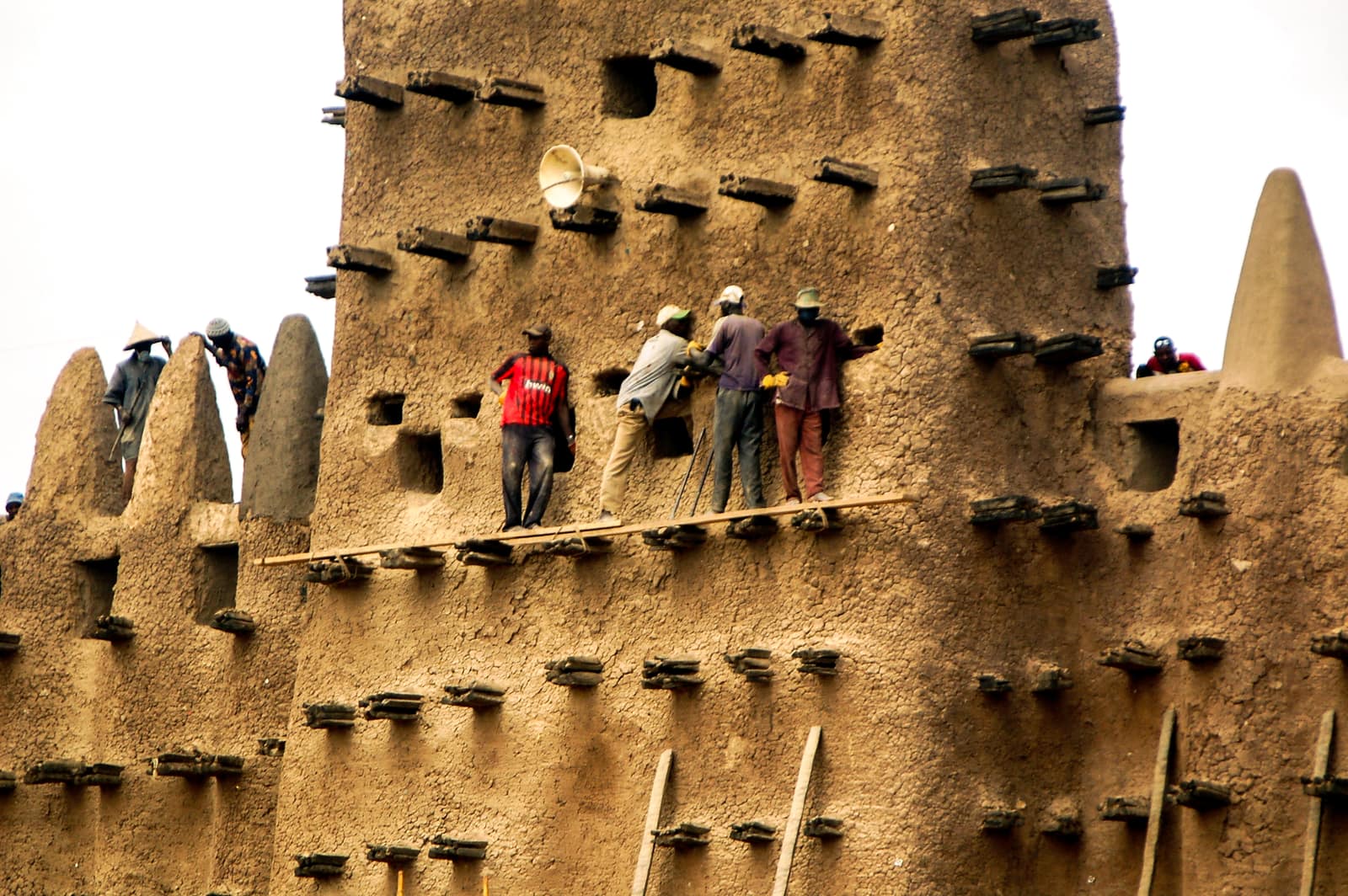
Image veiled by default
Ralf Steinberger, CC BY 2.0, via Wikimedia CommonsCC-BY-2.0Original record
Data saver is on. Images load only when you ask. You can change this in Settings at any time.
From the archivist
In this civilization some buildings were finished once. The mosque of Djenné was never finished. Its walls were earth, and every rainy season washed part of them away. So every year, before the rains, the town came back to it.
The masons decided how it should be done. They belonged to an association, the barey ton, and beforehand the older ones gathered the young ones to explain the work. For weeks a pit of mud mixed with bran had been left to rot until it was ready.
On the day itself the girls rose at dawn. They went to the wells and down to the river and came back with water, again and again, because without water the mud could not be mixed. Bare feet trod it. Young men carried it up the walls in baskets and buckets, climbing the palm-wood beams that stick out of the façade like the rungs of a ladder that never comes down. Men sat astride them and slapped the plaster on by hand. By evening everyone was covered in it, and the town ate together.
No one owned this building more than anyone else. It stood because, every year, everyone had touched it.
Established
- The present Great Mosque of Djenné was built in 1907 (CyArk); the old town of Djenné has been on the UNESCO World Heritage List since 1988 (UNESCO Courier).
- Each year the mosque receives a new coat of banco, a plaster of earth and water mixed with cereal bran and left to rot in a pit for fifteen days to a month before use (CyArk, interview with Nouhoum Touré; UNESCO Courier).
- The masons of Djenné belong to an association, the barey ton, with an elected head; apprentices work first beside the labourers, then beside the masons, until a master declares them ready (Massing 2012, reviewing Marchand 2009).
- Before the plastering, the masons call the young masons to a meeting and explain how the work must be done (CyArk, interview with Nouhoum Touré).
- On the day of the plastering the girls rise at dawn to bring water from the wells and the river, and the young men mix the mud and carry it up, down, inside and outside the building (CyArk, interview with Aïssata Djitteye).
- In 2000 the Malian writer Albakaye Ousmane Kounta described a plastering that began at dawn at the end of Ramadan: clay trodden by bare feet, hundreds of women and men streaming toward the walls, workers seated astride the palm-wood beams like riders (UNESCO Courier).
- On 12 May 2024 thousands of residents took part despite insecurity in central Mali; the town has been on the List of World Heritage in Danger since 2016 (Associated Press).
Interpretation
The date of the plastering is fixed each year by the town's authorities and has moved: Kounta's account places it at the end of Ramadan, while in 2024 it took place in May, before the rains; the role of the imam and of the village chief in choosing the day is described in the CyArk interviews. Kounta's text is a poem as much as a report. The 1907 building was raised under French colonial rule, and how far the colonial administration shaped its design has been debated. Accounts in the press often name the head of the masons' association; that role could not be checked here against a scholarly source. The organisation of the barey ton is documented by the anthropologist Trevor Marchand, who trained as an apprentice in Djenné, and is summarised here through a published review of his book.
Looking ahead
A hundred years from now, will there still be a building that a whole town must touch every year to keep it standing?
Sources (5)
- Kounta, A. O. (text), Jaspars, C. (photographs). Que soit et reste Djenné. Le Courrier de l'UNESCO, April 2000, p. 3-8. · webarchive.unesco.org
- CyArk. The Great Mosque of Djenné: interview transcripts (the imam Alphamoye Diakité, the mason Nouhoum Touré, Aïssata Djitteye of the Sankoré district), Tapestry. · tapestry.cyark.org
- Massing, A. Review of Trevor H. J. Marchand, The Masons of Djenné (Bloomington, Indiana University Press, 2009). Cahiers d'études africaines 206-207, 2012, p. 709-713. · journals.openedition.org
- Marchand, T. H. J. The Masons of Djenné. Bloomington, Indiana University Press, 2009 (not consulted directly; cited through Massing 2012).
- Associated Press. In Mali, thousands replaster the Great Mosque of Djenne, under threat from conflict, 13 May 2024. · www.clickondetroit.com
Related fragments
1000 to 1350 CE
The Great Mosque of Kilwa
Kilwa Kisiwani island, Lindi Region, Tanzania · Africa
after 1200 CE
The Timbuktu manuscripts
Timbuktu, Mali · Africa
1100 to 1500
Great Zimbabwe
Near Masvingo, Zimbabwe · Africa