The Ratu Finau, a drua, and the axe marks of its builders
- Dated
- Place
- Fulaga, Lau Islands, Fiji; now at the Fiji Museum, Suva · The mataisau, hereditary canoe builders of Fulaga and the Lau Islands, Fiji
- Coordinates
- 19° 08′ S · 178° 37′ W (approximate)
- Remains
- Intact
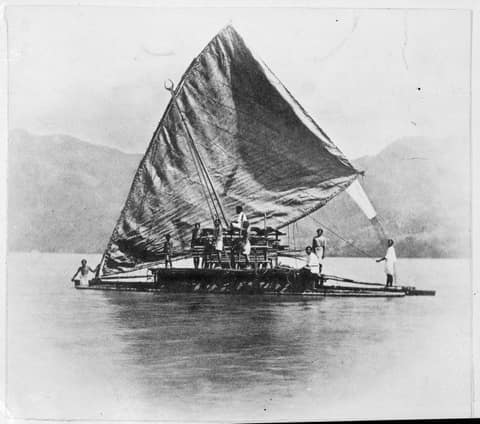
John Horsburgh, photograph of Fijians on a drua, 19th century, Alexander Turnbull Library (PAColl-8257), public domain, via Wikimedia CommonsPDMOriginal record
Data saver is on. Images load only when you ask. You can change this in Settings at any time.
From the archivist
The Ratu Finau was built on Fulaga, in the southern Lau Islands of Fiji, around 1913, by mataisau, the hereditary carpenters who served the chiefs of Lau. Their master's name has not come down to us. Their hands have.
A drua was two hulls joined by a deck, made of hard vesi wood, without a single piece of metal. The great ones were longer than thirty metres and carried more than two hundred people. This one is small, about thirteen metres, made late, when such canoes had almost stopped being built. Along its hulls the builders left marks, cut with an axe, on purpose.
It sailed to Suva, and it is said to have raced the yachts in the harbour, and won. The family of the man who had paid for it kept it for decades, and in 1981 gave it to the national museum.
A century after it was built, a mataisau of the Lemaki clan, Kaiafa Ledua, came to the museum to measure it. From those lines, in 2016, a small team launched a new drua on the Navua River, the first of its size in a hundred years. The old canoe, he said, contains within it the secrets of building a drua.
Sometimes what a people keeps is a way to begin again.
Established
- Drua were double-hulled sailing canoes built without metal; the largest were more than 100 feet long, carried more than 200 people and reached about fifteen knots (Nuttall, D'Arcy and Philp 2014).
- The vesi loa timber of the southern Lau Islands drew craftsmen from Samoa, Tonga and Fiji, and drua building there was a shared, cross-cultural craft; no great drua has been built for more than a century (Nuttall, D'Arcy and Philp 2014).
- The Ratu Finau, about 13.4 m long, was built on Fulaga in the southern Lau Islands at the command of Ratu Alifereti Finau, Tui Nayau; it is the oldest surviving of Fiji's great ocean-going double canoes (The Fiji Times 2017, 2026).
- Its builders were mataisau, hereditary craftsmen of Lau who served the high chiefs; the name of the master builder is not given in the sources consulted (The Fiji Times 2017, 2023).
- The Turner family gave the canoe to the Fiji Museum in 1981; it was restored in 1982 and conserved again recently, and it is the centrepiece of the museum's exhibition Voyages: Stories of an Ocean People (The Fiji Times 2023; Fiji Museum).
- Kaiafa Ledua, a mataisau of the Lemaki clan, measured the Ratu Finau to help build a new drua, I Vola Siga Vou, launched on 30 October 2016; visiting New Zealand boatbuilders confirmed that marks on the old hulls were cut deliberately with an axe (The Fiji Times 2017).
Interpretation
Sources differ on the year of building, 1913 or 1914, and on its circumstances: one account says the canoe was made for Ratu Finau and sold to J. B. Turner to save drua-building knowledge, another that it was built for Turner, and a 1982 report says the original vessel rotted and the builder made a smaller replacement. Reports of its speed, from 17 to 25 knots for drua in general, come from oral and museum tradition rather than measurement. The meaning of the axe marks is the reading of today's builders. The film in which it is said to have last sailed, in the 1920s, is cited through Fiji Heritage and has not been checked here.
Looking ahead
In a thousand years, what will we have left that a descendant could measure with their hands, and build again?
Sources (5)
- Nuttall, P., D'Arcy, P., Philp, C. Waqa Tabu, sacred ships: the Fijian drua. International Journal of Maritime History 26 (3), 2014, p. 427-450. · doi.org
- Fiji Museum. Voyages: Stories of an Ocean People (exhibition presentation, Our Exhibitions). · fijimuseum.org.fj
- Simmons, M. 2 years to build a 'giant'. The Fiji Times, 8 January 2017. · www.fijitimes.com.fj
- The Fiji Times. Back in history: Ratu Finau good as new, 30 January 2023. · www.fijitimes.com.fj
- Kamea, J. Discovering Fiji: the reign of the mighty drua. The Fiji Times, 15 February 2026. · www.fijitimes.com.fj
Related fragments
1976
Hōkūleʻa
Hawaiʻi, United States, to Tahiti, French Polynesia · Oceania
1920 to 1929
A map of the swell: Marshall Islands stick charts
Majuro, Marshall Islands · Oceania
c. 1000 BCE
Lapita pottery
Teouma, Efate, Shefa Province, Vanuatu · Oceania