The Great Mosque of Kilwa
- Dated
- Place
- Kilwa Kisiwani island, Lindi Region, Tanzania · Swahili city state of Kilwa Kisiwani (Kilwa Sultanate)
- Coordinates
- 8° 57′ S · 39° 31′ E (approximate)
- Remains
- Fragmentary
_(28962880322).jpg)
Richard Mortel from Riyadh, Saudi Arabia, CC BY 2.0, via Wikimedia CommonsCC-BY-2.0Original record
Data saver is on. Images load only when you ask. You can change this in Settings at any time.
From the archivist
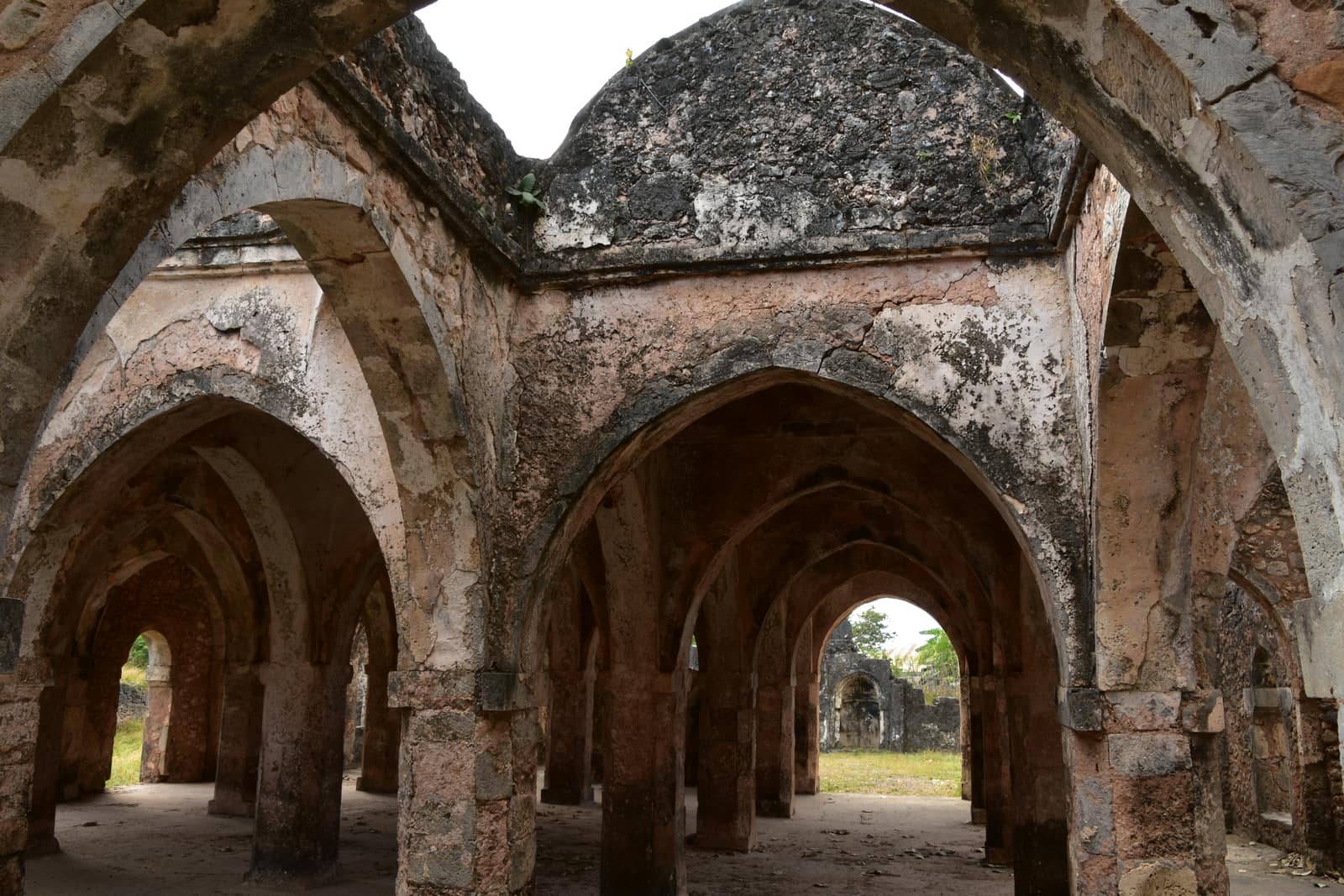
The stone of this mosque came from the sea. On the island of Kilwa, off the coast of East Africa, builders cut blocks from old coral reef, burned coral to make lime, and raised walls that still hold the sun.
The first prayer hall, standing by the eleventh or twelfth century, was roofed on rows of pillars. Some two hundred years later a sultan named al-Hasan ibn Sulaiman added a greater hall to the south, roofed with domes and vaults, and a great dome above them all. Kilwa was then rich: gold from the interior passed through its harbour on its way across the Indian Ocean, and the city struck its own coins.
In 1331 the traveller Ibn Battuta came here from Morocco and wrote that Kilwa was one of the most beautiful and best built towns in the world.
Trade moved elsewhere, and the town declined. Today the domes are open to the sky in places, and the arches frame the trees.
Established
- The oldest surviving part of the Great Mosque, the northern prayer hall, dates to the 11th or 12th century; it had sixteen bays roofed on nine pillars, and its walls are of squared and coursed coral stone (Chittick 1974).
- In the early 14th century Sultan al-Hasan ibn Sulaiman added a large southern extension with a great dome and a roof of vaults and smaller domes (Chittick 1974).
- Ibn Battuta visited Kilwa in 1331 and described it as one of the most beautiful and best built towns in the world (Ibn Battuta, trans. Gibb 1962).
- The Ruins of Kilwa Kisiwani and Songo Mnara were inscribed on the UNESCO World Heritage List in 1981, placed on the List of World Heritage in Danger in 2004 and removed from it in 2014 after conservation work (UNESCO).
Interpretation
Who first built at Kilwa and when is debated: the Kilwa Chronicle tells of a founding prince from Shiraz in Persia, while archaeologists stress that Kilwa grew from an African coastal town whose people spoke Swahili and traded across the ocean. The story of Persian origins is now read by many as a later claim to prestige rather than a record of migration.
In 10,000 years
In 10,000 years, when the coral has returned to the sea, what will remind anyone that a city of stone once prayed here?
Sources (4)
- UNESCO World Heritage Centre. Ruins of Kilwa Kisiwani and Ruins of Songo Mnara (property 144), inscribed 1981. · whc.unesco.org
- UNESCO World Heritage Centre. Ruins of Kilwa Kisiwani and Ruins of Songo Mnara removed from the List of World Heritage in Danger (World Heritage Committee, Doha, 2014). · whc.unesco.org
- Chittick, H. N. Kilwa: An Islamic Trading City on the East African Coast. 2 vols. Nairobi, British Institute in Eastern Africa (Memoir 5), 1974.
- Gibb, H. A. R. (trans.). The Travels of Ibn Battuta, A.D. 1325-1354, vol. II. Cambridge, Hakluyt Society, 1962.
Related fragments
1150 to 1250 CE
The rock-hewn churches of Lalibela
Lalibela, Amhara Region, Ethiopia · Africa
1100 to 1500
Great Zimbabwe
Near Masvingo, Zimbabwe · Africa