Great Zimbabwe
- Dated
- Place
- Near Masvingo, Zimbabwe · Ancestors of the Shona (Bantu-speaking farmers and traders of the Zimbabwe plateau)
- Coordinates
- 20° 16′ S · 30° 56′ E (approximate)
- Remains
- Fragmentary
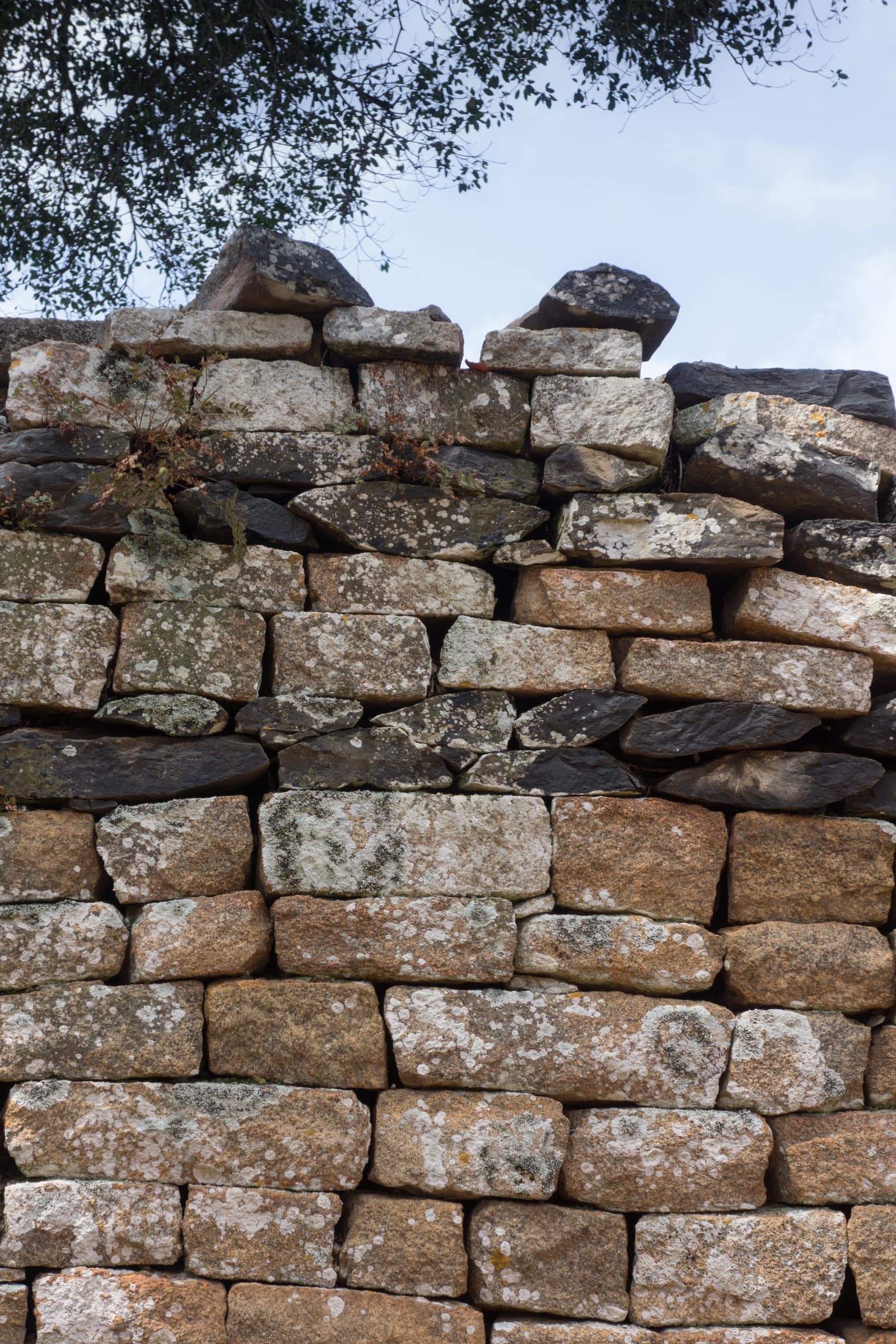
Fanny Schertzer, CC BY 3.0, via Wikimedia CommonsCC-BY-3.0Original record
Data saver is on. Images load only when you ask. You can change this in Settings at any time.
From the archivist
This civilization built with what the land offered. On the plateau between the Zambezi and the Limpopo, granite splits naturally into slabs under sun and cold. The people who lived there shaped those slabs into blocks and laid them, course upon course, without mortar, into walls that curve along the hill and through the valley below.
The largest enclosure is ringed by a wall some two hundred and fifty metres around and up to eleven metres high. Inside stands a solid conical tower. Near the top of some walls runs a band of stones set in a chevron pattern. Here lived people who kept cattle, worked gold and iron, and traded with the coast of the Indian Ocean; beads and porcelain from distant shores lie in the ground.
When foreign settlers reached the plateau in the late nineteenth century, many refused to believe that Africans had raised these walls. Queens and lost peoples from elsewhere were invented to explain them. Archaeologists showed otherwise as early as 1905, and again in 1929; a government continued to deny it for decades more.
The country that became independent in 1980 took its name from these walls.
Established
- Great Zimbabwe National Monument was inscribed on the UNESCO World Heritage List in 1986 as a unique testimony to the Bantu civilization of the Shona between the 11th and 15th centuries (UNESCO).
- A Bayesian analysis of radiocarbon dates places the start of stone wall building at the end of the 12th or beginning of the 13th century, with a peak in the 14th and 15th centuries and occupation continuing into at least the 16th (Chirikure et al. 2013).
- The walls are built of granite blocks laid without mortar; the site comprises the Hill Complex, the Great Enclosure and the valley ruins between them (UNESCO).
- Excavations by David Randall-MacIver in 1905 and Gertrude Caton-Thompson in 1929 showed that the site was built by Africans in the medieval period (Caton-Thompson 1931).
- The Rhodesian authorities nevertheless kept promoting theories of foreign builders; in 1970 the Inspector of Monuments, Peter Garlake, who attributed the site to the ancestors of the Shona, left his post and the country (Pikirayi 2012).
Interpretation
How the site was used is still debated: whether the Hill Complex was the seat of rulers and the Great Enclosure a royal residence or a place of initiation, and whether the stages of building mark a single capital or shifting centres of power. Its decline in the 15th and 16th centuries has been linked to changing trade routes and the exhaustion of land and wood, without agreement on the main cause.
In 10,000 years
In 10,000 years, will stones without mortar still speak for their builders when no one believes them?
Sources (5)
- UNESCO World Heritage Centre. Great Zimbabwe National Monument (property 364), inscribed 1986. · whc.unesco.org
- Chirikure, S., Pollard, M., Manyanga, M., Bandama, F. A Bayesian chronology for Great Zimbabwe: re-threading the sequence of a vandalised monument. Antiquity 87 (337), 2013, p. 854-872. · doi.org
- Pikirayi, I. Peter Garlake (1934-2011), Great Zimbabwe and the politics of the past in Zimbabwe. Azania: Archaeological Research in Africa 47 (2), 2012. · doi.org
- The Metropolitan Museum of Art. Great Zimbabwe (11th to 15th century), Heilbrunn Timeline of Art History essay. · www.metmuseum.org
- Caton-Thompson, G. The Zimbabwe Culture: Ruins and Reactions. Oxford, Clarendon Press, 1931.
.jpg)