Einkorn and emmer: the first wheats
Before, people in southwest Asia gathered wild grasses whose ears shattered as they ripened; after centuries of sowing and reaping, they grew wheats whose grain waited for the sickle, and the farming villages from which later cities grew came to depend on them.
- Dated
- Place
- Karacadağ mountains, southeastern Türkiye · Early Neolithic communities of the Fertile Crescent, from southeast Anatolia to the Middle Euphrates and the Levant
- Coordinates
- 37° 40′ N · 39° 50′ E (approximate)
- Remains
- Intact
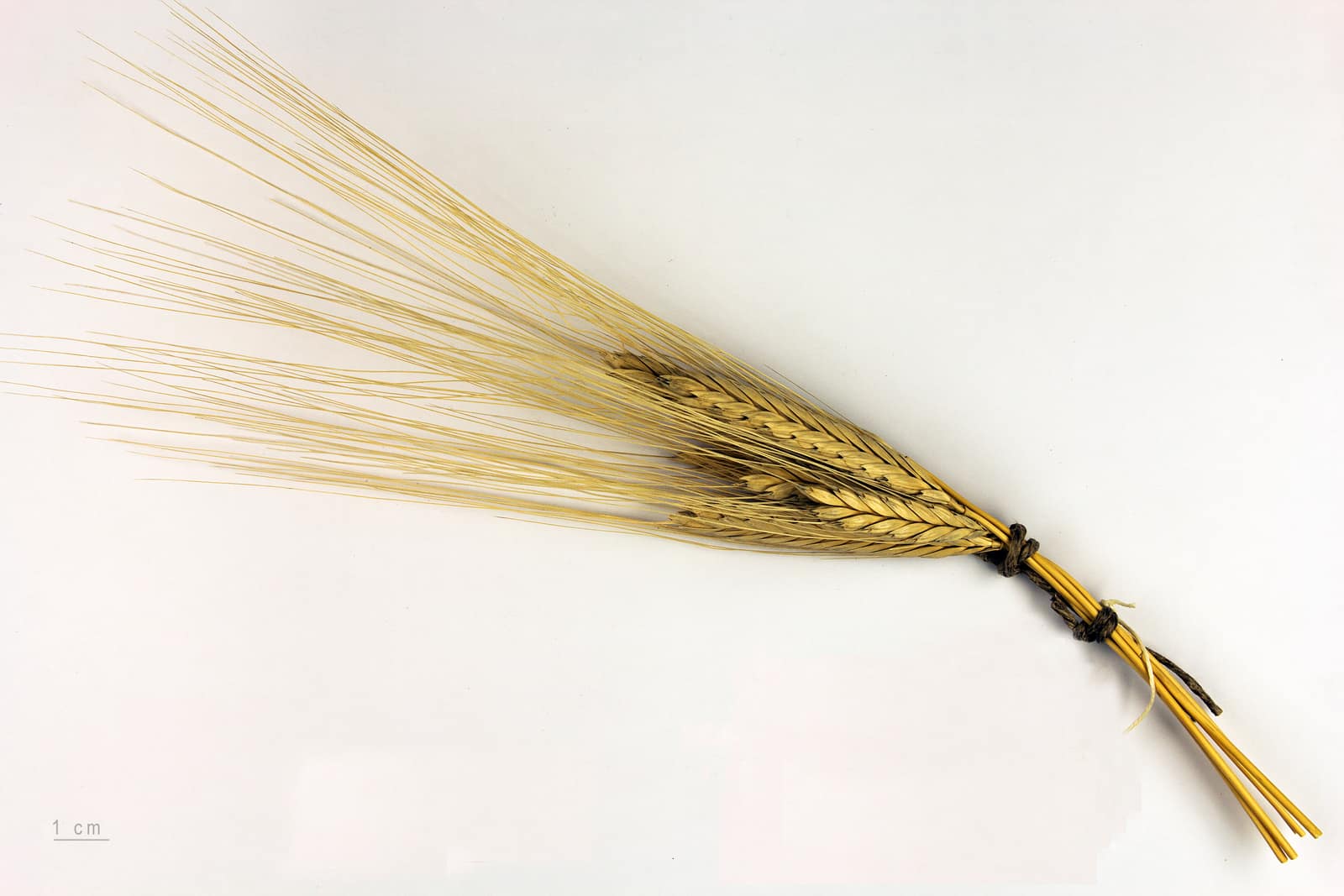

Roger Culos, CC BY-SA 3.0, via Wikimedia CommonsCC-BY-SA-3.0Original record
Data saver is on. Images load only when you ask. You can change this in Settings at any time.
From the archivist
The grass on these slopes had a way of escaping. When its ears ripened, they broke apart and the seeds fell to the ground at a touch, which is how a wild plant sows itself.
People came each summer to gather it, with sickles of flint set in handles of bone or wood. Perhaps they began to keep some seed and to sow it near their houses. Year after year, without anyone intending it, the plants whose ears held together were the ones that reached the threshing floor, and the ones sown again. It took a thousand years or more.
What came out of those fields was a wheat that waited for the people who grew it. Einkorn, with its single grain to each spikelet, and emmer, with two. The ears kept here are einkorn, tied with a twist of cord, their long awns fanned out.
Almost every loaf of bread this civilization ever ate descends from grass that once grew on a few dry hills.
Established
- Wild einkorn and wild emmer grew in the hills of the Fertile Crescent; their ripe ears shatter and scatter their seed, whereas in domesticated forms the ear stays whole until it is harvested (Tanno and Willcox 2006).
- In 1997 Manfred Heun and colleagues compared DNA fingerprints at 288 marker loci from 338 wild and 68 cultivated lines of einkorn; the wild einkorn of the Karacadağ mountains in southeast Turkey was the closest to the cultivated plant, near early farming villages (Heun et al. 1997).
- In 2002 a similar study of wild and cultivated emmer also pointed to southeast Turkey as the region where emmer, and the durum wheat descended from it, were domesticated (Özkan et al. 2002).
- Remains of grain from Near Eastern sites show that cultivation began about 10,500 years ago, that ears which no longer shattered emerged only around 9,500 years ago, and that shattering forms were still common in cultivated fields about 7,500 years ago (Tanno and Willcox 2006).
- Communities from southeast Turkey to the Middle Euphrates were managing the wild ancestors of crops by at least 11,500 years ago, in a process that unfolded over millennia and across the whole region (Zeder 2011).
Interpretation
Whether wheat was domesticated in one core area, such as the Karacadağ, or through many cultivations across the Fertile Crescent is still argued; the genetic studies compare modern wild populations, whose ranges may have shifted, and archaeologists now tend to see a slow, dispersed process rather than a single event. The link between farming and the first towns is also debated: monumental sites such as Göbekli Tepe were built by people who did not yet grow domesticated cereals.
In 10,000 years
In 10,000 years, will wheat still be sown by hand or machine, or will it return to the hillsides and scatter its own seed again?
Sources (4)
- Heun, M., Schäfer-Pregl, R., Klawan, D., Castagna, R., Accerbi, M., Borghi, B., Salamini, F. Site of einkorn wheat domestication identified by DNA fingerprinting. Science 278 (5341), 1997, p. 1312-1314. · doi.org
- Özkan, H., Brandolini, A., Schäfer-Pregl, R., Salamini, F. AFLP analysis of a collection of tetraploid wheats indicates the origin of emmer and hard wheat domestication in southeast Turkey. Molecular Biology and Evolution 19 (10), 2002, p. 1797-1801. · doi.org
- Tanno, K., Willcox, G. How fast was wild wheat domesticated? Science 311 (5769), 2006, p. 1886. · doi.org
- Zeder, M. A. The origins of agriculture in the Near East. Current Anthropology 52 (S4), 2011, p. S221-S235. · doi.org
Related fragments
9600 to 8200 BCE
Göbekli Tepe
Near Şanlıurfa, Türkiye · Asia
c. 7000 BCE
Maize, from teosinte
Near Iguala, Guerrero, Mexico · Americas
8200 to 2000 BCE
Kuk Swamp
Near Mount Hagen, Western Highlands Province, Papua New Guinea · Oceania
2008
The Svalbard Global Seed Vault
Longyearbyen, Svalbard, Norway · Europe
1909 to 1913
Bread from the air: the Haber-Bosch synthesis of ammonia
Karlsruhe Institute of Technology, Karlsruhe, Germany · Europe