Göbekli Tepe
- Dated
- Place
- Near Şanlıurfa, Türkiye · Hunter-gatherers of the Pre-Pottery Neolithic in Upper Mesopotamia
- Coordinates
- 37° 13′ N · 38° 55′ E (approximate)
- Remains
- Fragmentary
Kerimove, CC0, via Wikimedia CommonsCC0-1.0Original record
Data saver is on. Images load only when you ask. You can change this in Settings at any time.
From the archivist
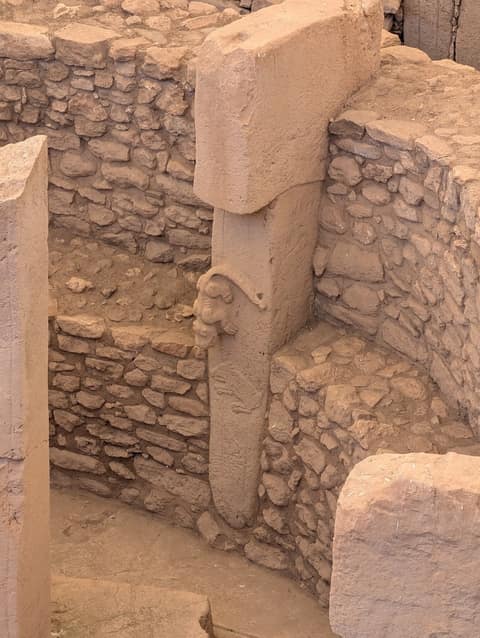
This civilization raised stone before it sowed grain. On a ridge above the plain of Harran, some eleven thousand years ago, people who hunted gazelle and gathered wild cereals quarried slabs of limestone from the bedrock, shaped them into tall T-shaped pillars and set them in circles, facing inward, bound by walls of rubble.
The pillars have arms. Carved hands meet above a belt on the front of some of them, so the stones stand like tall figures without faces. On others, animals move over the surface: foxes, boars, cranes, snakes, scorpions. On one pillar a beast of prey crawls downward in high relief, head jutting from the stone, above a boar cut in flat outline.
No one here yet kept flocks or tilled fields. The labour needed to cut, drag and raise pillars weighing several tonnes was gathered by groups who still lived from the wild. They ate together in great numbers; the bones of their game lie thick in the fill.
We do not know the names they gave these figures, nor what was spoken inside the circles.
Established
- Göbekli Tepe was inscribed on the UNESCO World Heritage List in 2018; its monumental round-oval and rectangular megalithic structures were erected by hunter-gatherers in the Pre-Pottery Neolithic, between about 9600 and 8200 BCE (UNESCO).
- The enclosures are ringed by walls and benches set with T-shaped limestone pillars, the largest over five metres tall; many carry reliefs of foxes, boars, snakes, birds and other wild animals (UNESCO; Dietrich et al. 2012).
- Some pillars bear carved arms, hands and belts, which show them to be stylised human or human-like figures (Dietrich et al. 2012).
- Excavations began in 1995 under Klaus Schmidt of the German Archaeological Institute with the Şanlıurfa Museum; after Schmidt's death in 2014, Lee Clare continued them (Clare 2020).
- Deposits at the site include large quantities of animal bone from wild game and ground stone tools for processing cereals, interpreted as traces of feasting (Dietrich et al. 2012).
Interpretation
Klaus Schmidt described the site as the world's first temple, a mountain sanctuary without houses. Later work found domestic buildings, rock-cut cisterns and evidence of daily life, and many archaeologists now see a settlement where people lived as well as gathered for ritual; whether the enclosures were deliberately buried or filled by slope slides is also disputed (Banning 2011; Clare 2020).
In 10,000 years
In 10,000 years, will anyone guess that the first great stones of this civilization were raised by people who did not yet farm?
Sources (5)
- UNESCO World Heritage Centre. Göbekli Tepe (property 1572), inscribed 2018. · whc.unesco.org
- Dietrich, O., Heun, M., Notroff, J., Schmidt, K., Zarnkow, M. The role of cult and feasting in the emergence of Neolithic communities. New evidence from Göbekli Tepe, south-eastern Turkey. Antiquity 86 (333), 2012, p. 674-695. · doi.org
- Banning, E. B. So fair a house: Göbekli Tepe and the identification of temples in the Pre-Pottery Neolithic of the Near East. Current Anthropology 52 (5), 2011, p. 619-660. · doi.org
- Clare, L. Göbekli Tepe, Turkey. A brief summary of research at a new World Heritage Site (2015-2019). e-Forschungsberichte des Deutschen Archäologischen Instituts 2020 (2). · publications.dainst.org
- Schmidt, K. Sie bauten die ersten Tempel. Das rätselhafte Heiligtum der Steinzeitjäger. Munich, C. H. Beck, 2006.