The Cave of the Hands
- Dated
- Place
- Cueva de las Manos, Pinturas River canyon, Santa Cruz Province, Argentina · Hunter-gatherers of Patagonia
- Coordinates
- 47° 09′ S · 70° 39′ W (approximate)
- Remains
- Intact

Mariano, CC BY-SA 3.0, via Wikimedia CommonsCC-BY-SA-3.0Original record
Data saver is on. Images load only when you ask. You can change this in Settings at any time.
From the archivist
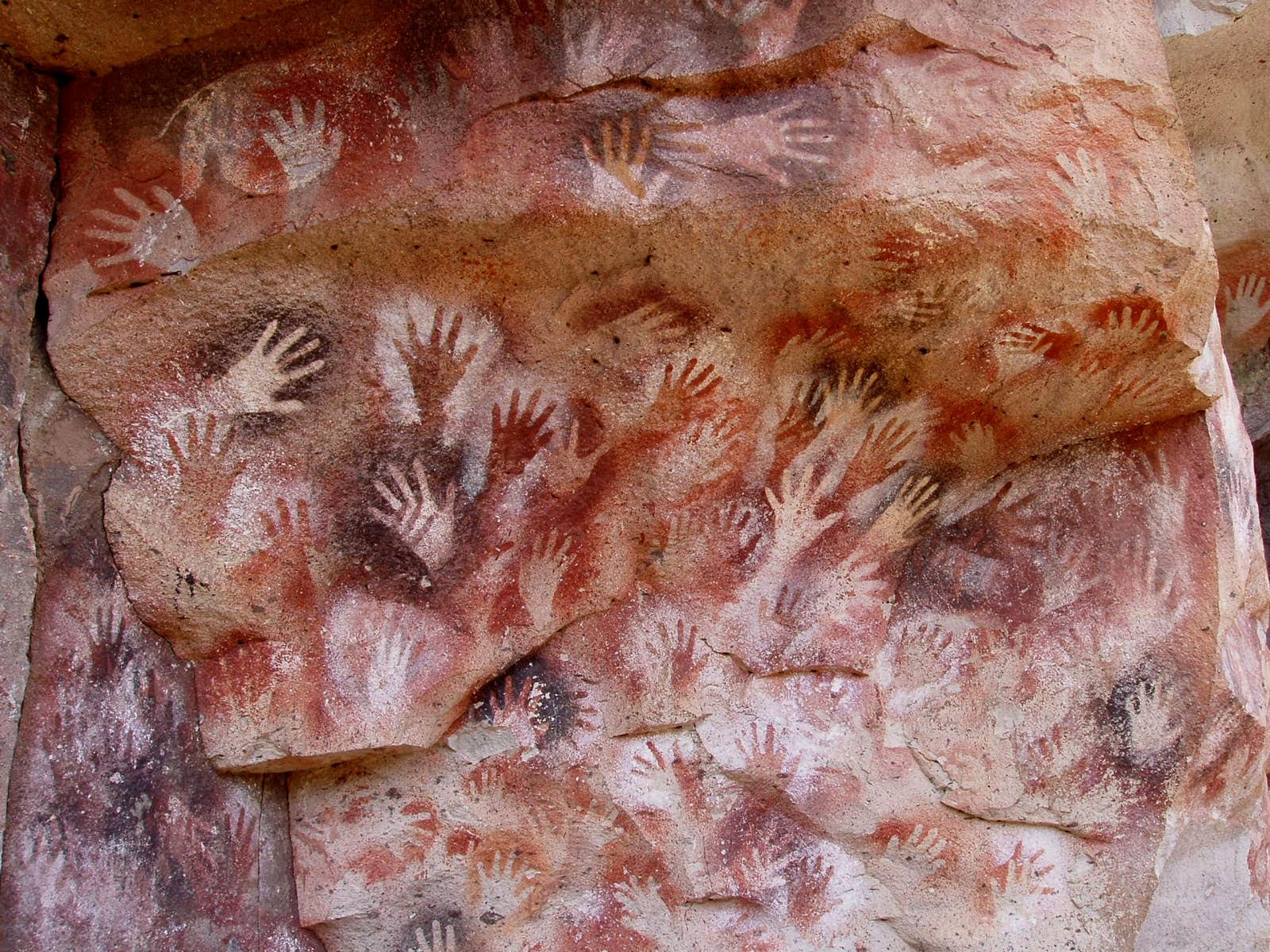
Above a river that had cut a deep canyon into the Patagonian plateau, the people of this civilization came back, again and again, to the same wall. They ground pigment, red, yellow, white and black, pressed a hand flat against the rock, and blew the colour around it. When the hand came away, its absence stayed.
Hundreds of these absences now crowd the stone. They overlap, small and large, the hands of people of different ages set side by side as if each answered the one before. Around them run guanacos, the animals these hunters followed across the steppe, and scenes in which many small figures close in on a herd together.
The lowest layers of the shelter still hold traces of ochre ground more than ten thousand years ago. We do not know what the hands meant: a name, a promise, a way of saying we were here, and we were many. We know only that they were placed with care, and that for thousands of years no one wiped them away.
Established
- Hundreds of hand stencils cover the walls of a rock shelter high above the canyon of the Pinturas River, in Santa Cruz Province, Argentina.
- Beside the hands are guanacos, scenes of collective hunting and geometric motifs, painted with mineral pigments: iron oxides, kaolin, natrojarosite and manganese oxide (UNESCO).
- Remains of ochre preparation in the lowest excavated layer are radiocarbon dated to about 9,300 years BP, roughly 10,700 to 10,200 calendar years ago (Gradin, Aschero and Aguerre, 1976).
- The stencils belong to people of different ages, and the painting of the walls was resumed again and again over at least 2,600 years (Aschero and Schneier, 2023).
- The site was inscribed on the UNESCO World Heritage List in 1999.
Interpretation
The dates remain indirect: the paintings are placed in time through the excavated layers and the pigments found in them, not measured on the walls themselves. UNESCO gives a range of 13,000 to 9,500 years ago, older than the excavators' radiocarbon sequence. UNESCO suggests that the painters may have been ancestors of the hunter-gatherer peoples of Patagonia met by European settlers in the nineteenth century. Why so many hands were placed here, whether as signature, rite or mark of belonging, is not known.
In 10,000 years
In 10,000 years, will a hand pressed against a screen have left as clear a trace as a hand outlined in ochre?
Sources (3)
- UNESCO World Heritage Centre. Cueva de las Manos, Río Pinturas (inscription 936), inscribed in 1999. · whc.unesco.org
- Gradin, C. J., Aschero, C. A., Aguerre, A. M. Investigaciones arqueológicas en la Cueva de las Manos, Alto Río Pinturas, Santa Cruz. Relaciones de la Sociedad Argentina de Antropología 10, 1976, p. 201-251.
- Aschero, C. A., Schneier, P. Ese asunto de volver: producción y significación en el arte rupestre de Cueva de las Manos, Patagonia meridional andina. Boletín del Museo Chileno de Arte Precolombino 28 (2), 2023. · boletinmuseoprecolombino.cl