The painted pig of Leang Tedongnge
- Dated
- Place
- Leang Tedongnge, karst of Maros and Pangkep, South Sulawesi, Indonesia · Early modern humans of Sulawesi
- Coordinates
- 4° 54′ S · 119° 39′ E (approximate)
- Remains
- Fragmentary
Basran Burhan, CC BY-SA 4.0, via Wikimedia CommonsCC-BY-SA-4.0Original record
Data saver is on. Images load only when you ask. You can change this in Settings at any time.
From the archivist
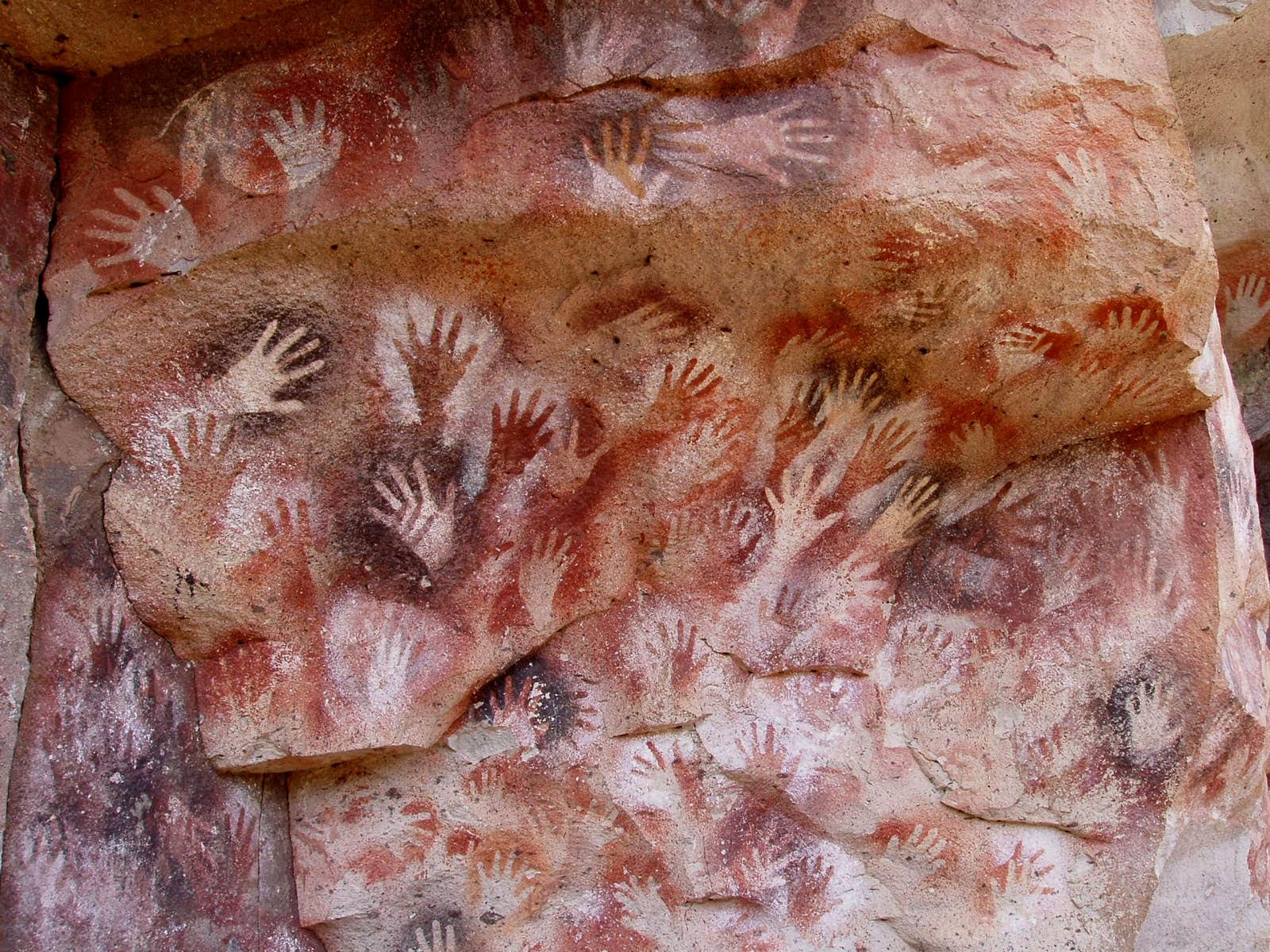
Someone, in a limestone hollow in the south of Sulawesi, painted a pig. Not the sign for a pig: a particular animal, with the crest of stiff hair and the warts on the face that belong to the species still living in the island's forests. The line was laid down in red earth, dense along the back, lighter where the belly rounds. Then two hands were pressed to the wall above the hindquarters and pigment was blown around them, so that their outline would stay.
This civilization left no name here. It left a gesture, repeated: look closely, then set your hand beside what you have looked at.
A thin crust of calcite slowly grew over the image. It is this crust, measured by the decay of its uranium, that tells us the painting was already there 45,500 years ago. Further along the wall, other pigs had been painted. Most of them have gone with the rock, which comes away in flakes.
Established
- A Sulawesi warty pig (Sus celebensis), 136 cm long and 54 cm high, painted in dark red ochre on the wall of a limestone cave (Brumm et al., 2021).
- Uranium-series dating of a mineral crust that formed over the painting gives it a minimum age of 45,500 years.
- Two hand stencils sit above the pig's hindquarters, and at least two or three other pigs, partly lost, share the same panel.
- The cave lies in a secluded karst valley on the border of the Maros and Pangkep districts; the research team recorded it in 2017.
- In 2024, a scene in the same region, at Leang Karampuang, showing a pig and three human-like figures, was dated to at least 51,200 years (Oktaviana et al., Nature).
Interpretation
The authors read the panel as a possible scene of several pigs interacting, which would make it a very early narrative composition; that reading is debated, and all these dates are minimum ages, not the moment of painting. In 2021 the pig was presented as the oldest known figurative image; the Leang Karampuang scene has since been dated older, and a hand stencil on Muna Island, off Sulawesi, was dated in 2026 to at least 67,800 years. New samples may move these limits again.
In 10,000 years
In 10,000 years, the thin skin of rock that carries this pig may have fallen; the photographs we take of it today could be all that is left.
Sources (3)
- Brumm, A., Oktaviana, A. A., Burhan, B., Hakim, B., Lebe, R., Zhao, J.-x., Sulistyarto, P. H., Ririmasse, M., Adhityatama, S., Sumantri, I., Aubert, M. Oldest cave art found in Sulawesi. Science Advances 7 (3), eabd4648, 2021. · doi.org
- Oktaviana, A. A., Joannes-Boyau, R., Hakim, B., Burhan, B., et al. Narrative cave art in Indonesia by 51,200 years ago. Nature 631, 2024, p. 814-818. · doi.org
- Oktaviana, A. A., Joannes-Boyau, R., Hakim, B., Burhan, B., et al. Rock art from at least 67,800 years ago in Sulawesi. Nature 650, 2026, p. 652-656. · doi.org