Maize, from teosinte
Before it, a wild grass of the Balsas valley bore a few hard seeds; after thousands of years of selection by the peoples of Mexico, it became maize, a staple that fed the civilizations of the Americas and, after 1492, much of the world.
- Dated
- Place
- Near Iguala, Guerrero, Mexico · Early cultivators of the Central Balsas River valley, southwestern Mexico, and the farmers of Mesoamerica after them
- Coordinates
- 18° 20′ N · 99° 32′ W (approximate)
- Remains
- Intact
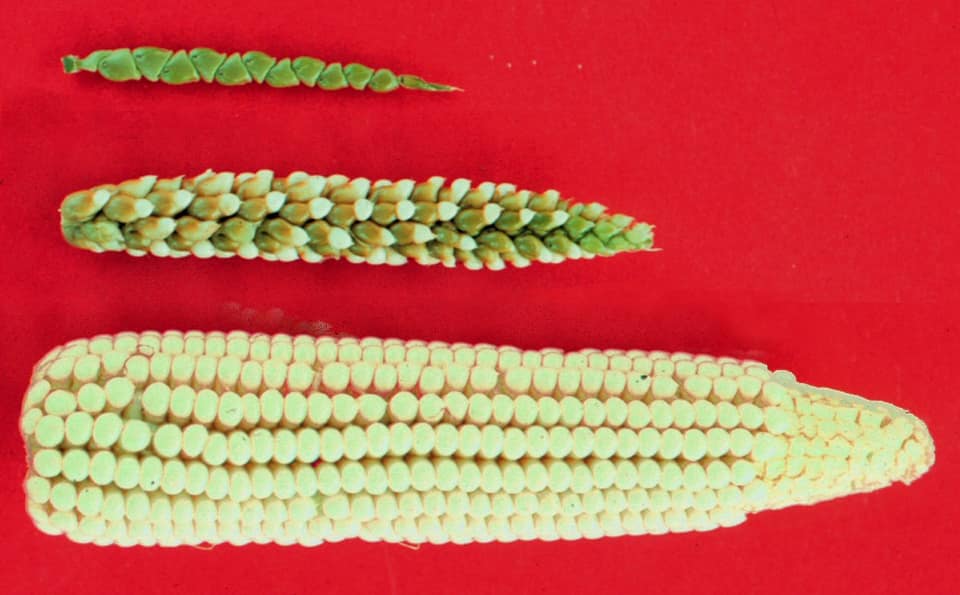

John Doebley, CC BY 3.0, via Wikimedia CommonsCC-BY-3.0Original record
Data saver is on. Images load only when you ask. You can change this in Settings at any time.
From the archivist
Look at the ear at the top of the picture. It is barely as long as a finger. Each of its few seeds is sealed in a case so hard that a tooth would break on it. This grass, teosinte, still grows wild on the hills of the Balsas River in southwestern Mexico.
Some nine thousand years ago, people living in the forests of that valley began to gather it, to sow the seeds they preferred, and to keep the plants whose seeds came loose. They left almost nothing we can see: only grains of starch, smaller than dust, caught in the cracks of the stones on which they ground it.
Generation after generation, the case softened, the rows multiplied, the ear swelled. The plant at the bottom of the picture could no longer scatter its own seed. It had become wholly dependent on the people who grew it, and they on it.
From that exchange came the fields of the Maya, the Aztecs and the Andes, and, after 1492, a food for much of the world.
Established
- A genetic study of 264 plants typed at 99 microsatellite markers concluded that all maize arose from a single domestication in southern Mexico about 9,000 years ago (Matsuoka et al. 2002).
- Its wild ancestor is Balsas teosinte (Zea mays subsp. parviglumis), a large grass native to the Balsas River valley of southwestern Mexico (Smithsonian; Matsuoka et al. 2002).
- Starch grains and phytoliths on stone tools from the Xihuatoxtla rock shelter, in the Central Balsas valley, show that maize was present there by 8,700 calendar years ago, together with a domesticated squash (Piperno et al. 2009; Ranere et al. 2009).
- The oldest maize cobs yet found, from Guilá Naquitz Cave in Oaxaca, are about 6,250 calendar years old (Piperno and Flannery 2001).
- A study of more than 1,000 genomes found that modern maize also carries a share of DNA from a second, highland teosinte (Zea mays subsp. mexicana), mixed in some 4,000 years after domestication began (Yang et al. 2023).
Interpretation
Why people first tended teosinte, whose few seeds are locked in hard cases, is debated: for its grain, for the sweet juice of its stalks, or for both. Whether the transformation happened in the lowlands, as the Balsas evidence suggests, or was completed in the highlands, and how much the highland teosinte contributed, are still being studied. The older idea that a second wild grass, Tripsacum, took part in the origin of maize has been largely abandoned.
In 10,000 years
In 10,000 years, will the plants we have shaped still carry the memory of the people who chose them, grain by grain?
Sources (6)
- Matsuoka, Y., Vigouroux, Y., Goodman, M. M., Sanchez G., J., Buckler, E., Doebley, J. A single domestication for maize shown by multilocus microsatellite genotyping. Proceedings of the National Academy of Sciences 99 (9), 2002, p. 6080-6084. · doi.org
- Piperno, D. R., Ranere, A. J., Holst, I., Iriarte, J., Dickau, R. Starch grain and phytolith evidence for early ninth millennium B.P. maize from the Central Balsas River Valley, Mexico. Proceedings of the National Academy of Sciences 106 (13), 2009, p. 5019-5024. · doi.org
- Ranere, A. J., Piperno, D. R., Holst, I., Dickau, R., Iriarte, J. The cultural and chronological context of early Holocene maize and squash domestication in the Central Balsas River Valley, Mexico. Proceedings of the National Academy of Sciences 106 (13), 2009, p. 5014-5018. · doi.org
- Piperno, D. R., Flannery, K. V. The earliest archaeological maize (Zea mays L.) from highland Mexico: new accelerator mass spectrometry dates and their implications. Proceedings of the National Academy of Sciences 98 (4), 2001, p. 2101-2103. · doi.org
- Yang, N., Wang, Y., Liu, X., et al. Two teosintes made modern maize. Science 382 (6674), 2023, eadg8940. · doi.org
- Smithsonian Institution. New research reveals the earliest evidence for corn in the New World, press release, March 2009. · www.si.edu
Related fragments
8200 to 2000 BCE
Kuk Swamp
Near Mount Hagen, Western Highlands Province, Papua New Guinea · Oceania
170 to 310 CE
The Pyramid of the Sun, Teotihuacan
San Juan Teotihuacán, State of Mexico, Mexico · Americas