The absence register of Deir el-Medina
- Dated
- Place
- Deir el-Medina, west bank of Luxor, Egypt · Workmen of the royal tomb and their families, Deir el-Medina, Egypt of the 19th Dynasty
- Coordinates
- 25° 44′ N · 32° 36′ E (approximate)
- Remains
- Intact
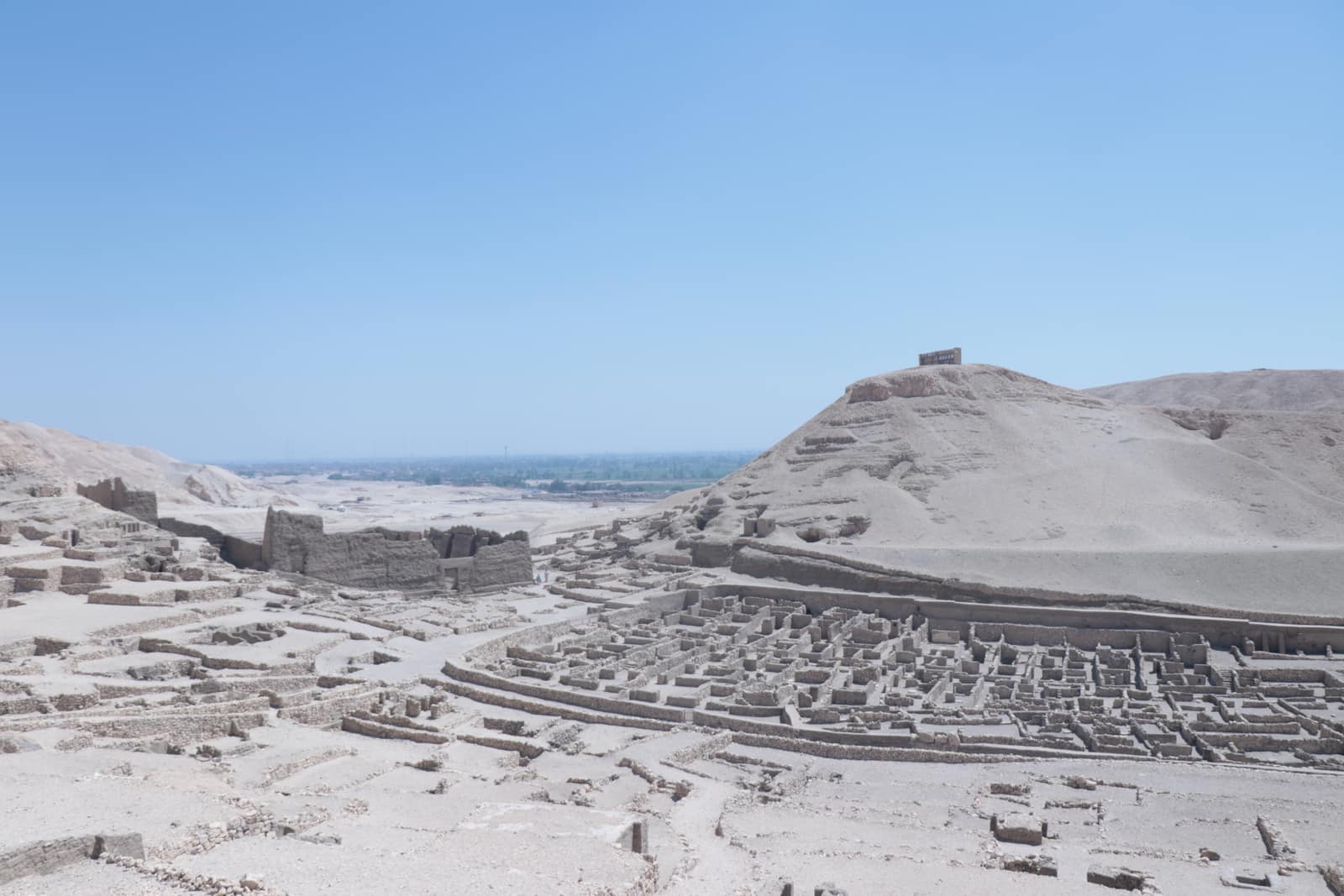
Gildas Guionnet, CC BY-SA 4.0, via Wikimedia CommonsCC-BY-SA-4.0Original record
Data saver is on. Images load only when you ask. You can change this in Settings at any time.
From the archivist
In the village of the men who cut the royal tombs, someone kept count of who did not come to work. Through a long year of Ramesses II's reign, a scribe took a flat flake of pale limestone, the size of a large book, and wrote forty names down its edge in black ink. Beside each name he set the days missed, and above the dates, in red, the reason.
The reasons are the life of the village. A man was ill; two had bad eyes; one had been stung by a scorpion. Men stayed home to brew, to make ready for a festival, to embalm and mourn their dead. Paherypedjet, who seems to have been the one who healed, was forever away, preparing remedies or sitting with the sick. Ten men were away because a wife or a daughter was bleeding. Others were building their own houses, or carrying stones for the scribe himself. Two men missed nothing at all.
This civilization is remembered for gold and for tombs cut deep into the cliffs. The men who cut them left this too: a stone that says they were tired, sick, grieving, needed at home, and that someone wrote it all down, day after day.
Established
- The ostracon is a flake of limestone 38.5 cm high and 33 cm wide, written on both sides: forty workmen's names, the dates on which each was absent, and above the dates, in red ink, the reason (Deir el-Medina Database; Gräßler 2016).
- It covers 280 days of year 40 of the reign of Ramesses II, around 1250 BCE; only about 70 of those days seem to have been full working days (British Museum).
- Illness is by far the most frequent reason; the scribe specifies eye disease for two men and a scorpion sting for one (Gräßler 2016).
- Other reasons include brewing, embalming, funerals and mourning, festivals and offerings, building a house, and work done for a superior or for the scribe, such as carrying stones (Deir el-Medina Database; Gräßler 2016; British Museum).
- Ten workmen gave as their reason that a wife or a daughter, or both, was menstruating, literally 'in purification' (Gräßler 2016).
- A workman named Paherypedjet, who seems to have acted as a healer, was often absent making remedies or visiting the sick; two workmen on the list missed no day at all (Gräßler 2016; British Museum).
Interpretation
Why a woman's menstruation could excuse a man from work is debated: to run the household in her place, or because of rules of ritual purity; the British Museum's notice suggests that some purifications may relate to childbirth. The absences for a superior raise the question of whether such work was an accepted favour or a quiet abuse. Popular accounts quote precise entries, such as a man 'embalming his brother' or 'brewing beer' on a given day; the categories are attested, but those exact wordings could not be checked here against a published translation.
Looking ahead
Every workplace still keeps its register of absences. A thousand years from now, may someone read ours as gently as we read this one.
Sources (4)
- Gräßler, N. Stung by a scorpion. Manuscript of the Month 2016.06, Centre for the Study of Manuscript Cultures, University of Hamburg, 2016. · www.csmc.uni-hamburg.de
- The Deir el-Medina Database, Leiden University. O. BM EA 05634 (HO 83-84), record last updated 23 October 2023. · dmd.wepwawet.nl
- The British Museum Images. Limestone ostrakon with a register of workmen's absences (EA 5634), catalogue notice. · www.bmimages.com
- Janssen, J. J. Absence from work by the necropolis workmen of Thebes. Studien zur Altägyptischen Kultur 8, 1980, p. 127-152.
Related fragments
c. 2560 BCE
The Great Pyramid of Giza
Giza, Greater Cairo, Egypt · Africa
c. 1600 BCE
The Edwin Smith Papyrus
Luxor, Egypt (place of purchase); now in New York, United States · Africa