The khipu
- Dated
- Place
- Peru · Andean peoples under the Inka state and after the Spanish conquest
- Remains
- Fragmentary
Daderot, CC0, via Wikimedia CommonsCC0-1.0Original record
Data saver is on. Images load only when you ask. You can change this in Settings at any time.
From the archivist
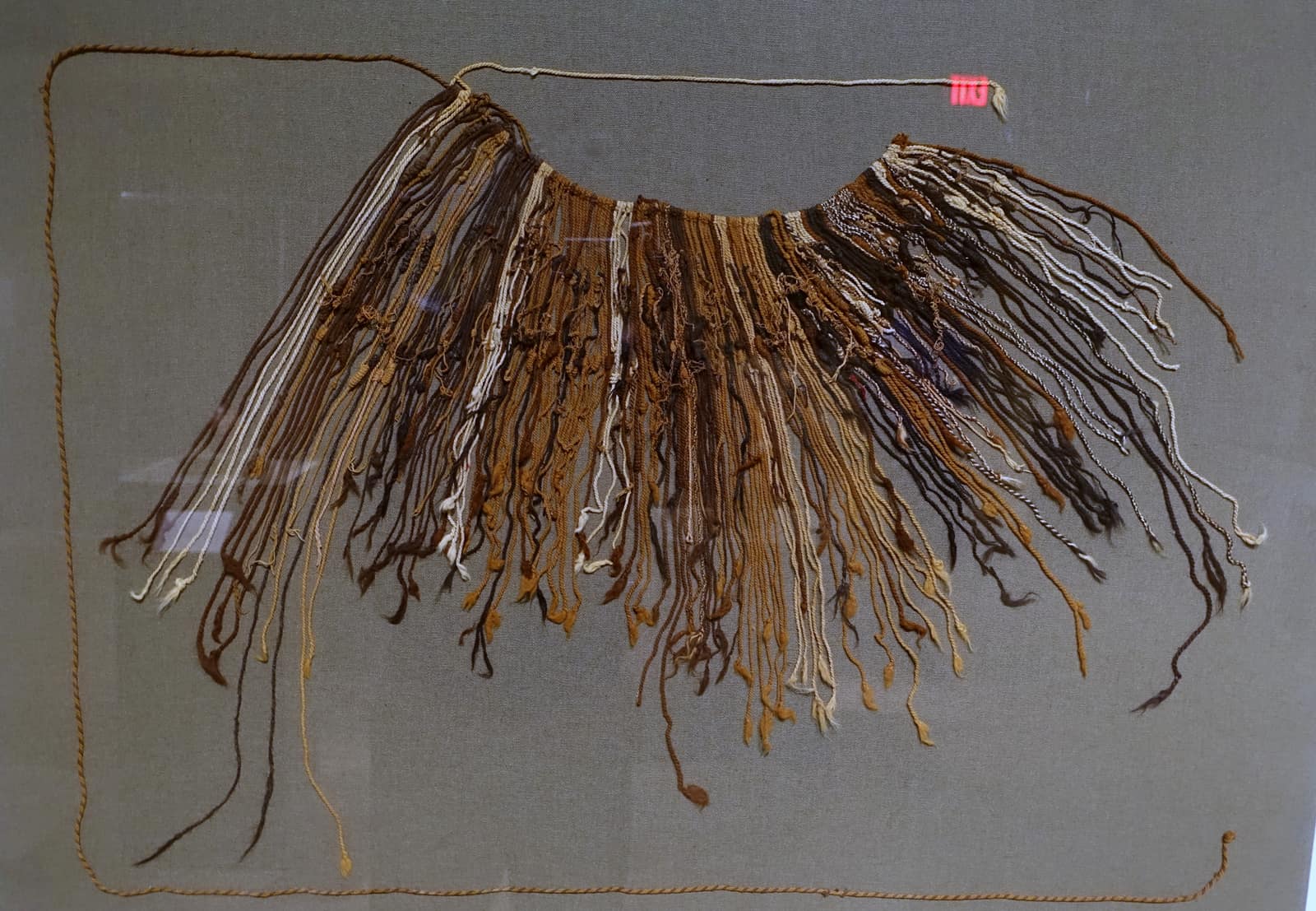
This civilization kept its archives in its hands. A cord of cotton or llama wool was hung with dozens, sometimes hundreds, of other cords, dyed and twisted, and on each cord knots were tied at chosen heights. A knot near the bottom counted ones; higher up, tens, then hundreds. A skilled keeper could run the strands through their fingers and give back a census, a harvest, a debt.
The Inka state governed millions of people across the Andes without letters as others knew them. Messengers ran with khipus along its roads. Spanish officials, arriving in the sixteenth century, watched keepers read them aloud, and sometimes used them in court; later, many were burned as suspect.
Scholars have learned to read the numbers. Whether the cords also held words is still unknown. In one mountain village, two khipus kept by families were called letters, sent during a rebellion. Their colours and fibres suggest a code large enough to write names.
The keepers are gone. The knots are still tied.
Established
- A khipu is a record made of knotted cords, usually of cotton or camelid fibre, hanging from a main cord; Spanish chroniclers describe specialists, khipukamayuq, keeping census, tribute and storehouse accounts on them (Smarthistory).
- In many khipus the knots encode numbers in a base ten system; a computer study of 21 khipus from Puruchuco showed accounts being summed and passed between levels of Inka administration (Urton and Brezine 2005).
- Six khipus from the Santa Valley have been matched with a Spanish census of 1670 listing 132 tributaries, the first time khipus and a written record were shown to correspond (Medrano and Urton 2018).
- Two 18th century khipus kept in the village of Collata, described by their owners as letters, use 95 distinct combinations of colour, fibre and ply, a number in the range of a logosyllabic script (Hyland 2017).
- The khipu shown, of the Inka Late Horizon (about 1476 to 1534), is in the Dallas Museum of Art (museum label).
Interpretation
Whether khipus could record language, names and narratives as well as numbers is the central open question. The Collata evidence suggests they could, at least late and locally; most khipus remain unread, and no general key has been found.
In 10,000 years
In 10,000 years, will someone read our records the way we still fail to read these knots?
Sources (4)
- Urton, G., Brezine, C. J. Khipu accounting in ancient Peru. Science 309 (5737), 2005, p. 1065-1067. · doi.org
- Medrano, M., Urton, G. Toward the decipherment of a set of mid-colonial khipus from the Santa Valley, coastal Peru. Ethnohistory 65 (1), 2018, p. 1-23. · doi.org
- Hyland, S. Writing with twisted cords: the inscriptive capacity of Andean khipus. Current Anthropology 58 (3), 2017, p. 412-419. · doi.org
- Smarthistory. The Inka khipu. · smarthistory.org
_composed_of_two_main_cords_with_subsidiary_and_tertiary_cords,_Inca,_Peru,_Late_Horizon,_1476-1534_AD,_cotton,_plant_fiber,_indigo_dye_-_Dallas_Museum_of_Art_-_DSC04703.jpg)