Shanidar 1, a Neanderthal who lived on with his wounds
- Dated
- Place
- Shanidar Cave, Erbil Governorate, Kurdistan Region, Iraq · Neanderthals of the Zagros Mountains, a humanity closely related to our own
- Coordinates
- 36° 50′ N · 44° 13′ E (approximate)
- Remains
- Fragmentary
This fragment shows human remains.
It is shown here as the institution that holds it presents it. Some communities connected to it ask that it be viewed with care. You may choose to see the image, or read the record without it.
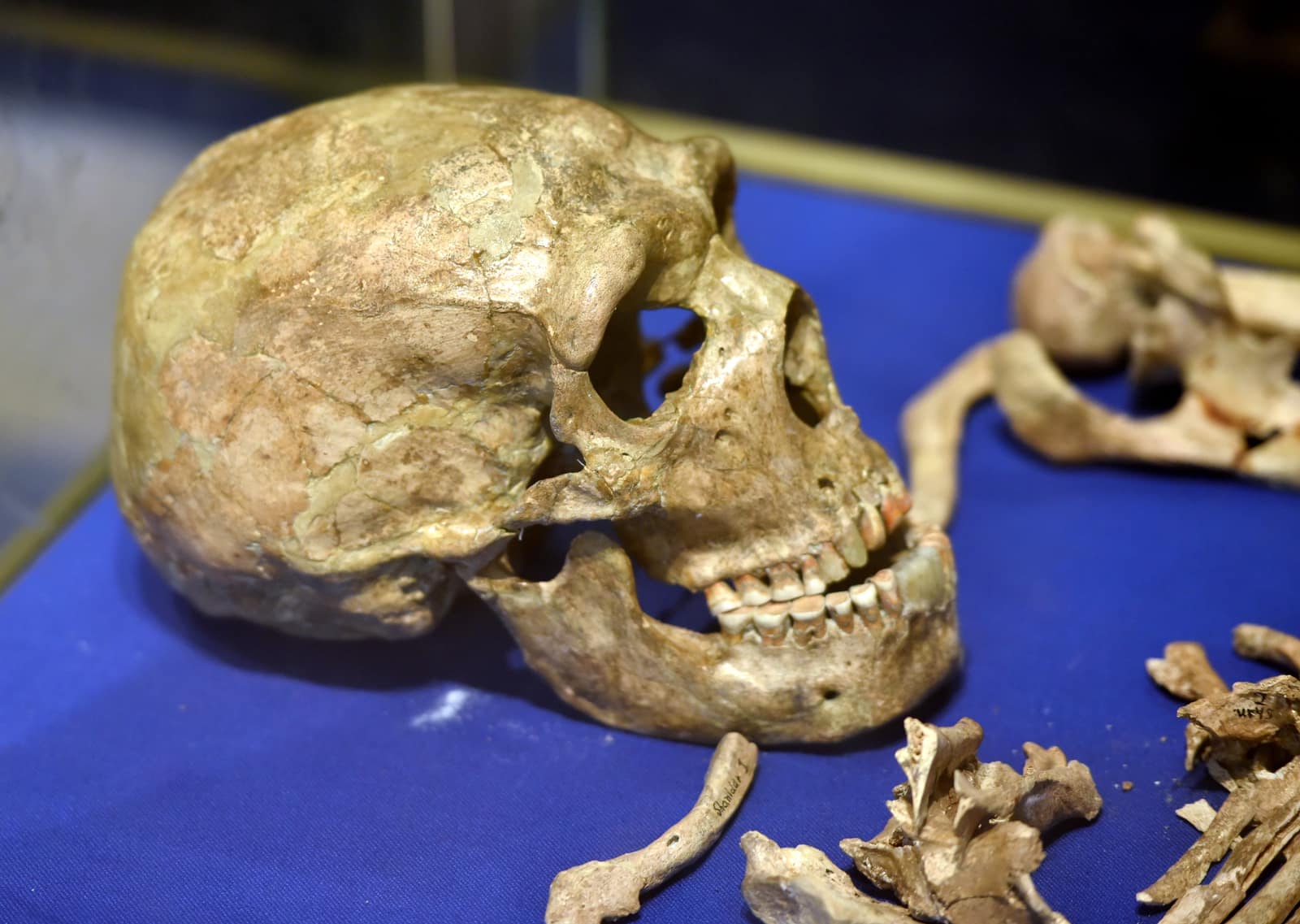
Image veiled by default
Osama Shukir Muhammed Amin FRCP(Glasg), CC BY-SA 4.0, via Wikimedia CommonsCC-BY-SA-4.0Original record
Data saver is on. Images load only when you ask. You can change this in Settings at any time.
From the archivist
He was not one of us, and he was very close to us. The Neanderthals were another humanity, with whom our ancestors met and had children, and whose traces some of us still carry.
This man lived in the mountains of what is now Iraqi Kurdistan. At some point in his life a blow crushed the bone around his left eye. His right arm withered after a break, and he lost the hand. His legs were injured and he walked with a limp. Bone had grown over his ear canals until he could hardly hear.
None of this killed him. The bones had healed, which takes time, and he lived on into what, for his people, was old age: somewhere between thirty-five and fifty.
A man who cannot see well on one side, or hear, or use both hands, or walk far, has to eat all the same. Someone may have brought him food, warned him when a sound he could not hear came close, waited for him on the path. Or he found ways to manage that we cannot picture. The bones do not say which. They say only that, wounded as he was, he went on living for years.
Established
- Shanidar 1, a nearly complete skeleton of an adult male Neanderthal, was found in 1957 in Shanidar Cave, in northern Iraq, by a team led by Ralph Solecki (Smithsonian Institution).
- Neanderthals are the closest extinct relatives of our species; they lived in Europe and southwestern to central Asia from about 400,000 to 40,000 years ago, and interbred with modern humans who had left Africa (Smithsonian Institution).
- He died between about 35 and 50 years of age (Spikins et al. 2018; Trinkaus and Villotte 2017).
- A crushing blow had fractured the bone around his left eye, which was probably blind or nearly so; his right arm was withered after a fracture that had healed, and he had lost the lower arm and hand; injuries to his legs and feet left him with a painful limp (Spikins et al. 2018; Trinkaus and Villotte 2017).
- Bony growths had closed his right ear canal: he was effectively deaf on that side and probably partly deaf on the other (Trinkaus and Villotte 2017).
- The injuries had healed long before he died, which means he lived with them for years (Spikins et al. 2018).
Interpretation
Solecki, and later Erik Trinkaus and others, concluded that a man so impaired could not have survived without daily help from his group; Trinkaus and Villotte write that substantial social support is indicated. Katherine Dettwyler (1991) and others warned that survival does not prove compassion: Neanderthals may have fended for themselves better than we assume, and care, where it existed, could have been calculated rather than kind. Lorna Tilley's bioarchaeology of care and the work of Penny Spikins read the same bones as evidence of care given in response to suffering. The age of the skeleton is also uncertain: estimates range from about 70,000 to 45,000 years, and some sources give younger dates.
Looking ahead
If nothing but our bones were left ten thousand years from now, what would they say about how we treated those who could no longer keep up?
Sources (7)
- Trinkaus, E., Villotte, S. External auditory exostoses and hearing loss in the Shanidar 1 Neandertal. PLOS ONE 12 (10), e0186684, 2017. · doi.org
- Spikins, P., Needham, A., Tilley, L., Hitchens, G. Calculated or caring? Neanderthal healthcare in social context. World Archaeology, 2018 (open access deposit, White Rose Research Online). · eprints.whiterose.ac.uk
- Dettwyler, K. A. Can paleopathology provide evidence for compassion? American Journal of Physical Anthropology 84 (4), 1991, p. 375-384.
- Tilley, L. Theory and Practice in the Bioarchaeology of Care. New York, Springer, 2015.
- Smithsonian Institution, Human Origins Program. Shanidar 1, fossil notice. · humanorigins.si.edu
- Smithsonian Institution, Human Origins Program. Homo neanderthalensis, species notice. · humanorigins.si.edu
- Amin, O. S. M. Shanidar 1 at the Iraq Museum. World History Encyclopedia, image notice. · www.worldhistory.org
Related fragments
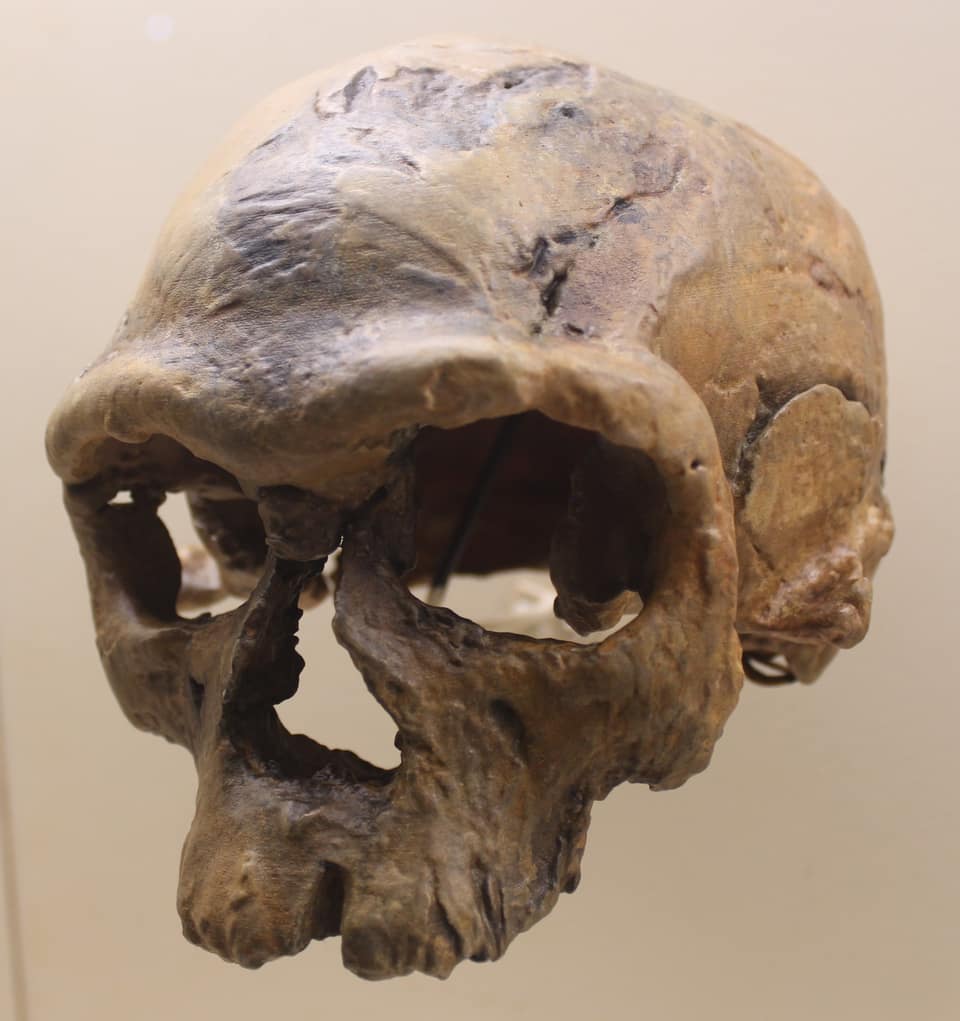
c. 320,000 years ago
The earliest known Homo sapiens, Jebel Irhoud
Jebel Irhoud, about 100 km west of Marrakech, Morocco · Africa

before 500 CE
The Sushruta Samhita
Varanasi, India; manuscript in Kathmandu, Nepal · Asia