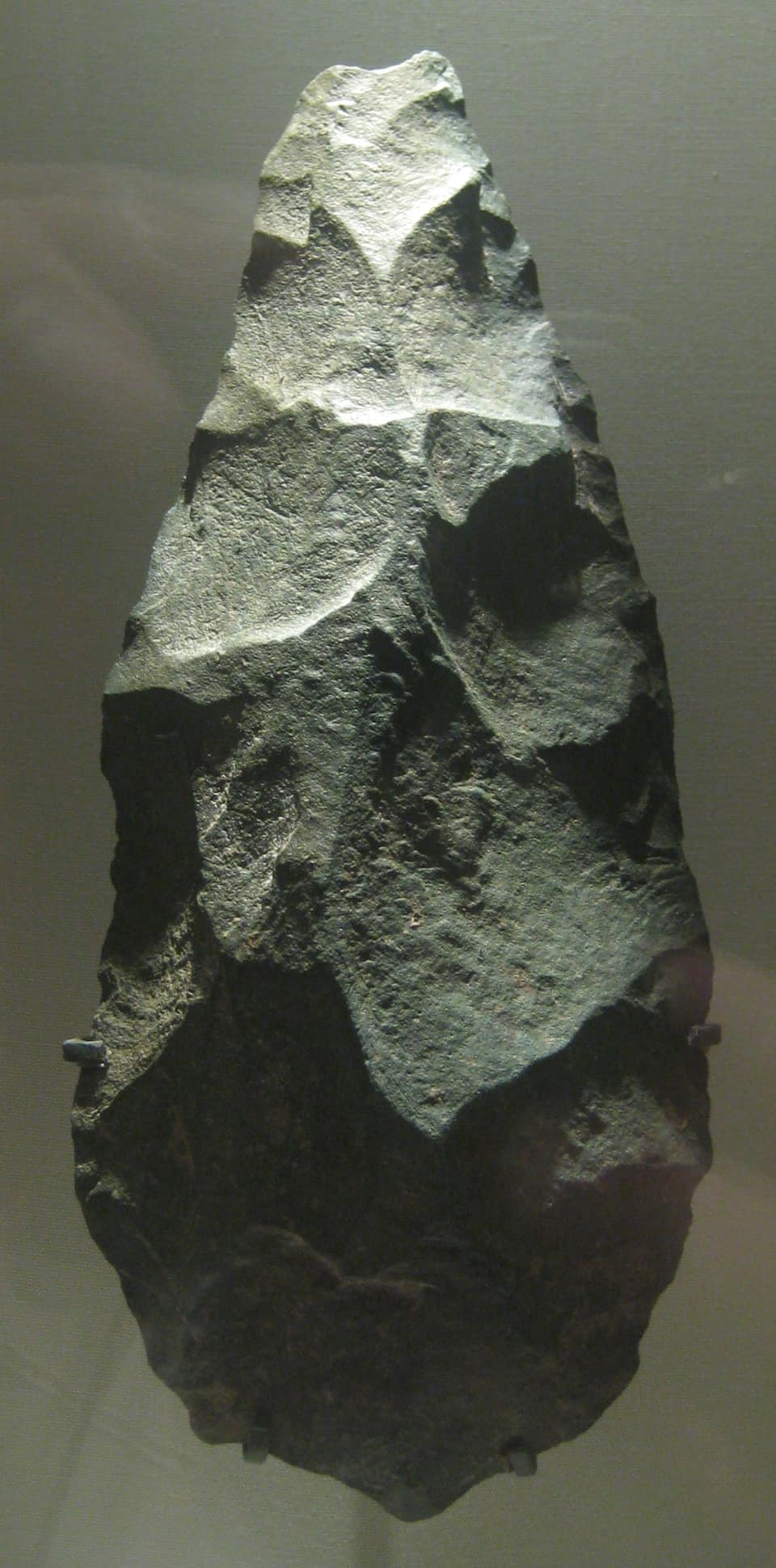
Early fire at Wonderwerk Cave
- Dated
- Place
- Between Danielskuil and Kuruman, Northern Cape, South Africa · Early humans of the Acheulean tradition (probably Homo erectus)
- Coordinates
- 27° 51′ S · 23° 33′ E (approximate)
- Remains
- Fragmentary
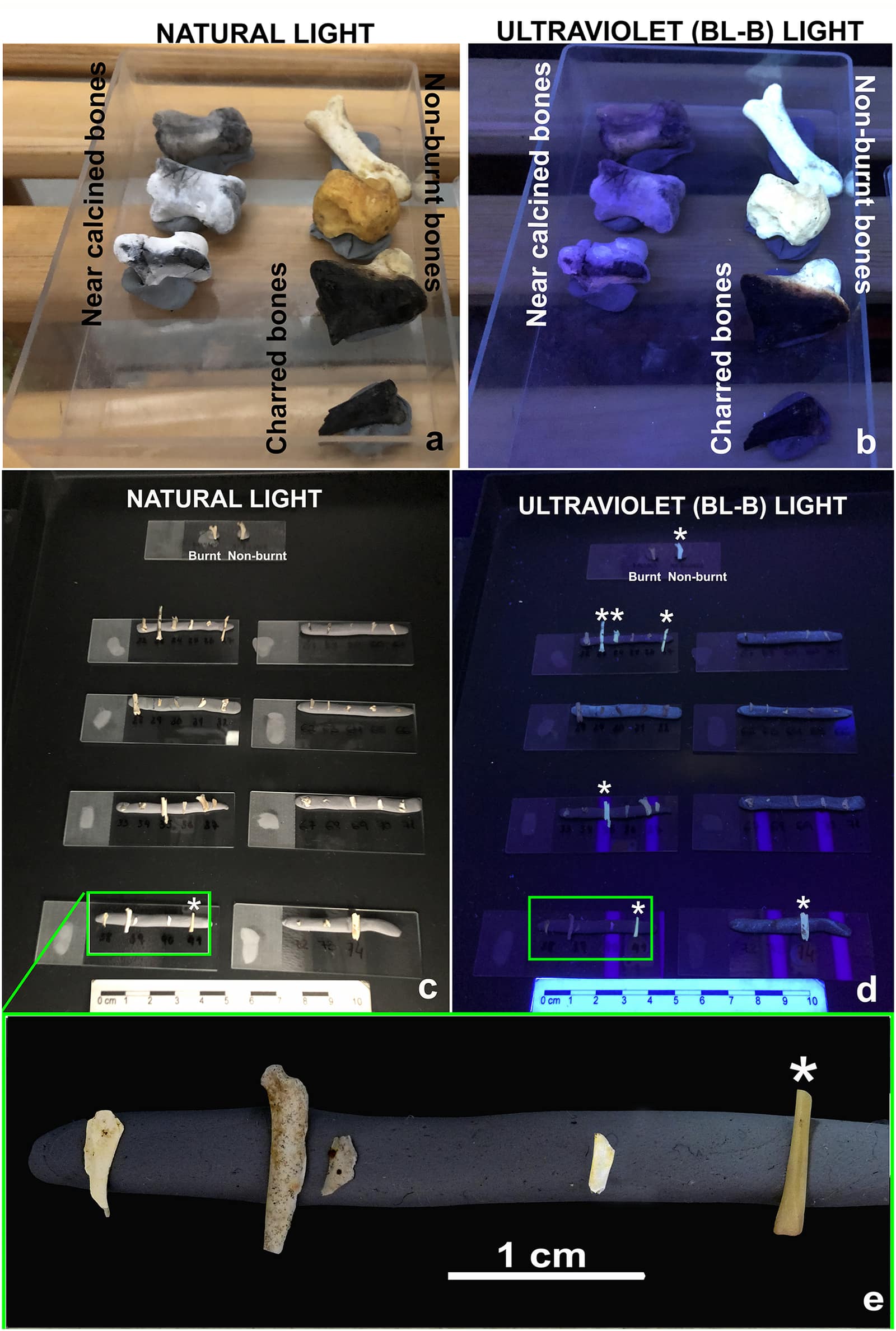
Marin-Monfort MD, Shaw CL, Natalio F, et al. New evidence for Early Pleistocene use of fire at Wonderwerk Cave (South Africa). PLOS ONE 21(6): e0347480 (2026), Fig 6, CC BY 4.0CC-BY-4.0Original record
Data saver is on. Images load only when you ask. You can change this in Settings at any time.
From the archivist
There is no hearth to show you here. What this civilization's oldest ancestors left in Wonderwerk Cave is almost invisible: a film of ash from burned grasses and leaves, and splinters of bone darkened by heat, pressed into the floor of a long cave in the Kuruman Hills.
The cave opens into the dolomite and runs deep into the hill. About thirty metres inside, where no wildfire from the plain could reach, people who made heavy stone handaxes brought fire with them, perhaps a million years ago. Under the microscope the ash still lies in thin, undisturbed layers, where it fell.
They probably could not strike a flame. More likely they carried one from a burning veld and fed it, and learned to keep it from dying. With it came warmth, light against the dark of the cave, food that was easier to eat, and perhaps the habit of sitting together around it.
Later studies found burned bone in an even older layer. The first fire this civilization kept is still being pushed further back in time.
Established
- Micromorphological and infrared analyses of intact sediments in Wonderwerk Cave found burned bone and ashed plant remains in an early Acheulean layer dated to about 1.0 million years ago, described by the authors as the earliest secure evidence of burning in an archaeological context (Berna et al. 2012).
- The burned material lies in Stratum 10, about 30 metres from the present entrance, too deep in the cave for a grass or bush fire outside to have reached it (Berna et al. 2012; Marin-Monfort et al. 2026).
- A 2026 study of 161 small mammal bones found repeated traces of burning in the older Stratum 11 as well, dated by magnetostratigraphy and cosmogenic burial to between 1.79 and 1.07 million years ago (Marin-Monfort et al. 2026).
- The cave runs about 140 metres into the Kuruman Hills and was declared a National Heritage Site of South Africa on 12 March 2010 (SAHRA).
Interpretation
Burning inside a cave does not by itself prove that its makers could light a fire. Most researchers read the Wonderwerk traces as fire carried in and kept alive by early humans, perhaps taken from natural blazes, rather than fire made at will; who tended it, most likely Homo erectus, and how often, are still open questions.
In 10,000 years
In 10,000 years, what will still show that we once carried a flame into the dark and kept it alive?
Sources (3)
- Berna, F., Goldberg, P., Horwitz, L. K., Brink, J., Holt, S., Bamford, M., Chazan, M. Microstratigraphic evidence of in situ fire in the Acheulean strata of Wonderwerk Cave, Northern Cape province, South Africa. Proceedings of the National Academy of Sciences 109 (20), 2012, p. E1215-E1220. · doi.org
- Marin-Monfort, M. D., Shaw, C. L., Natalio, F., Grossman, L., Andrews, P., Campos, J., García-Morato, S., Pereira, J. M., Pons, A., Chazan, M., Kolska Horwitz, L., Fernández-Jalvo, Y. New evidence for Early Pleistocene use of fire at Wonderwerk Cave (South Africa). PLOS ONE 21 (6), 2026, e0347480. · doi.org
- South African Heritage Resources Agency. Wonderwerk Cave, National Heritage Site (declared 12 March 2010). · www.sahra.org.za