The hearths of Gesher Benot Ya'aqov
- Dated
- Place
- Banks of the Jordan River near the Bnot Ya'akov Bridge, northern Israel · Acheulean hominins of the Levantine corridor (probably Homo erectus in the broad sense)
- Coordinates
- 33° 01′ N · 35° 38′ E (approximate)
- Remains
- Fragmentary
Benno Rothenberg / Meitar Collection / National Library of Israel / The Pritzker Family National Photography Collection, CC BY 4.0, via Wikimedia CommonsCC-BY-4.0Original record
Data saver is on. Images load only when you ask. You can change this in Settings at any time.
From the archivist
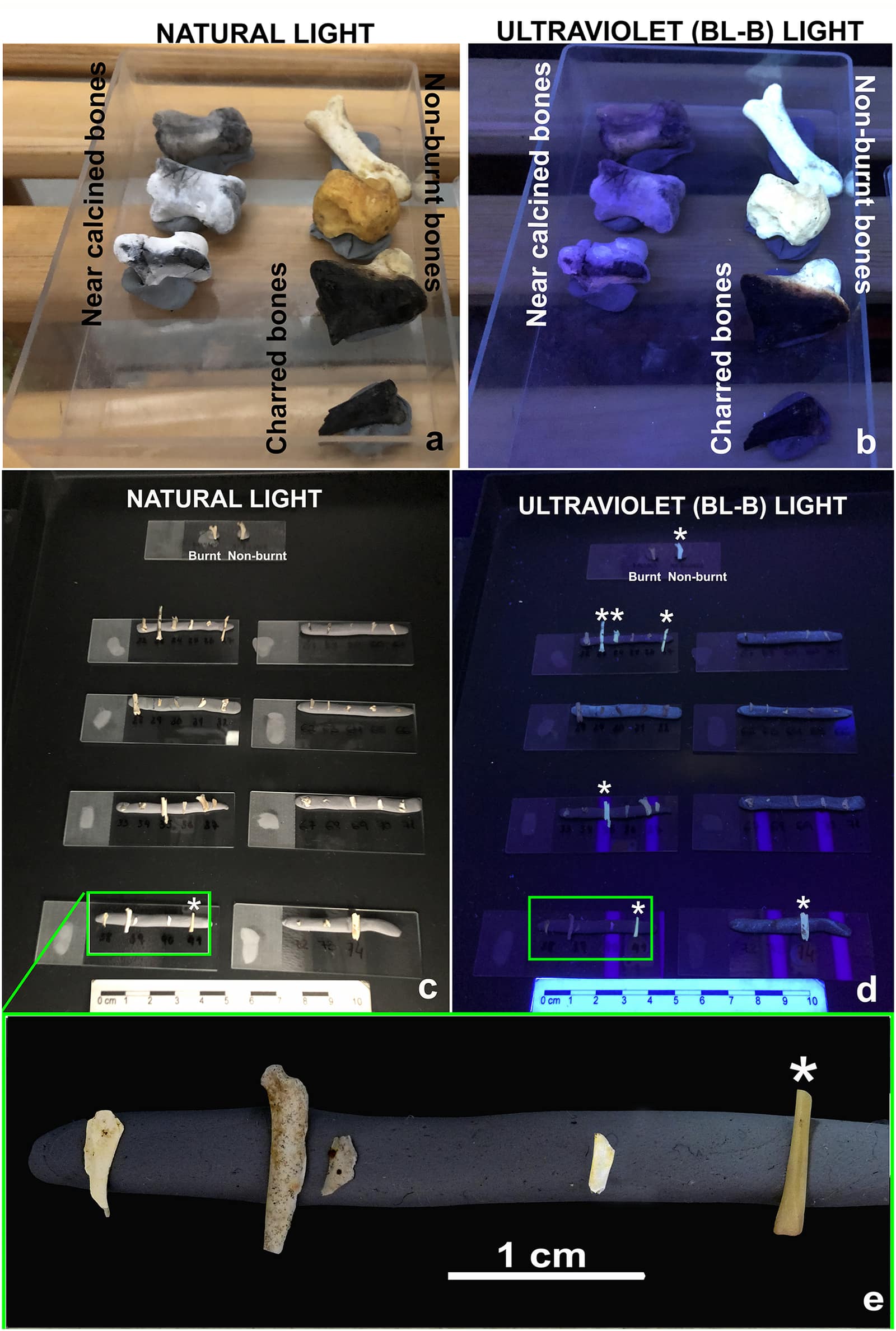
There are no ashes here. The hearths of Gesher Benot Ya'aqov are known only from what the fire touched: tiny chips of flint, cracked and reddened by heat, scattered on the shore of a lake that has since vanished; a few charred seeds; fragments of burned wood from olive, grape and wild barley.
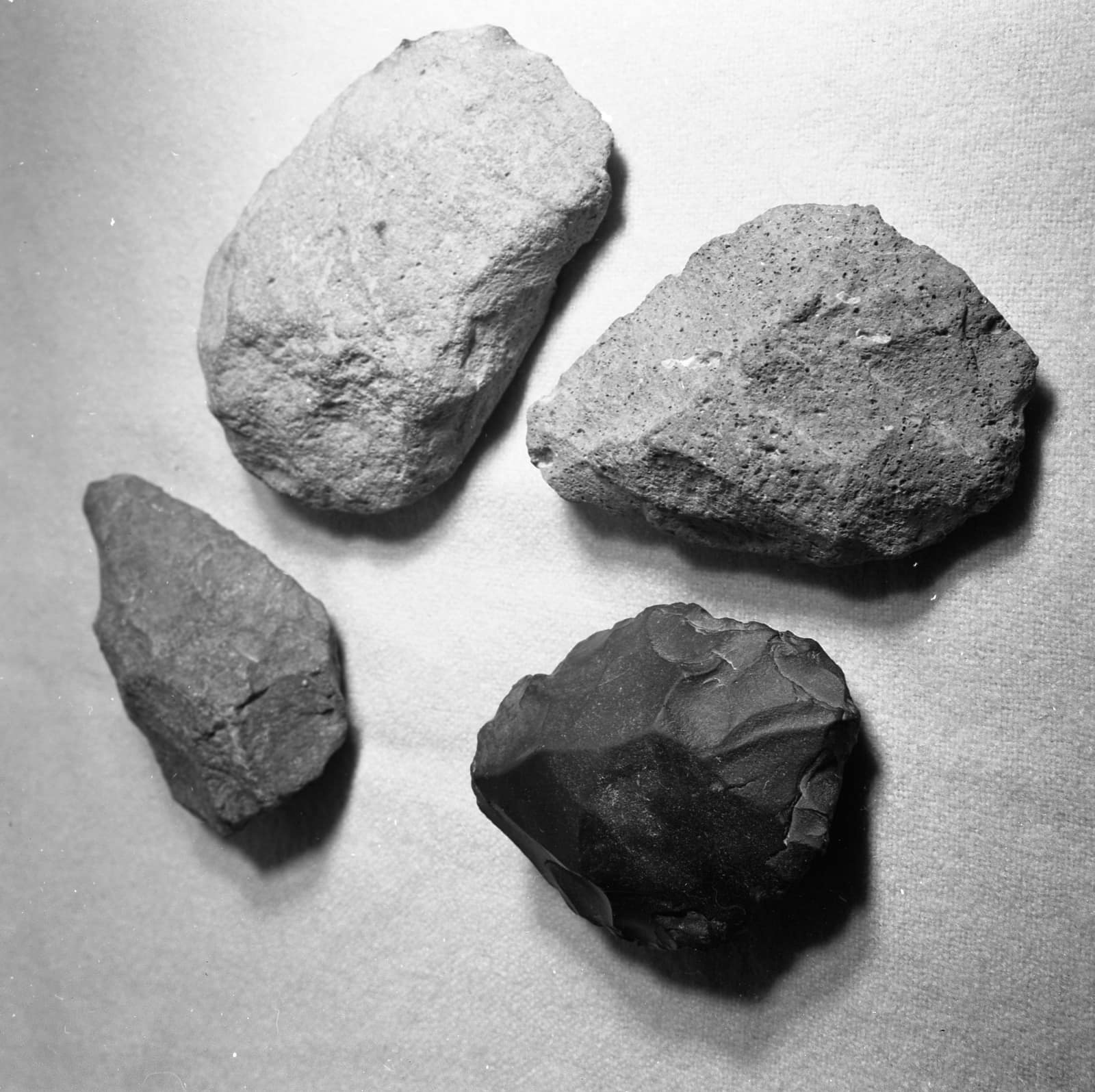
About seven hundred and eighty thousand years ago, groups of our distant relatives camped at the edge of this water in the valley of the Jordan. They cut basalt and flint into large handaxes and cleavers. When archaeologists plotted every burned chip in the layers they left, the chips did not lie evenly across the ground. They gathered in patches, again and again, level after level, in the same way a fire keeps people close around it.
In those patches, they seem to have cooked fish from the lake.
Each fire was small and each went out. What remained, for a very long time, was the habit of making it again in the same place.
Established
- Burned seeds, wood and flint found at the Acheulean site of Gesher Benot Ya'aqov, on the Jordan River in northern Israel, were presented in 2004 as evidence that hominins controlled fire nearly 790,000 years ago (Goren-Inbar et al. 2004).
- The site's layers lie close to the Matuyama-Brunhes reversal of the Earth's magnetic field, about 780,000 years ago (Goren-Inbar et al. 2004; Zohar et al. 2022).
- Burned wood from six plant taxa was identified, among them wild olive, wild barley and wild grape (Goren-Inbar et al. 2004).
- Spatial analysis of burned flint microartifacts across eight archaeological horizons shows dense clusters, interpreted as hearth locations, repeated through the sequence (Alperson-Afil 2008).
- Tooth enamel of fish from the site shows changes consistent with cooking at controlled, relatively low temperatures (Zohar et al. 2022).
Interpretation
No hearth structure or ash layer survives: the hearths are inferred from where burned flint clusters, which some researchers have called phantom hearths. Whether the people of Gesher Benot Ya'aqov could make fire at will, or only kept and fed fire taken from natural blazes, is still debated, as is the identity of the hominins, since no human bones of this age have been found at the site.
In 10,000 years
In 10,000 years, will anyone read a hearth from the way a few flakes of flint were scattered around it?
Sources (4)
- Goren-Inbar, N., Alperson, N., Kislev, M. E., Simchoni, O., Melamed, Y., Ben-Nun, A., Werker, E. Evidence of hominin control of fire at Gesher Benot Ya`aqov, Israel. Science 304 (5671), 2004, p. 725-727. · doi.org
- Alperson-Afil, N. Continual fire-making by hominins at Gesher Benot Ya'aqov, Israel. Quaternary Science Reviews 27 (17-18), 2008, p. 1733-1739. · doi.org
- Zohar, I., Alperson-Afil, N., Goren-Inbar, N., et al. Evidence for the cooking of fish 780,000 years ago at Gesher Benot Ya'aqov, Israel. Nature Ecology & Evolution 6, 2022, p. 2016-2028. · doi.org
- Alperson-Afil, N., Richter, D., Goren-Inbar, N. Evaluating the intensity of fire at the Acheulian site of Gesher Benot Ya'aqov: spatial and thermoluminescence analyses. PLOS ONE 12 (11), 2017, e0188091. · doi.org