AlphaGo and Lee Sedol
- Dated
- Place
- Seoul, Republic of Korea · Lee Sedol, Korean professional Go player; AlphaGo, a program of Google DeepMind (London)
- Coordinates
- 37° 34′ N · 126° 59′ E (approximate)
- Remains
- Digital
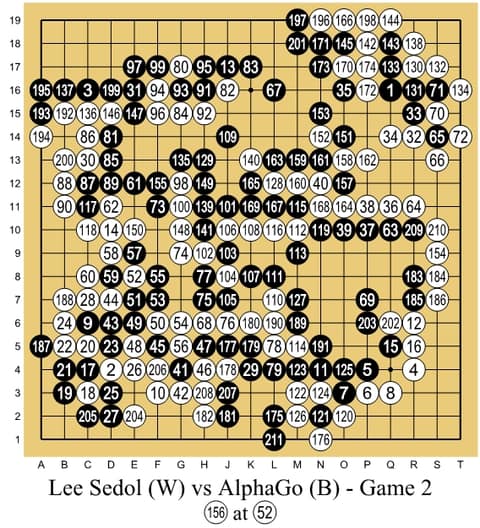
Wesalius, CC BY-SA 4.0, via Wikimedia CommonsCC-BY-SA-4.0Original record
Data saver is on. Images load only when you ask. You can change this in Settings at any time.
From the archivist
Go is played with black and white stones on a grid of nineteen lines by nineteen. The rules fit on a page. The number of possible positions is greater than the number of atoms in the observable universe. This civilization had played it for more than two thousand years.
In March 2016, in a hotel in Seoul, one of the strongest players of his generation sat across from a machine. A person from the company that built it placed its stones on the board. Millions watched.
In the second game the machine played its thirty-seventh stone on the right side, on the fifth line from the edge, where no teacher would have put it. Commentators thought it was a mistake. Later in the game it became clear that it was not.
The machine won the first three games. In the fourth, Lee Sedol played his seventy-eighth stone into a narrow gap in the centre. The machine did not find the answer, and resigned.
He lost the fifth. Three years later he stopped playing professionally.
Established
- AlphaGo, developed by DeepMind, combined deep neural networks trained on human games and on games against itself with Monte Carlo tree search; in October 2015 it became the first program to defeat a human professional Go player on a full-size board without handicap (Silver et al. 2016).
- From 9 to 15 March 2016, at the Four Seasons Hotel in Seoul, AlphaGo played a five-game match against Lee Sedol and won by 4 games to 1 (Google DeepMind).
- In the second game, AlphaGo's 37th move, a shoulder hit on the fifth line, surprised professional commentators; AlphaGo's own estimate put the chance of a human playing it at about one in ten thousand (Google DeepMind).
- In the fourth game, Lee Sedol's 78th move, a wedge in the centre, led to AlphaGo's only defeat in the match (Google DeepMind).
- The Korea Baduk Association awarded AlphaGo an honorary 9 dan professional rank (Google DeepMind).
- In November 2019 Lee Sedol retired from professional play, saying that AI was an entity that cannot be defeated (Yonhap 2019).
Interpretation
What the match showed is still discussed. For some, move 37 was a sign that a machine could be creative; others see the result of search and statistics on a scale no human can match, with no understanding behind it. Lee Sedol's single win has been read both as proof that the programs had weaknesses and as the last victory of a human over the strongest machine in a match of this kind.
In 10,000 years
In 10,000 years, will anyone remember that a human once won a game against the machine, and why it mattered?
Sources (4)
- Silver, D., Huang, A., Maddison, C. J., Guez, A., et al. Mastering the game of Go with deep neural networks and tree search. Nature 529, 2016, p. 484-489. · doi.org
- Google DeepMind. AlphaGo. · deepmind.google
- NPR. Google A.I. computer takes second game from human champion, 10 March 2016. · www.npr.org
- Yonhap News Agency. Interview with Lee Sedol on his retirement, November 2019.
_vs_AlphaGo_(B)_-_Game_2.jpg)