Mtoto, the child of Panga ya Saidi
- Dated
- Place
- Panga ya Saidi, Kilifi County, Kenya · Middle Stone Age people of the coastal hills of Kenya
- Coordinates
- 3° 41′ S · 39° 44′ E (approximate)
- Remains
- Fragmentary
This fragment shows human remains.
It is shown here as the institution that holds it presents it. Some communities connected to it ask that it be viewed with care. You may choose to see the image, or read the record without it.
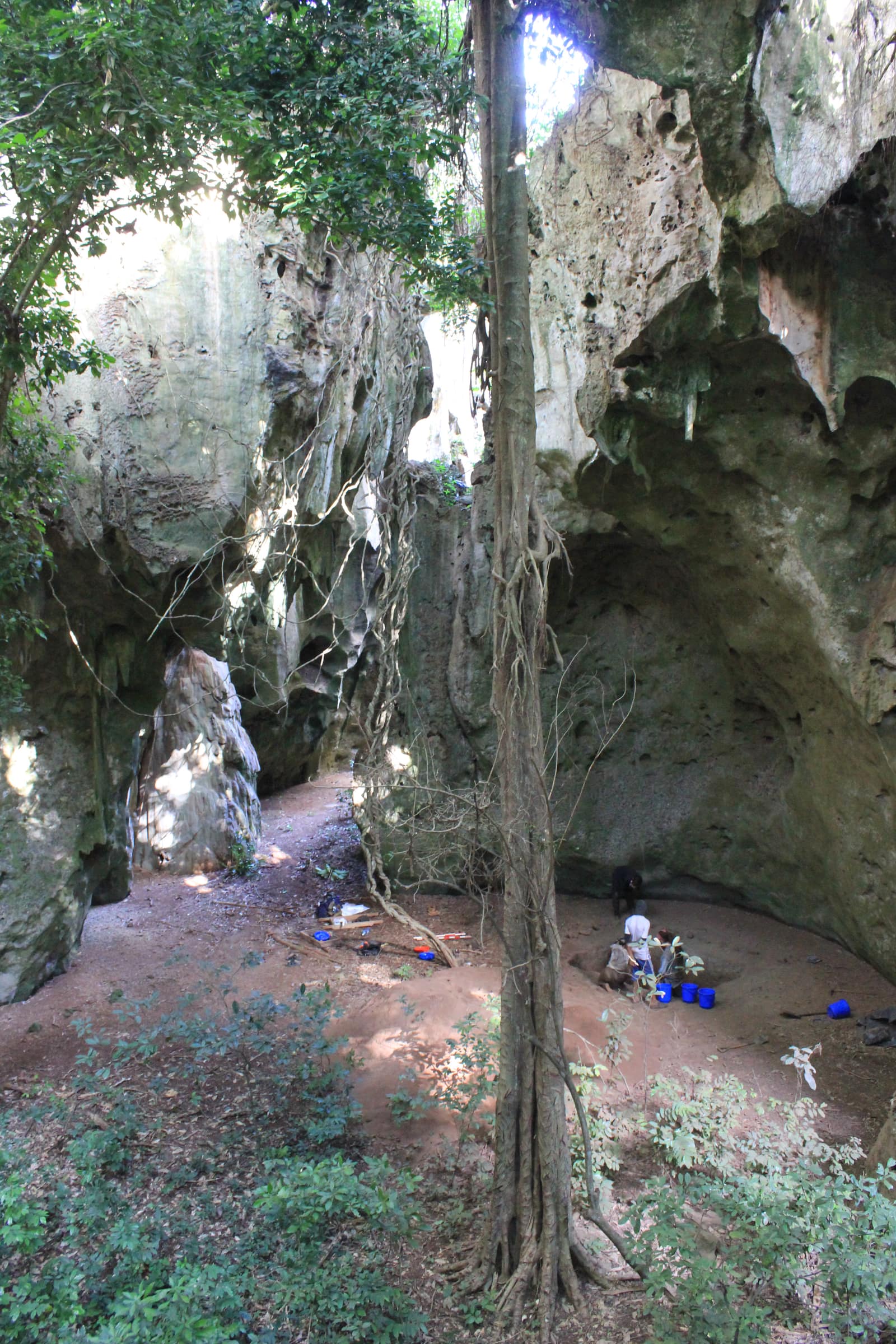
Image veiled by default
Ceri Shipton, CC BY-SA 4.0, via Wikimedia CommonsCC-BY-SA-4.0Original record
Data saver is on. Images load only when you ask. You can change this in Settings at any time.
From the archivist
Under the overhang of a cave in the green hills behind the Kenyan coast, someone dug a small pit in the floor. It was shallow, just long enough for a child of two or three, who was laid on the right side with the knees drawn up to the chest, the way children sleep.
The body was probably wrapped close, perhaps in a hide; nothing of the wrapping is left, only the way the small bones lie tight together. The head had been set on something soft, and when that rotted, the head sank a little. Then earth was pushed back over the child, and nothing moved again. No bead, no tool was placed alongside. What was given was the care itself.
This civilization had no writing and no metal. It had this: a grief that stopped the work of the day long enough to dig, to fold small limbs, to find a pillow.
The archaeologists who lifted the block of earth some 78,000 years later called the child Mtoto, the Swahili word for child. The people who laid the child down surely had another name, and we will never hear it.
Established
- The partial skeleton of a child aged about two and a half to three years was found in the Middle Stone Age layers of Panga ya Saidi, a cave in the tropical hills of the Kenyan coast, and dated by luminescence to 78,300 years ago, give or take 4,100 years (Martinón-Torres et al. 2021).
- Analyses of the sediment show that the pit was dug on purpose; the body lay flexed on its right side, knees drawn toward the chest, and decomposed where it had been laid, in a grave filled with earth (Martinón-Torres et al. 2021).
- Bones were first seen in 2013 and the pit fully exposed in 2017; two teeth found during laboratory excavation at CENIEH in Burgos showed that the remains were human (Max-Planck-Gesellschaft 2021).
- No grave goods or ornaments were placed with the child (Crowther and Faulkner 2021).
- The skeleton is assigned to Homo sapiens, with some archaic features in the teeth (Martinón-Torres et al. 2021).
- The researchers named the child Mtoto, the Swahili word for child. The cave is sacred to the Mijikenda people who live in the area today (Crowther and Faulkner 2021).
Interpretation
The pillow and the shroud are inferences, not finds: the researchers read the collapse of the head as the sign of a perishable support that rotted away, and the tight position of the bones as the sign of a body wrapped closely, perhaps in an animal skin. Whether the burial involved beliefs about an afterlife cannot be known from the bones alone. It is the oldest known burial in Africa; older finds may yet change that.
Looking ahead
Somewhere tonight, a parent is easing something soft under a sleeping child's head. Ten thousand years from now, will anyone find the trace of that gesture and know it for what it was?
Sources (4)
- Martinón-Torres, M., d'Errico, F., Santos, E., Álvaro Gallo, A., Amano, N., Archer, W., et al., Boivin, N., Petraglia, M. D. Earliest known human burial in Africa. Nature 593, 2021, p. 95-100. · doi.org
- Max-Planck-Gesellschaft. Oldest human burial in Africa. Press release, 5 May 2021. · www.mpg.de
- Crowther, A., Faulkner, P. A cave site in Kenya's forests reveals the oldest human burial in Africa. The Conversation, May 2021. · theconversation.com
- ScienceDaily. The oldest human burial in Africa (press materials from CENIEH), 5 May 2021. · www.sciencedaily.com
Related fragments
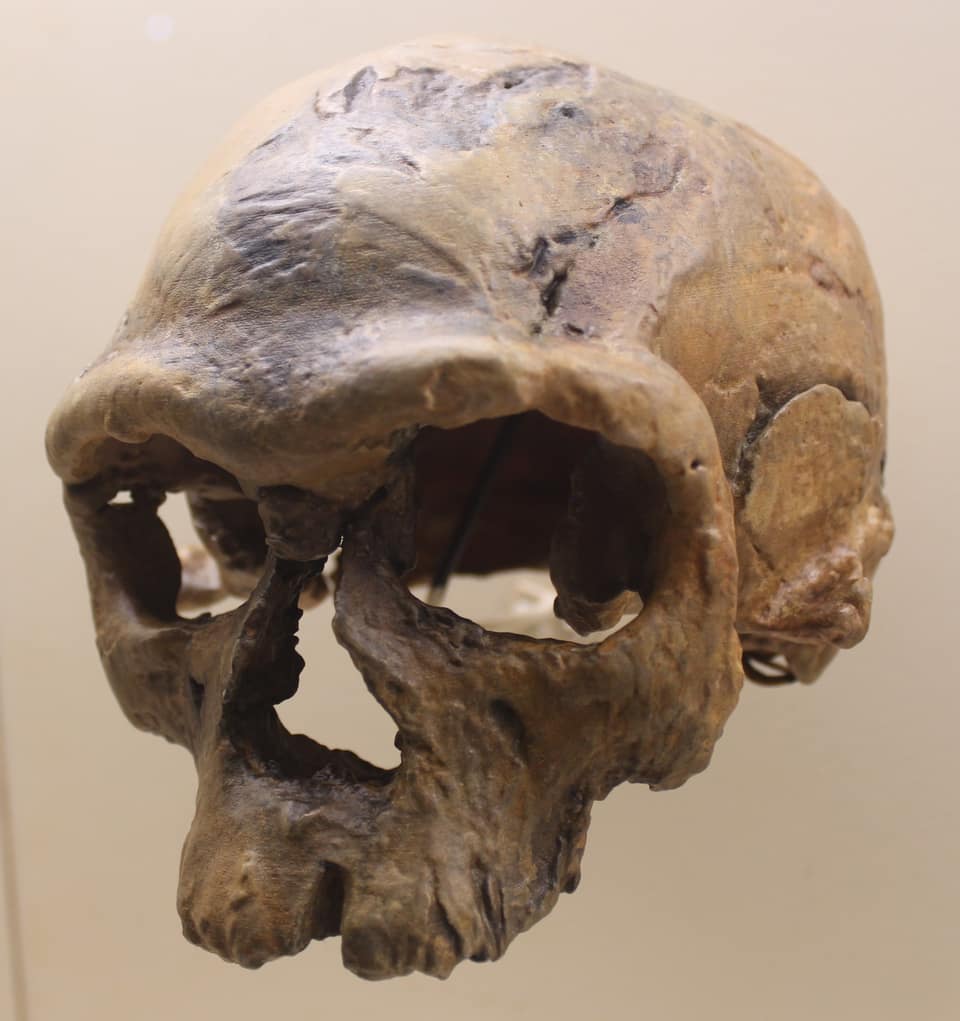
c. 320,000 years ago
The earliest known Homo sapiens, Jebel Irhoud
Jebel Irhoud, about 100 km west of Marrakech, Morocco · Africa
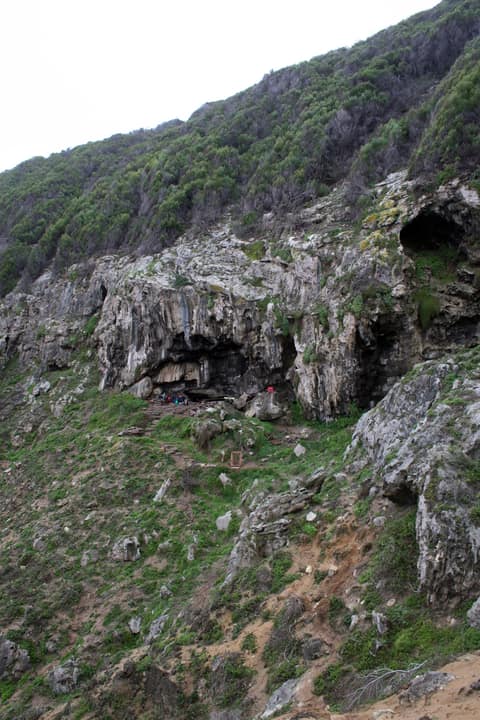
c. 77,000 years ago
The engraved ochre of Blombos Cave
Near Still Bay, Western Cape, South Africa · Africa