The engraved ochre of Blombos Cave
- Dated
- Place
- Near Still Bay, Western Cape, South Africa · Middle Stone Age Homo sapiens of the southern Cape (Still Bay phase)
- Coordinates
- 34° 25′ S · 21° 13′ E (approximate)
- Remains
- Intact
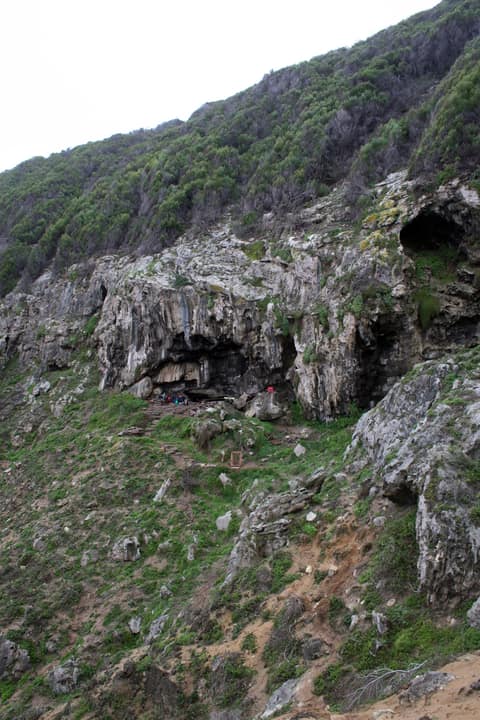

Vincent Mourre / Inrap, CC BY-SA 3.0, via Wikimedia CommonsCC-BY-SA-3.0Original record
Data saver is on. Images load only when you ask. You can change this in Settings at any time.
From the archivist
The block is small enough to close in a fist: a piece of red ochre, soft stone that stains the fingers. Someone in a cave above the Indian Ocean ground one face of it smooth. Then, with a sharp stone point, they cut lines across it, one way and then the other, and framed them with a line above and a line below.
This was about seventy-seven thousand years ago. The people of Blombos Cave hunted, gathered shellfish on the shore, made fine stone points and bone tools, and threaded small shells into beads. They used ochre often, perhaps as paint for bodies or objects. On a few pieces they did something more: they made a pattern that served no purpose we can name.
More engraved pieces were found in the layers below, some older still, and on a stone flake a crossing pattern drawn in ochre like a crayon stroke.
We do not know what the lines meant. We know only that they were made with care, and that the hand returned to the same design.
Established
- Two pieces of red ochre engraved with abstract cross-hatched patterns, catalogued SAM-AA 8937 and SAM-AA 8938, were recovered from Middle Stone Age layers at Blombos Cave (Henshilwood et al. 2002).
- Thermoluminescence dating of burnt stone tools gave a mean age of 77,000 years for the layers holding the engravings, and an overlying dune was dated to about 70,000 years (Henshilwood et al. 2002).
- The larger piece, SAM-AA 8938, is a slab of ochreous shale about 7.6 cm long whose face was ground flat before a cross-hatched motif framed by horizontal lines was cut into it (Henshilwood et al. 2002).
- Thirteen further incised ochre pieces were later reported from layers dated to about 100,000 to 75,000 years ago (Henshilwood et al. 2009).
- In 2018 the same team described a cross-hatched pattern drawn with an ochre crayon on a silcrete flake from the 73,000 year old levels (Henshilwood et al. 2018).
Interpretation
Whether the lines carried a meaning, a mark of a group or an idea, or were a pleasing gesture repeated by hand, cannot be known. Many researchers see them as early evidence of symbolic thought in Africa, tens of thousands of years before the cave art of Europe; others warn that pattern alone does not prove a shared code.
In 10,000 years
In 10,000 years, will anyone still recognise a few crossed lines as the sign that someone once thought in symbols?
Sources (4)
- Henshilwood, C. S., d'Errico, F., Yates, R., Jacobs, Z., Tribolo, C., Duller, G. A. T., Mercier, N., Sealy, J. C., Valladas, H., Watts, I., Wintle, A. G. Emergence of modern human behavior: Middle Stone Age engravings from South Africa. Science 295 (5558), 2002, p. 1278-1280. · doi.org
- Henshilwood, C. S., d'Errico, F., Watts, I. Engraved ochres from the Middle Stone Age levels at Blombos Cave, South Africa. Journal of Human Evolution 57 (1), 2009, p. 27-47. · doi.org
- Henshilwood, C. S., d'Errico, F., van Niekerk, K. L., Dayet, L., Queffelec, A., Pollarolo, L. An abstract drawing from the 73,000-year-old levels at Blombos Cave, South Africa. Nature 562, 2018, p. 115-118. · doi.org
- Iziko Museums of South Africa. Archaeology collection (Blombos ochre and shell beads on display at the Iziko South African Museum). · www.iziko.org.za
Related fragments
c. 20,000 years ago
The Ishango bone
Ishango, Virunga National Park, North Kivu, Democratic Republic of the Congo · Africa
c. 1 million years ago
Early fire at Wonderwerk Cave
Between Danielskuil and Kuruman, Northern Cape, South Africa · Africa