The Library of Alexandria
- Dated
- Place
- Alexandria, Egypt · Ptolemaic Egypt (Greek-speaking court of the Ptolemies at Alexandria)
- Coordinates
- 31° 12′ N · 29° 55′ E (approximate)
- Remains
- Lost
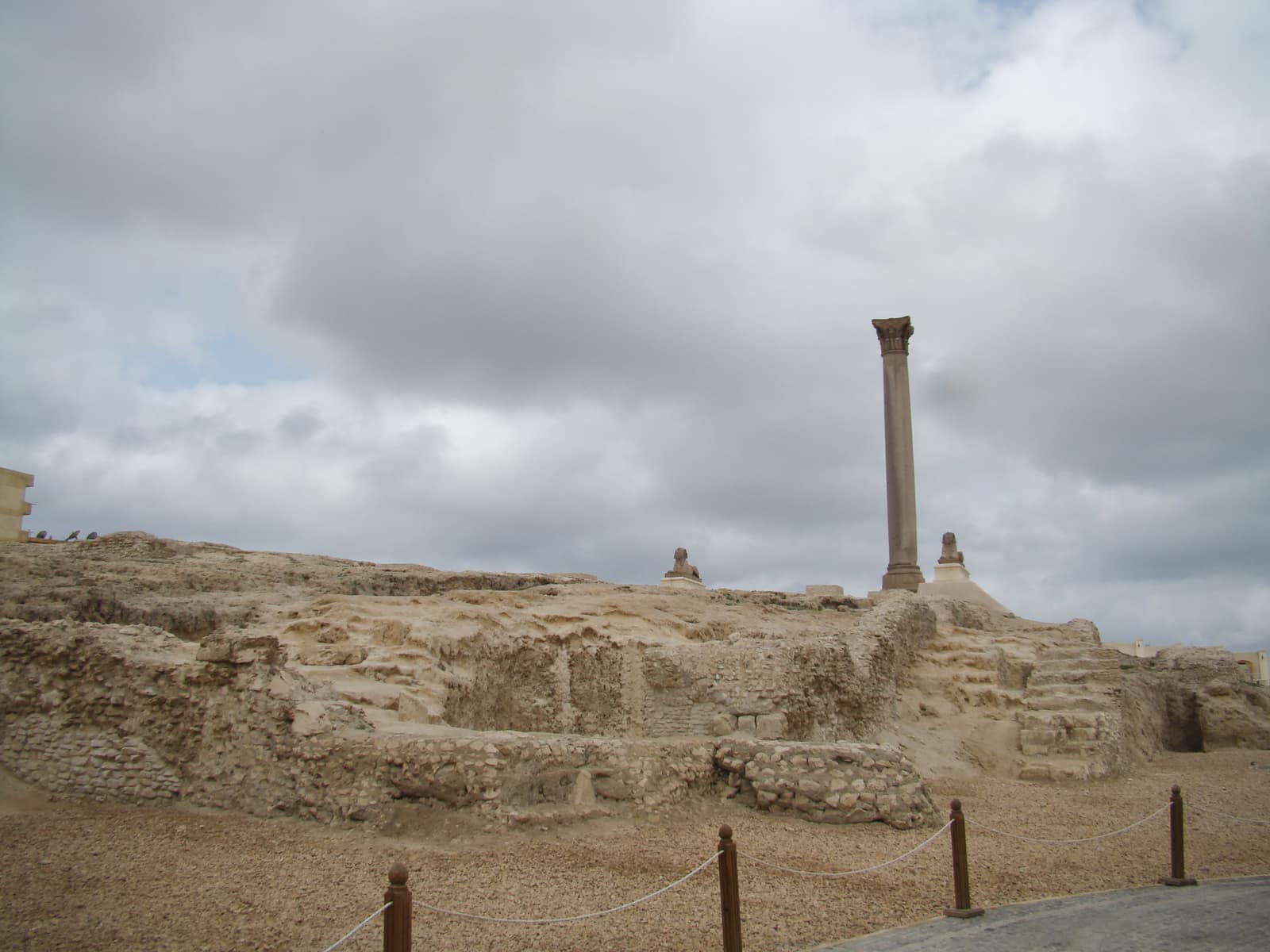
Institute for the Study of the Ancient World, CC BY 2.0, via Wikimedia Commons (Flickr isawnyu/7591102274)CC-BY-2.0Original record
Data saver is on. Images load only when you ask. You can change this in Settings at any time.
From the archivist
This civilization once tried to gather every book in the world in one place. In Alexandria, the Greek-speaking kings of Egypt founded a library beside a house for scholars. The story goes that they had ships searched in the harbour and the books on board copied, keeping the originals.
There, scholars edited Homer, and one of them, Callimachus, compiled tables of authors and their works. Eratosthenes, who reckoned the size of the Earth, was a keeper of the books.
How many rolls it held, no one can say. Ancient writers gave numbers that grow with each telling, from forty thousand to seven hundred thousand. How it ended is just as uncertain. Fire, war, the fall of a temple, a caliph's order written down six hundred years after the fact: each generation has chosen its culprit.
No shelf has been found, no wall, no roll. What we have lost is not only the books, but the certainty that they existed as we imagine them.
Established
- The Library was founded at Alexandria under the first Ptolemies, Ptolemy I or Ptolemy II, in the early 3rd century BCE, as part of the Mouseion, a royal institution for scholars (Bagnall 2002).
- Ancient writers gave its holdings as anything from 40,000 to 700,000 rolls; these figures are unreliable, and Bagnall argues that the real collection was much smaller than the legend (Bagnall 2002).
- A secondary or daughter collection was kept in the Serapeum, the temple of Serapis, which was destroyed in 391 CE (Bagnall 2002).
- The story that the Library was burned on the orders of the caliph Umar after the Arab conquest of 642 CE appears only in sources written some six centuries later and is not accepted by historians as evidence (Bagnall 2002).
- No archaeological remains of the main Library building have been identified (Bagnall 2002).
Interpretation
There was no single night when the Library burned. Fire in the harbour during Julius Caesar's war in 48 BCE, the fighting of the 270s CE in the royal quarter, the destruction of the Serapeum in 391 and simple neglect have each been blamed, and most historians now picture a slow decline rather than one catastrophe; its size and its end are both parts of a legend built on very little evidence.
In 10,000 years
In 10,000 years, will anyone mourn our lost archives, or only the legend we built around them?
Sources (3)
- Bagnall, R. S. Alexandria: Library of Dreams. Proceedings of the American Philosophical Society 146 (4), 2002, p. 348-362. · archive.nyu.edu
- MacLeod, R. (ed.). The Library of Alexandria: Centre of Learning in the Ancient World. London, I. B. Tauris, 2000.
- Bibliotheca Alexandrina. The Ancient Library of Alexandria. · www.bibalex.org
.jpg)