A seal from the Indus, and the readers we lost
- Dated
- Place
- Mohenjo-daro, Larkana District, Sindh, Pakistan · The Indus (Harappan) civilisation, Mature Harappan period
- Coordinates
- 27° 20′ N · 68° 08′ E (approximate)
- Remains
- Intact
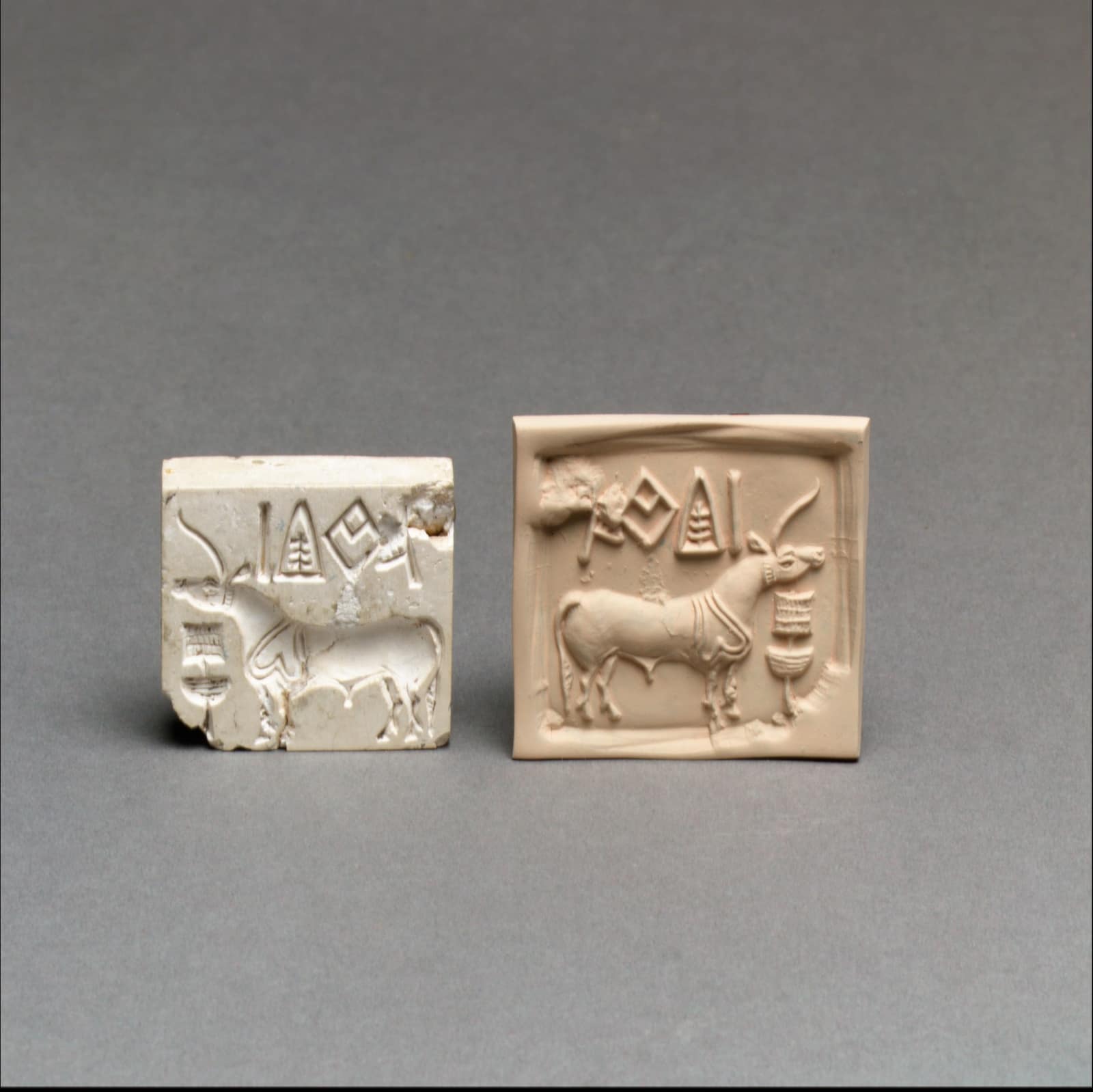
The Metropolitan Museum of Art, Dodge Fund, 1949, 49.40.1, CC0, via Wikimedia CommonsCC0-1.0Original record
Data saver is on. Images load only when you ask. You can change this in Settings at any time.
From the archivist
Someone pressed this square of stone into soft clay, and the clay kept a picture: an animal with a single horn, its head lowered before a tall object on a stand, and above its back a short line of signs.
In the cities of the Indus, at Mohenjo-daro and at Harappa, people did this thousands of times. They carved seals small enough to close in a fist, fired them hard and pale, and pressed them into clay, perhaps to mark a bundle of goods or a door. Whoever received the clay read the signs at a glance. A name, perhaps. A title, an office, a town, a god. It was obvious to them, the way a signature or a label on a shelf is obvious to us.
Then the cities emptied. The people who knew moved away, or stopped teaching their children, and the signs went on lying in the earth with no one left who could hear them.
Archaeologists have gathered some four thousand of these short inscriptions. They have counted the signs, measured their order, argued over whether they write a language at all. No one has been able to say a single word of them aloud.
What was lost was not the stone. It was the reader.
Established
- Stamp seal of burnt steatite, 3.8 by 3.8 cm, with a modern impression; Indus civilisation, Mature Harappan period, about 2600 to 1900 BCE; Metropolitan Museum of Art, 49.40.1, bought in 1949 (Metropolitan Museum of Art).
- The impression shows a one-horned animal facing a tall object that the museum identifies, with a question mark, as an incense burner, under a short inscription (Metropolitan Museum of Art).
- Some 4,000 inscribed objects are known, on seals, tablets, pottery and other materials; an inscription averages about five signs, the longest on a single surface has 17, and some 400 distinct signs have been counted (Rao et al. 2010).
- The script has not been deciphered, and no reading proposed for it has been confirmed (Rao et al. 2010; Sproat 2014).
- Farmer, Sproat and Witzel argued in 2004 that the signs did not record speech; Rao and colleagues answered in 2009 that the order of the signs has a statistical structure close to that of languages (Farmer et al. 2004; Rao et al. 2010).
Interpretation
Whether the Indus signs write a language at all is debated. Farmer, Sproat and Witzel (2004) held that the inscriptions are too short, and the signs too unchanging over some six centuries, to be writing, and read them as a non-linguistic system of emblems with religious, political and social uses. Rao and colleagues (2009) measured the order of the signs and found it closer to languages than to non-linguistic systems such as DNA or a computer program; Sproat (2014) contested that such measures can tell the two apart, and Rao and colleagues maintain that their result adds weight to the other language-like features of the script rather than proving them alone. Proposals that the signs record an early Dravidian language, or another, remain unproved. The animal on this seal is called a unicorn by convention, and the object before it may be a standard, an altar or an incense burner.
Looking ahead
A few thousand years from now, someone may turn one of our bank cards over in their hand, or a door key, and ask the question we ask of these seals: was this writing, and what did it say?
Sources (5)
- The Metropolitan Museum of Art. Stamp seal and modern impression: unicorn and incense burner (?), Indus, Mature Harappan, ca. 2600 to 1900 BCE, burnt steatite, 49.40.1, Dodge Fund, 1949 (collection record, open access). · www.metmuseum.org
- Farmer, S., Sproat, R., Witzel, M. The collapse of the Indus-script thesis: the myth of a literate Harappan civilization. Electronic Journal of Vedic Studies 11 (2), 2004, p. 19-57.
- Rao, R. P. N., Yadav, N., Vahia, M. N., Joglekar, H., Adhikari, R., Mahadevan, I. Entropy, the Indus script, and language: a reply to R. Sproat. Computational Linguistics 36 (4), 2010, p. 795-805 (defending their paper in Science 324, 2009, p. 1165). · aclanthology.org
- Sproat, R. A statistical comparison of written language and nonlinguistic symbol systems. Language 90 (2), 2014, p. 457-481. · doi.org
- Connecticut College, Digital Asian art collection. Stamp seal (Metropolitan Museum of Art 49.40.1), provenance note. · diluo.digital.conncoll.edu
Related fragments
before 1864
Rongorongo, the tablets no one can read
Rapa Nui (Easter Island), Chile · Oceania
3300 to 2900 BCE
The first writing: proto-cuneiform tablets of Uruk
Warka, Al-Muthanna Governorate, Iraq · Asia
196 BCE
The Rosetta Stone
Rashid, Beheira, Egypt; now in London, United Kingdom · Africa
1400 to 1800
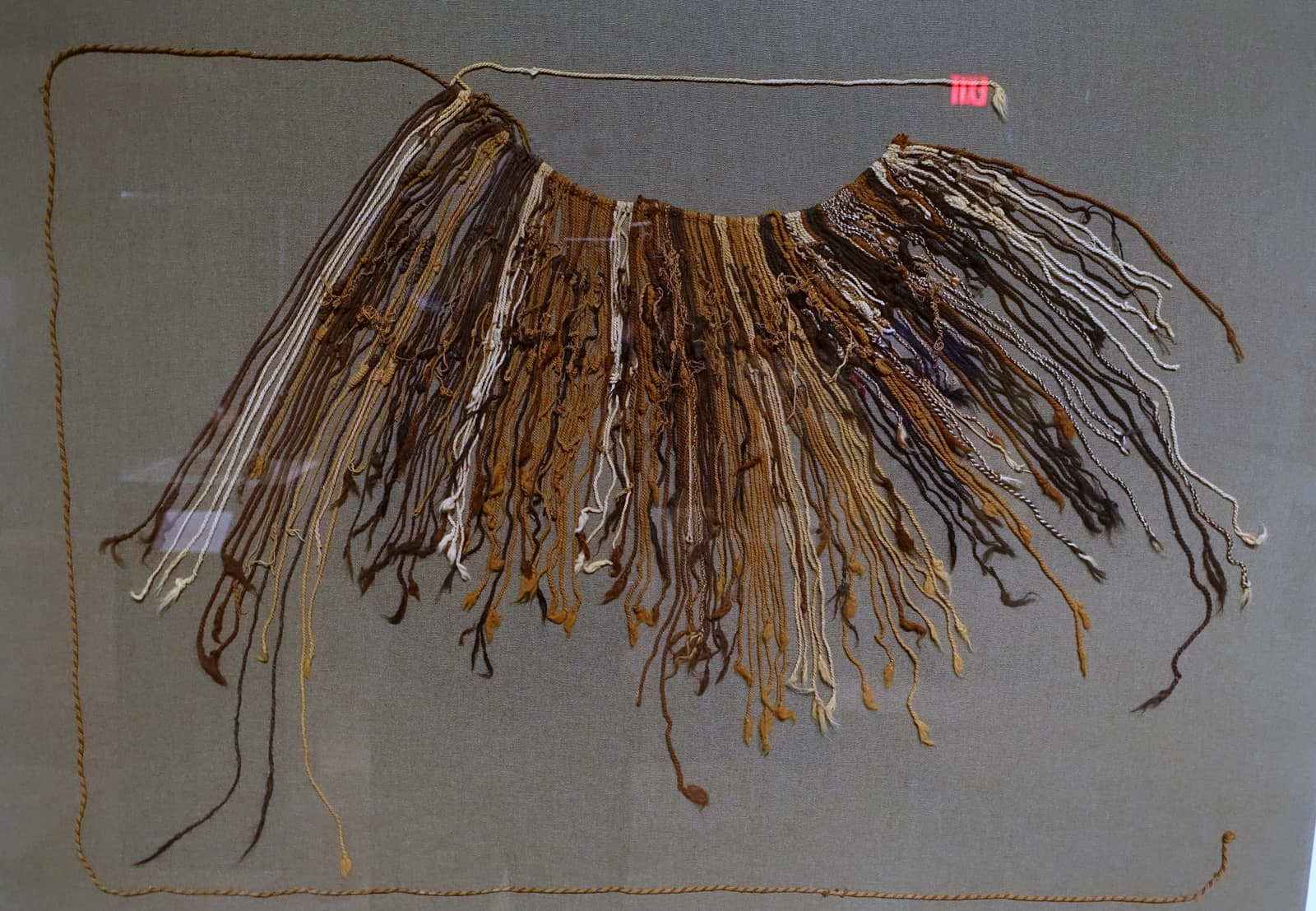
The khipu
Peru · Americas