The Cave of Swimmers, in a desert that was green
- Dated
- Place
- Wadi Sura, Gilf Kebir, New Valley Governorate, Egypt · Hunter-gatherers and foragers of the humid Holocene Sahara, in the Gilf Kebir
- Coordinates
- 23° 36′ N · 25° 14′ E (approximate)
- Remains
- Fragmentary
Roland Unger, CC BY-SA 3.0, via Wikimedia CommonsCC-BY-SA-3.0Original record
Data saver is on. Images load only when you ask. You can change this in Settings at any time.
From the archivist
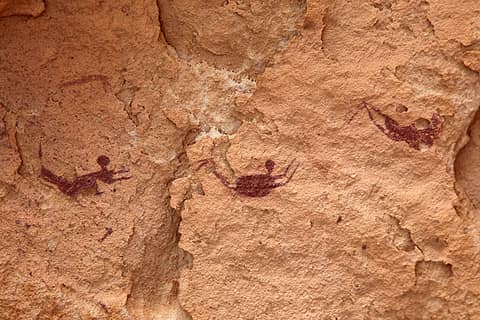
On the wall of a shallow shelter, someone painted small people with their arms reaching forward and their legs lifted behind, bodies level, as if something were holding them up. Beside them, hands were pressed to the rock and pigment was blown around the fingers.
The shelter now looks out on sand and bare stone. When the painters lived here, some seven or eight thousand years ago by current estimates, the summer rains of the monsoon reached this far north. There was grass, there may have been lakes that filled and dried with the seasons, and there were people who hunted and foraged and moved with the water. Then the rains drew back to the south, slowly, and the people went with them.
In 1933 the explorer László Almásy came upon the paintings and wrote of his surprise at finding swimmers in the heart of the desert. He took them as proof that the Sahara had once been green. He was right about the rain. Whether these figures are swimming at all, no one can say.
What they keep is a feeling that needs no translation: bodies weightless, carried, at ease in something we can no longer see. The rock is flaking. The swimmers are slowly going the way of the water.
Established
- The Cave of Swimmers (Wadi Sura I) is the larger of two shallow rock shelters side by side in Wadi Sura, the 'valley of pictures', at the foot of the Gilf Kebir plateau in Egypt's Western Desert (British Museum; Kuper 2013).
- The Hungarian explorer László Almásy found the shelter in October 1933, on an expedition with the German ethnographers Leo Frobenius and Hans Rhotert; he wrote of his surprise at seeing 'in the heart of the Libyan Desert images of swimmers' (Kuper 2013, quoting Almásy 1936).
- Besides the 'swimming' figures, the walls carry other human figures, some richly adorned, and many negative hand stencils made by blowing pigment over a hand held against the rock (British Museum).
- The British Museum gives the paintings an age of between 9,000 and 6,000 years; the survey of Wadi Sura links the regional painting tradition to the 'Gilf B' phase, about 6500 to 4400 BCE (British Museum; Riemer 2013).
- In the Western Desert, the pottery of this period begins to disappear from about 5300 BCE, as the monsoon summer rains retreated southwards (Riemer 2013).
- In 2002 a second painted shelter, the Cave of Beasts (Wadi Sura II), was found about 10 km away, with more 'swimmers' in long rows (Kuper 2013).
Interpretation
Almásy read the figures as real swimmers and as evidence that the desert had once held water; the change of climate has since been confirmed, but on other evidence than the paintings. Since the Cave of Beasts was found, where 'swimmers' appear near strange headless creatures, many researchers ask whether they swim at all. Jean-Loïc Le Quellec has proposed that they are the dead, floating like the souls in the primeval waters of Nun in much later Egyptian funerary texts; others think their meaning is lost, and the link to Pharaonic beliefs thousands of years later is contested (Kuper 2013). The dates rest on style and associated pottery, not on direct dating of the paint.
Looking ahead
You who read this may think of deserts as timeless. This one had grass and rain. Ten thousand years from now, which of our green places will survive only as pictures on a wall?
Sources (4)
- British Museum, African Rock Art Image Project. Cave of Swimmers, Egypt. · africanrockart.britishmuseum.org
- Kuper, R. (ed.). Wadi Sura: the Cave of Beasts. A rock art site in the Gilf Kebir (SW Egypt). Africa Praehistorica 26. Cologne, Heinrich-Barth-Institut, 2013 (open access), foreword and introductory chapters. · doi.org
- Riemer, H. Dating the rock art of Wadi Sura. In Kuper, R. (ed.), Wadi Sura: the Cave of Beasts, Africa Praehistorica 26, Cologne, Heinrich-Barth-Institut, 2013, p. 38-41. · hbi.uni-koeln.de
- Riemer, H., Kröpelin, S., Zboray, A. Climate, styles and archaeology: an integral approach towards an absolute chronology of the rock art in the Libyan Desert (Eastern Sahara). Antiquity 91 (355), 2017, p. 7-23. · doi.org
Related fragments
8700 to 6500 BCE
The Cave of the Hands
Cueva de las Manos, Pinturas River canyon, Santa Cruz Province, Argentina · Americas
before 46,000 years ago
The painted pig of Leang Tedongnge
Leang Tedongnge, karst of Maros and Pangkep, South Sulawesi, Indonesia · Asia