Rongorongo, the tablets no one can read
- Dated
- Place
- Rapa Nui (Easter Island), Chile · Rapa Nui
- Coordinates
- 27° 07′ S · 109° 21′ W (approximate)
- Remains
- Fragmentary
This fragment shows an object held as sacred.
It is shown here as the institution that holds it presents it. Some communities connected to it ask that it be viewed with care. You may choose to see the image, or read the record without it.
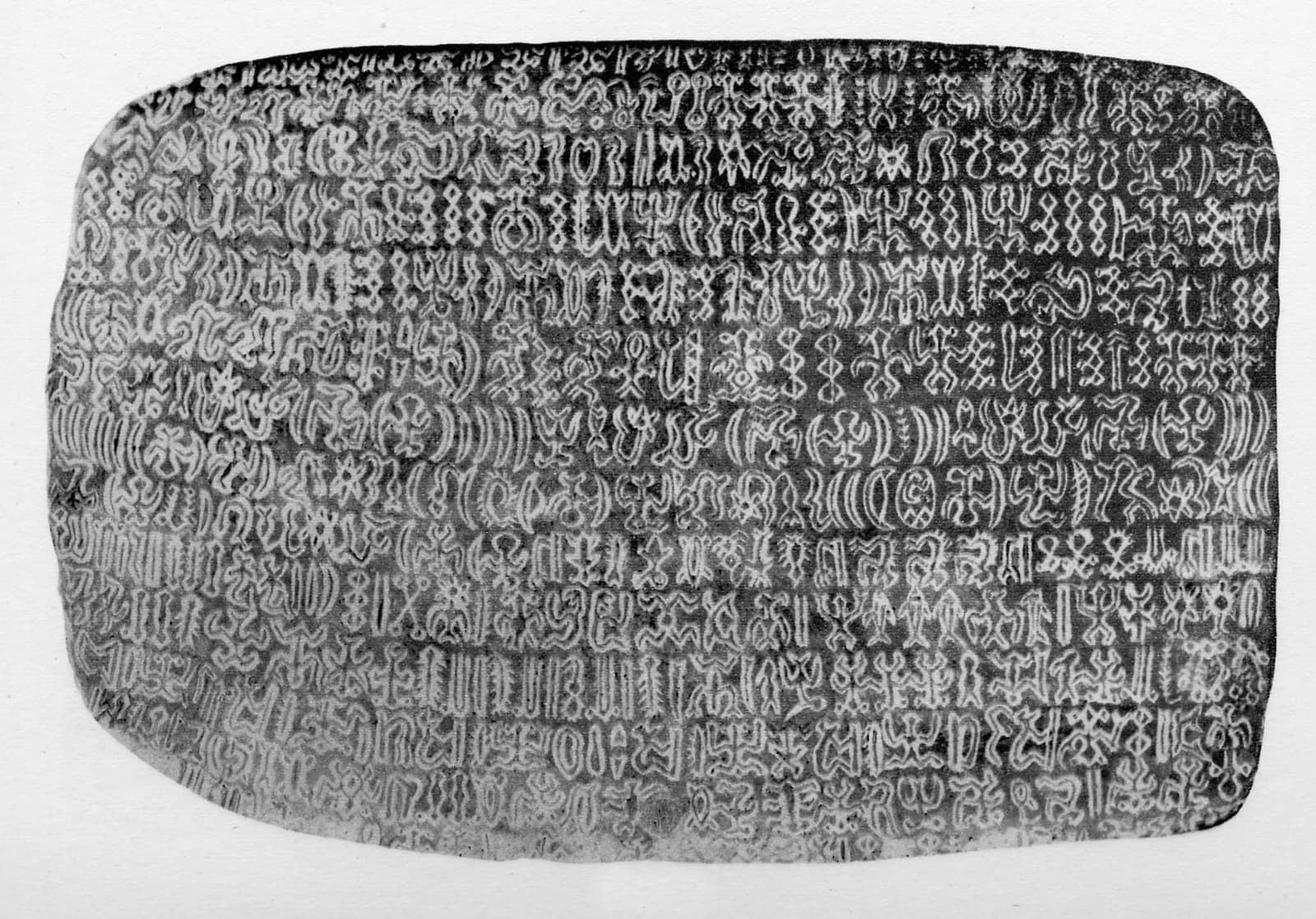
Image veiled by default
Photograph taken in Papeete while the tablet was in Bishop Jaussen's possession, from S.-C. Chauvet, L'île de Pâques et ses mystères (1935; English translation by Ann M. Altman, ed. Shawn McLaughlin, 2004), CC BY-SA 3.0, via Wikimedia CommonsCC-BY-SA-3.0Original record
Data saver is on. Images load only when you ask. You can change this in Settings at any time.
From the archivist
On Rapa Nui there were houses of learning, where the young practised the signs on dried bark before they were trusted with wood. Later, with a flake of obsidian or a sliver of bone, a hand cut them into the tablets: animals, small human figures, crescents, hundreds of shapes in close rows. The reader followed a line to its end, then turned the board round, because every other line runs upside down. What was recited from them, the names, the order of the moons, the chants, belonged to the few who knew how.
In the early 1860s, slave ships from Peru carried off a great part of the island's people. Epidemics followed. Within a few years, those who could make the wood speak were gone.
When missionaries began to gather the tablets in 1869, the boards were still there, but most of the voices were not. Island memory says that others had been burned for their wood, in years of hunger, to cook fish. Some two dozen survive, in museums from Rome to Honolulu. None is on the island.
This civilization did not lose the tablets. It lost their readers.
Established
- Rongorongo is the script of Rapa Nui; kōhau roŋoroŋo, the name of the tablets, is rendered as 'talking tablet', roŋoroŋo meaning 'to call' or 'to recite' (Australian Museum).
- The script survives on twenty-six or twenty-seven wooden objects, all outside Rapa Nui; it was first noticed by outsiders in 1864 and remains undeciphered (Ferrara et al. 2024; Australian Museum).
- It counts around 600 distinct signs, mostly human and animal figures, read in reverse boustrophedon: the tablet is turned round at the end of each line (Australian Museum).
- Rapa Nui tradition recalls houses of learning, hare roŋoroŋo, where students practised on dried bark before carving toromiro wood with obsidian or bone (Australian Museum, from Rapa Nui knowledge holders).
- Slave raiders from Callao, in Peru, deported around 1,500 Rapa Nui, and epidemics followed; the knowledge holders who could read the script were lost (Musée du quai Branly; Ferrara et al. 2024; Australian Museum).
- The Mamari (tablet C), kept in Rome, is carved on Pacific rosewood felled between about 1694 and 1840; the wood of tablet D was felled between 1493 and 1509, before Europeans reached the island in the 1720s (Ferrara et al. 2024).
Interpretation
Whether rongorongo was a full writing system or a set of signs that helped reciters remember chants, and whether it was invented before any contact with Europeans, is still debated; the early date of tablet D supports an independent invention, but its wood, a species that never grew on the island, may have been driftwood. Specialists think the tablets recorded the cycle of the moon, events, legends and chiefly genealogies (Musée du quai Branly), but no proposed reading has been confirmed. Sources differ on the count of objects (twenty-six, twenty-seven, around twenty, thirty in island memory) and on the dates of the raids (1862 to 1864 for Maude, 1859 to 1863 for the quai Branly).
Looking ahead
The signs are all still there, sharp in the wood. Which of our own scripts will still have a reader in a thousand years, and who will be the last?
Sources (4)
- Ferrara, S., Tassoni, L., Kromer, B., Wacker, L., Friedrich, M., Tonini, F., Lastilla, L., Ravanelli, R., Talamo, S. The invention of writing on Rapa Nui (Easter Island). New radiocarbon dates on the Rongorongo script. Scientific Reports 14, 2794, 2024. · doi.org
- Australian Museum. Kōhau Roŋoroŋo: talking tablet (information shared by Rapa Nui knowledge holders Victor Pakomio and Johnny Tuki). · australian.museum
- Musée du quai Branly, Jacques Chirac. Trésors de Rapa Nui (île de Pâques), vitrine temporaire, prêt de quatre tablettes par la Congrégation des Sacrés-Cœurs de Jésus et de Marie, jusqu'en juin 2025. · m.quaibranly.fr
- Maude, H. E. Slavers in paradise: the Peruvian labour trade in Polynesia, 1862-1864. Canberra, Australian National University Press, 1981. · openresearch-repository.anu.edu.au
Related fragments
1200 to 1650
The moai of Rapa Nui
Ahu Tongariki, Rapa Nui National Park, Valparaíso Region, Chile · Oceania
1400 to 1800
The khipu
Peru · Americas
1992
Tevfik Esenç, the last voice of Ubykh
Hacıosman, Manyas, Balıkesir Province, Turkey · Asia