The moai of Rapa Nui
- Dated
- Place
- Ahu Tongariki, Rapa Nui National Park, Valparaíso Region, Chile · Rapa Nui, the Polynesian people of Rapa Nui (Easter Island)
- Coordinates
- 27° 08′ S · 109° 17′ W (approximate)
- Remains
- Fragmentary
This fragment shows an object held as sacred.
It is shown here as the institution that holds it presents it. Some communities connected to it ask that it be viewed with care. You may choose to see the image, or read the record without it.
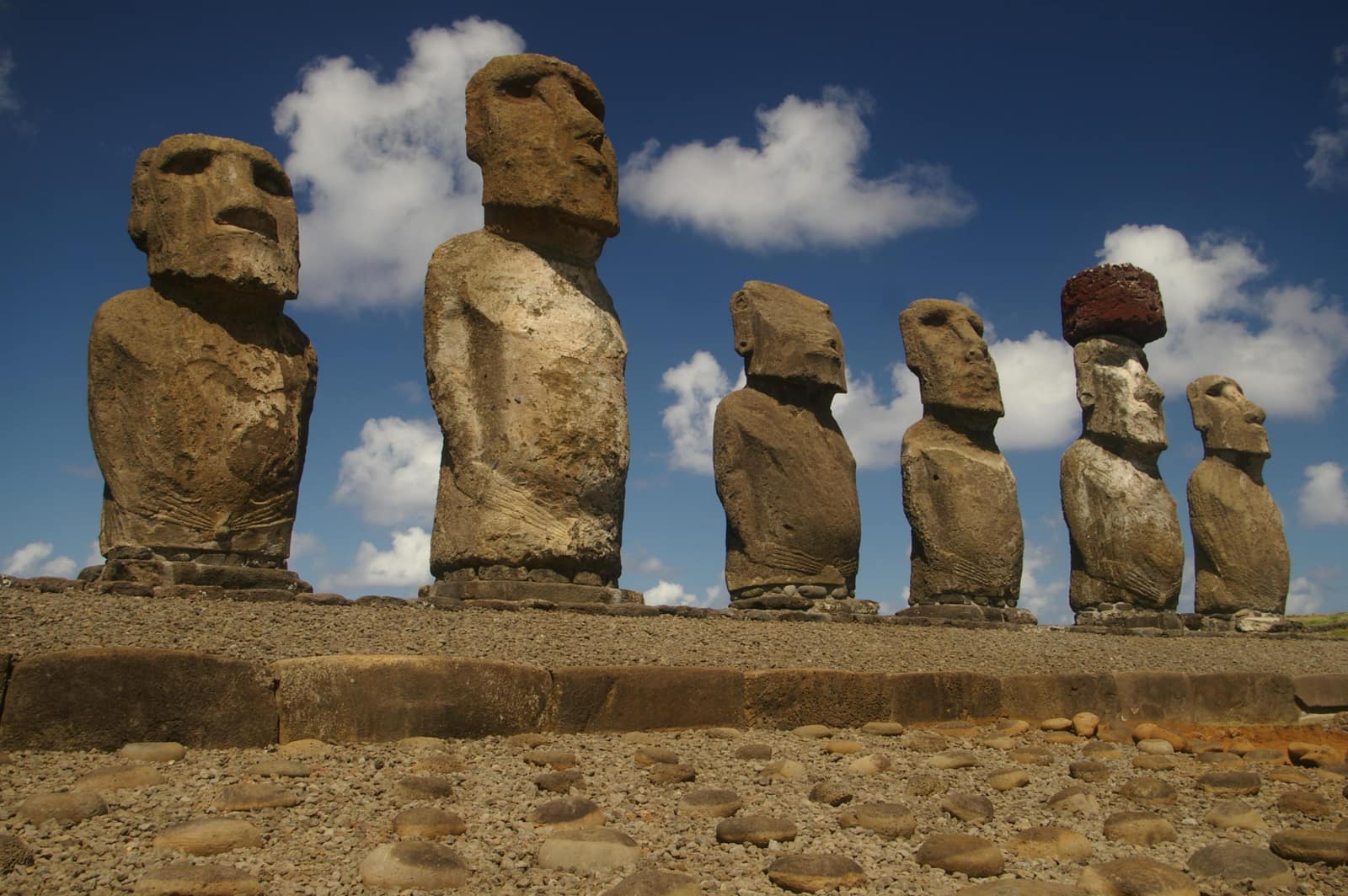

Image veiled by default
Rivi, CC BY-SA 3.0, via Wikimedia CommonsCC-BY-SA-3.0Original record
Data saver is on. Images load only when you ask. You can change this in Settings at any time.
From the archivist
The people of this island shaped their ancestors in stone. From the flank of an extinct volcano they cut the soft, pale tuff with harder stone tools, and from it drew long faces, heavy brows and arms that run down to the belly. The finished figures were moved across the island and set on platforms near the shore, most of them facing inland, towards the villages they watched over.
Hundreds were made. Some stand again today; at Ahu Tongariki fifteen were raised once more in the 1990s after a tsunami in 1960 had scattered them inland. Many never left the quarry, half carved, still lying in the rock.
For the Rapa Nui, the moai are not sculptures from the past but living ancestors. In 1868 sailors from a British warship took one of them, Hoa Hakananai'a, from the ceremonial village of Orongo. It stands in London. In 2018 the island's governor went there and said that its people were only the body; the soul was in the museum.
We record the question as it stands. It has not yet been answered.
Established
- Rapa Nui National Park was inscribed on the UNESCO World Heritage List in 1995; since 2017 it has been administered by the Rapa Nui community Ma'u Henua (UNESCO).
- Most moai were carved with stone tools from the volcanic tuff of the Rano Raraku quarry, where hundreds of statues remain at every stage of work (UNESCO; Lipo, Hunt and Rapu Haoa 2013).
- Hoa Hakananai'a, a basalt moai about 2.4 metres high carved on its back with images linked to the birdman cult, was taken from Orongo in 1868 by the crew of HMS Topaze and has been in the British Museum since 1869 (British Museum).
- In November 2018 a Rapa Nui delegation led by the island's governor, Tarita Alarcón Rapu, asked the British Museum for its return; the museum has discussed loans, not restitution (CNN; British Museum).
Interpretation
How the statues were moved from the quarry to their platforms is debated: some researchers, supported by experiments and oral tradition, argue that they were rocked upright along prepared roads, as if walking; others favour sledges or rollers. The long held story of an island ruined by its own builders is also contested, with growing weight given to the impact of European diseases and slave raids in the 19th century.
In 10,000 years
In 10,000 years, will the faces still be turned towards the island, keeping watch over whoever lives there?
Sources (5)
- UNESCO World Heritage Centre. Rapa Nui National Park (property 715), inscribed 1995. · whc.unesco.org
- The British Museum. Hoa Hakananai'a, figure, Oc1869,1005.1, collection online. · www.britishmuseum.org
- The British Museum. Contested objects from the collection: Moai. · www.britishmuseum.org
- Lipo, C. P., Hunt, T. L., Rapu Haoa, S. The 'walking' megalithic statues (moai) of Easter Island. Journal of Archaeological Science 40 (6), 2013, p. 2859-2866. · doi.org
- CNN. Easter Islanders call on British Museum for return of ancient statue, November 2018. · edition.cnn.com
Related fragments
1976
Hōkūleʻa
Hawaiʻi, United States, to Tahiti, French Polynesia · Oceania
1180 to 1500
Nan Madol
Madolenihmw, Pohnpei State, Federated States of Micronesia · Oceania