Hildegard of Bingen: the year her sisters were forbidden to sing
- Dated
- Place
- Bingerbrück, Bingen am Rhein, Rhineland-Palatinate, Germany · Benedictine nuns of the Rupertsberg near Bingen, Rhineland, Holy Roman Empire
- Coordinates
- 49° 58′ N · 7° 54′ E (approximate)
- Remains
- Intact
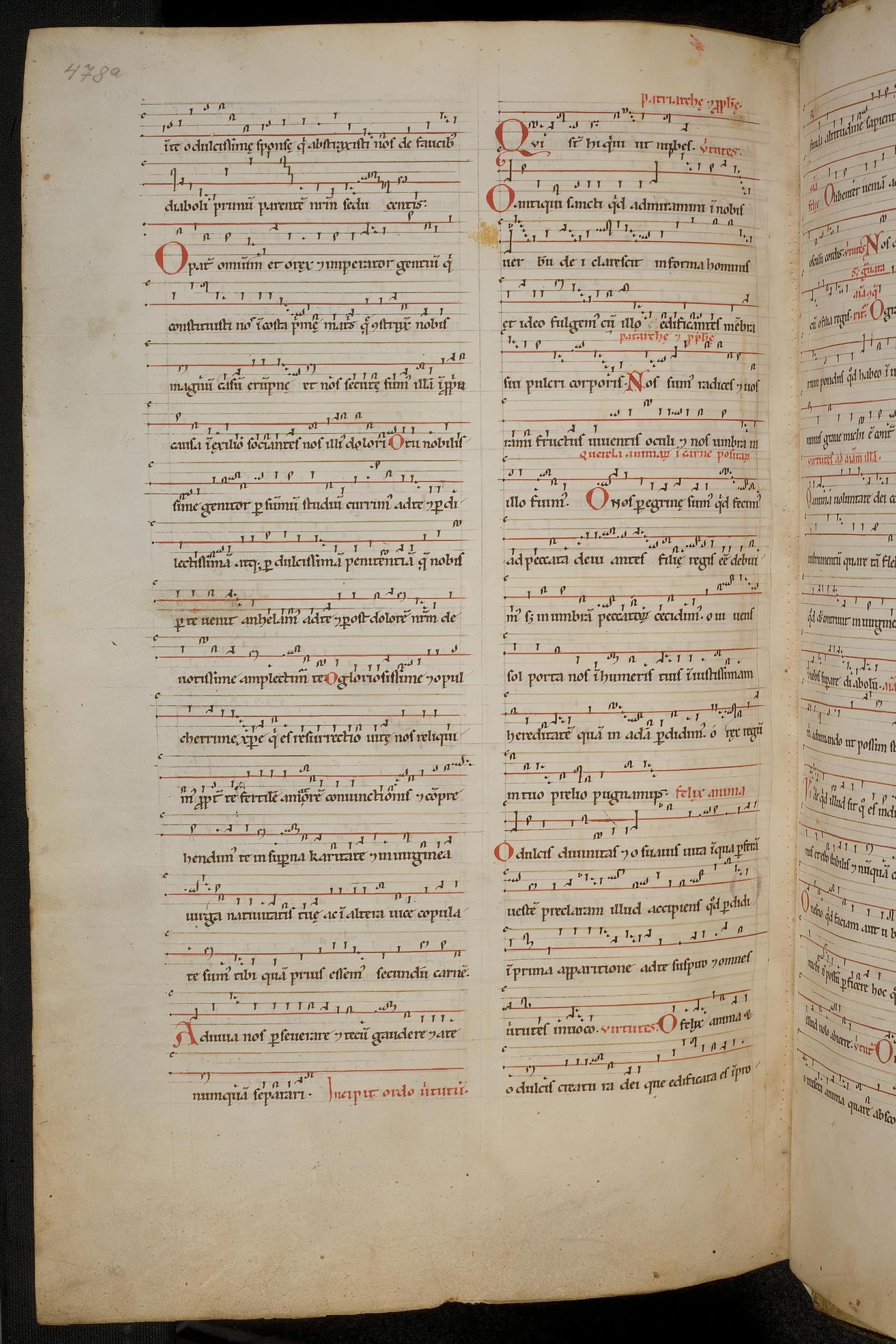
Riesencodex, Hochschul- und Landesbibliothek RheinMain, Wiesbaden, Hs. 2, fol. 478v, public domain, via Wikimedia CommonsPDMOriginal record
Data saver is on. Images load only when you ask. You can change this in Settings at any time.
From the archivist
In the last year of her life, Hildegard was about eighty, and her sisters had stopped singing.
A man had been buried in the cemetery of the monastery on the Rupertsberg, above the Rhine. He had once been excommunicated, but before he died he had confessed and received the sacraments. The prelates of Mainz ordered the body dug up. She refused. So the house was laid under interdict, and the women, who had sung the hours of the day all their lives, now only read them.
She had made much of what they sang, and a drama in which the Virtues fight the Devil for a human soul. Every part in it is sung but one. The Devil only speaks.
She wrote to Mainz. Those who silence a church without just cause, she warned, will lose their place in the choir of angels.
The interdict was lifted a few months before she died. Her melodies were written down in a great book, with small black signs above every line of words, and that book survived a war. Her songs are still sung.
Established
- Hildegard was born in 1098 at Bermersheim, near Alzey, received as an oblate at the Benedictine abbey of Disibodenberg at the age of eight, and made her profession in 1115; around 1136 she succeeded Jutta of Sponheim as magistra of the women's community (Benedict XVI 2012).
- Around 1150 she founded a monastery on the Rupertsberg near Bingen, moving there with twenty sisters, and in 1165 a second house on the opposite bank of the Rhine; she died at the Rupertsberg on 17 September 1179 (Benedict XVI 2012).
- Her songs were gathered under the title Symphonia armonie celestium revelationum, the symphony of the harmony of heavenly revelations (Benedict XVI 2012).
- Her music drama, the Ordo Virtutum, is built on the contrast between speech and song: Satan's five speeches are spoken, while the Virtues, who are sung, teach the fallen soul, Anima, to regain the music she had at the opening of the play; it takes some forty-five minutes to perform and ends with a quiet plea rather than a triumph (Fassler 2026).
- Only two large collections of her music survive, one in Leuven and the Riesencodex in Wiesbaden (Bain 2018).
- Near the end of her life, a man who had been excommunicated but had confessed, received the last rites and been reconciled before his death was buried at the Rupertsberg; the prelates of Mainz ordered the body removed, she refused, and the monastery was placed under interdict (Baird 2006, letter 72; Senz 2023).
- In her letter to the prelates she writes that the sisters had ceased to sing the divine office and were merely reading it, and warns that those who impose silence on a church without just cause will lose their place among the chorus of angels (Baird 2006, letter 72).
- The interdict was lifted a few months before her death (Senz 2023).
- Benedict XVI proclaimed her a Doctor of the Universal Church on 7 October 2012 (Benedict XVI 2012).
Interpretation
Sources date the letter to the prelates of Mainz to 1178 or 1179, and the man's identity and standing are given differently in different accounts. In the letter she presents her defence of sung praise as something she heard from a voice coming from the Living Light; how to read such claims is a matter of faith and of interpretation. The Ordo Virtutum is often described as a morality play, but how and by whom it was first performed is not recorded. That the Devil's part is spoken is usually read as a theological statement, that evil has no share in the harmony of heaven.
Looking ahead
In a hundred years, who will decide which voices may be heard, and who will still dare to write that a silence imposed without cause is a wrong?
Sources (5)
- Benedict XVI. Apostolic letter proclaiming Saint Hildegard of Bingen, professed nun of the Order of Saint Benedict, a Doctor of the Universal Church, 7 October 2012. · www.vatican.va
- Bain, J. History of a book: Hildegard of Bingen's 'Riesencodex' and World War II. Plainsong and Medieval Music 27 (2), 2018, p. 143-170. · doi.org
- Hildegard of Bingen. Letter to the prelates of Mainz (1178 or 1179), in Baird, J. L. (ed. and trans.), The Personal Correspondence of Hildegard of Bingen, Oxford University Press, 2006, letter 72; excerpt edited for the HEMED teaching resources, Le Mans Université. · hemed.univ-lemans.fr
- Fassler, M. Speech, melody, and theology in Hildegard's music drama, lecture abstract, Faculty of Music, University of Cambridge, 28 January 2026. · talks.cam.ac.uk
- Senz, P. The life and music of St. Hildegard von Bingen, Doctor of the Church. Catholic World Report, 16 September 2023. · www.catholicworldreport.com
Related fragments
c. 43,000 years ago
The bone flute of Geißenklösterle
Near Blaubeuren, Baden-Württemberg, Germany · Europe
c. 1400 BCE
The Hurrian Hymn no. 6
Ras Shamra, near Latakia, Syria · Asia
1431 to 1582
Only a little while here: the songs of Nezahualcóyotl
Texcoco, State of Mexico, Mexico · Americas