The Tale of Genji: a lady of the court writes what passes
- Dated
- Place
- Kyoto, Japan · The imperial court of Heian Japan
- Coordinates
- 35° 02′ N · 135° 46′ E (approximate)
- Remains
- Intact
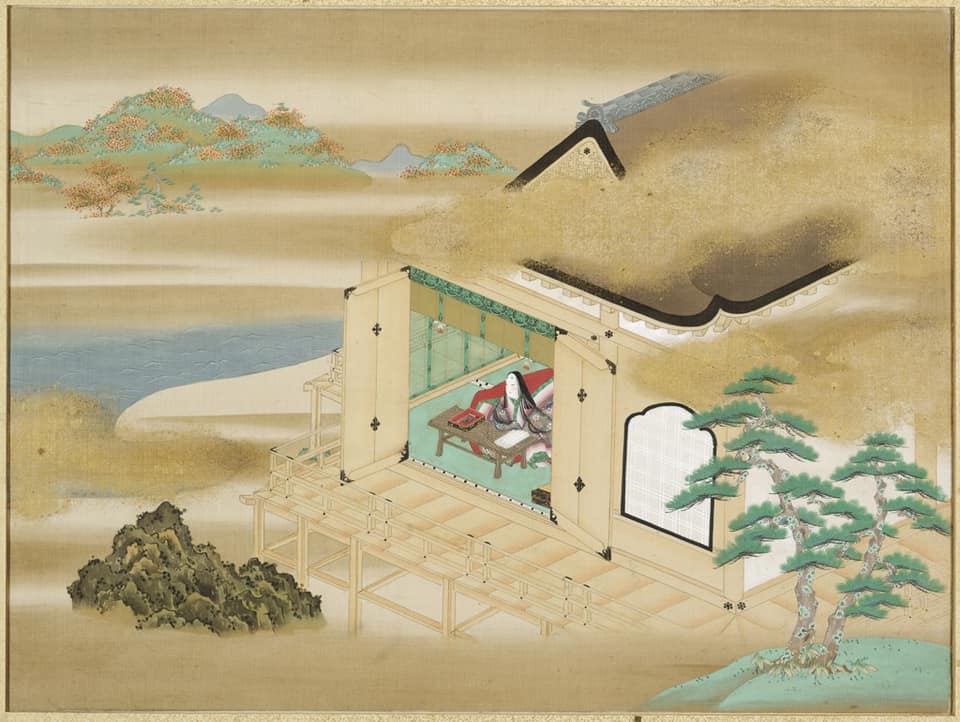
Tosa Mitsuoki, Landscape with Murasaki Shikibu writing at Ishiyamadera, late 17th century, Harvard Art Museums, 1985.352.55, public domain, via Wikimedia CommonsPDMOriginal record
Data saver is on. Images load only when you ask. You can change this in Settings at any time.
From the archivist
Her name was not kept. We call her Murasaki, after a girl in her own story, and Shikibu, after an office her father once held. As a child she listened outside the door while he taught Chinese to her brother, and she learned it too, quietly, from the other side of the wall.
She married, had a daughter, and within a few years her husband was dead. It was then, it is thought, that she began to write.
Later she served at the court of the empress Shōshi, among women in layered silks who spent their days behind screens and curtains, watching the seasons turn and sending one another poems. Her tale follows a prince, Genji, through his loves and their endings: a woman who dies young in a deserted house, a girl he takes in and raises, a lady who leaves the world to become a nun. Nothing in it lasts, not beauty, not rank, not desire, and the people in it know this and love each other anyway.
She wrote fifty-four chapters and wove through them nearly eight hundred poems.
A thousand years have passed. The court is gone, the silks are dust, and readers in languages she never heard still recognise the ache of it: the sense that what we love is already leaving.
Established
- Her own name is not recorded: 'Murasaki' comes from the heroine of her tale, 'Shikibu' from a post once held by her father, a scholar and provincial governor (Tyler 2002).
- She learned Chinese by listening outside the door while her father taught her brother (Tyler 2002).
- She married in 998 or 999 and was widowed in 1001; she is thought to have begun the tale after the death of her husband, Fujiwara no Nobutaka (Tyler 2002; National Diet Library).
- Called to court around 1006, she served Empress Shōshi, consort of Emperor Ichijō and daughter of Fujiwara no Michinaga, and explained to her the poems of Bai Juyi; her diary covers autumn 1008 to the first month of 1010 (Tyler 2002; National Diet Library).
- The tale has 54 chapters and contains nearly 800 poems of her own (Tyler 2002; National Diet Library).
- In the eighteenth century the scholar Motoori Norinaga, who lectured on the Genji from 1758, looked for the core of literature in 'the mind that knows the pathos of things', mono no aware o shiru kokoro (Mori, Encyclopedia of Shinto).
- The painting shown is by Tosa Mitsuoki, late seventeenth century, ink, colour and gold on silk, 31.2 by 42.1 cm, the frontispiece of an album of Genji illustrations (Harvard Art Museums, 1985.352.55).
Interpretation
Mono no aware, the gentle sorrow felt at the passing of things, is the key Motoori Norinaga gave the tale some seven centuries after it was written; it has become the most familiar way into the Genji, but it is one reading among others. The temple of Ishiyama-dera holds that she conceived the story there during a seven-day retreat, watching the full moon of August 1004; this is a temple tradition rather than a recorded fact, and Mitsuoki's painting illustrates that legend. Scholars debate whether the chapters were written in their present order and whether every chapter is hers, and her dates of birth and death are uncertain (Tyler 2002).
Looking ahead
Someone in the year 3000 may weep over a story written today by a woman no one will remember. Which story, and which woman?
Sources (5)
- National Diet Library (Japan), via Japan Search. Murasaki Shikibu, gallery entry: her service to Empress Shōshi, the Murasaki Shikibu nikki and The Tale of Genji. · jpsearch.go.jp
- Tyler, R. Murasaki Shikibu, a profile in the Vita series. Harvard Magazine, May-June 2002. · www.harvardmagazine.com
- Mori, M. Motoori Norinaga. Encyclopedia of Shinto, Kokugakuin University, Schools, Groups, and Personalities. · d-museum.kokugakuin.ac.jp
- Harvard Art Museums. Tosa Mitsuoki, Landscape with Murasaki Shikibu writing at Ishiyamadera (frontispiece to an album containing 54 illustrations and calligraphic excerpts from the Tale of Genji), late 17th century, 1985.352.55. · www.harvardartmuseums.org
- Ishiyamadera Temple, Ōtsu. Official site in English: the legend of Murasaki Shikibu and the Room of Genji. · ishiyamadera.or.jp
Related fragments
1586
Won-i's mother: a letter to a husband in his grave
Jeongsang-dong, Andong, North Gyeongsang Province, South Korea · Asia
1431 to 1582
Only a little while here: the songs of Nezahualcóyotl
Texcoco, State of Mexico, Mexico · Americas
97 to 105 CE
Come to my birthday: Claudia Severa's letter to Lepidina
Chesterholm, near Bardon Mill, Northumberland, England, United Kingdom · Europe