Come to my birthday: Claudia Severa's letter to Lepidina
- Dated
- Place
- Chesterholm, near Bardon Mill, Northumberland, England, United Kingdom · Households of Roman officers on the northern frontier of Britain, before Hadrian's Wall
- Coordinates
- 54° 59′ N · 2° 22′ W (approximate)
- Remains
- Fragmentary
Fæ, CC BY-SA 3.0, via Wikimedia CommonsCC-BY-SA-3.0Original record
Data saver is on. Images load only when you ask. You can change this in Settings at any time.
From the archivist
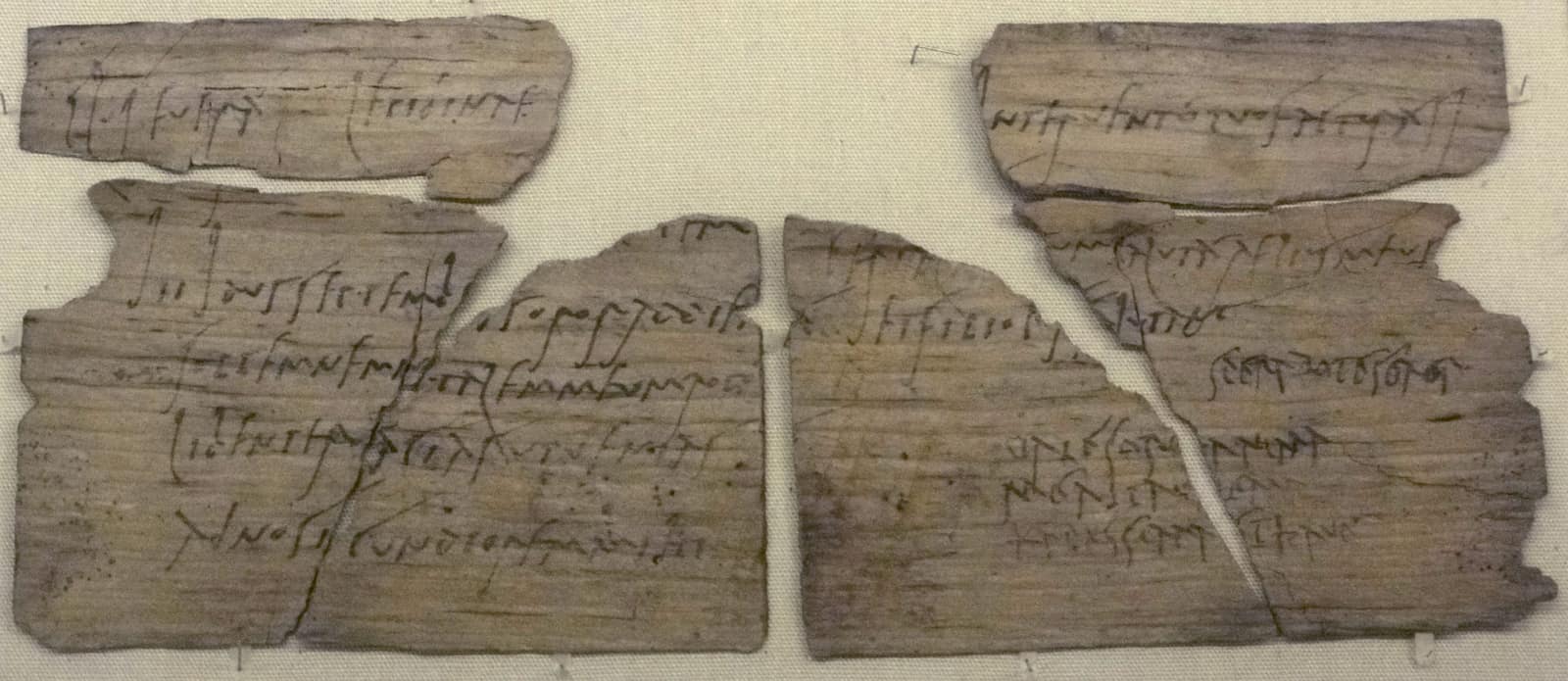
On a thin leaf of wood, a scribe first wrote out the invitation in a neat, practised hand. Claudia Severa, wife of Aelius Brocchus, asked her friend Sulpicia Lepidina to come to her on 11 September, for her birthday: her arrival, she said, would make the day more enjoyable. Greetings to Lepidina's husband; greetings from her own husband and her little son.
Then Severa took the pen herself. The letters change. They lean, they crowd together, they are less sure of themselves. "I shall expect you, sister. Farewell, sister, my dearest soul, as I hope to prosper, and hail." As far as anyone knows, the two women were not sisters. This civilization gave that name to a friend it could not do without.
They lived on the northern edge of an empire, in forts set among the hills, and their letters went from one garrison to another. This one ended up in the ground at Vindolanda, where the damp, airless soil kept it for nineteen centuries.
It is the oldest known Latin written by a woman's own hand. What she chose to do with that hand was not to keep an account or say a prayer. It was to write: come. I am waiting for you.
Established
- An ink writing tablet of thin wood, in diptych form, 223 mm wide and 96 mm high, found at Vindolanda in 1985 and dated by its context to about 97 to 105 CE (Roman Inscriptions of Britain, Tab. Vindol. 291).
- It is kept in the British Museum, London, under the number 1986,1001.64 (Roman Inscriptions of Britain).
- Claudia Severa, wife of Aelius Brocchus, invites Sulpicia Lepidina, wife of Flavius Cerialis, to her birthday celebration on 11 September, the third day before the Ides (Tab. Vindol. 291).
- Most of the letter is written in the practised hand of a scribe; the closing greeting is in a second hand, taken to be Severa's own, which also closes her letters 292 and 293 (Bowman and Thomas 1987; Enos and Robinson 2016).
- The address on the back reads: to Sulpicia Lepidina, wife of Cerialis, from Severa (Enos and Robinson 2016).
- Another letter from Severa shows that she lived not at Vindolanda but at another fort, Briga, whose site has not been identified (Cromwell 2019).
Interpretation
That the closing lines are in Severa's own hand is inferred from the change of script and from the same hand recurring in her other letters; nothing on the tablet says so, and whether she composed the main text herself or dictated it is not known. The letter is described as almost certainly the earliest known Latin written by a woman, a claim that rests on what happens to have survived and been found. The words 'anima mea', 'my soul', have been read as a formula of women's speech in Latin (Clackson, cited by Enos and Robinson 2016). Whether Lepidina came to the party is not recorded.
Looking ahead
Almost everything we write now is typed. A thousand years from now, will anyone be able to tell where one of us stopped dictating and took up the pen herself?
Sources (4)
- Roman Inscriptions of Britain online. Tab.Vindol. 291: Birthday invitation of Sulpicia Lepidina (text, translation, find date, museum number and dating). · romaninscriptionsofbritain.org
- Bowman, A. K., Thomas, J. D. New texts from Vindolanda. Britannia 18, 1987, p. 125-142. · doi.org
- Enos, R. L., Robinson, N. T. Claudia Severa's birthday invitation: a rhetorical analysis of the earliest artifact of Latin written by a woman's hand. Peitho Journal 18 (2), 2016. · cfshrc.org
- Cromwell, J. Birthday parties on the Roman frontier. Papyrus Stories, 6 November 2019. · papyrus-stories.com
Related fragments
c. 1749 BCE
Nanni's complaint to Ea-nasir
Tell al-Muqayyar, near Nasiriyah, Dhi Qar Governorate, Iraq · Asia
1860
The phonautograph and the oldest recognisable recorded voice
Paris, France · Europe