The walls of Pompeii: love, insults and a shopping list
- Dated
- Place
- Archaeological site of Pompeii, Campania, Italy · Inhabitants and visitors of Pompeii, a Roman town of Campania
- Coordinates
- 40° 45′ N · 14° 29′ E (approximate)
- Remains
- Fragmentary
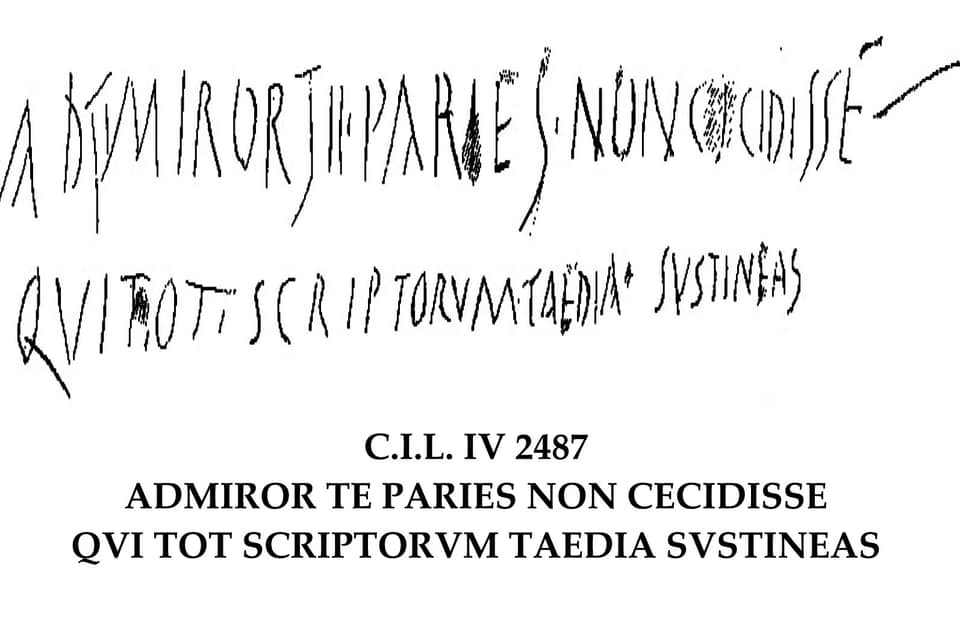
Fer.filol, tracing of CIL IV 2487, public domain (PD-self), via Wikimedia CommonsPDMOriginal record
Data saver is on. Images load only when you ask. You can change this in Settings at any time.
From the archivist
Someone stopped in front of a wall in the Basilica of Pompeii and scratched a little verse into the plaster: I am amazed, O wall, that you have not fallen in ruins, you who bear the tedium of so many writers. The joke was a good one. The same lines turn up at the theatre.
The wall had reason to be tired. Across the town, people wrote on it what they could not keep to themselves. On a house front in a side street, someone wrote that Successus the weaver loved Iris, a slave woman at the inn, who did not care for him in the least, and that he begged her for pity. Signed: a rival. Beneath it, another voice answered: envious one.
By a doorway, two guests apologised in verse to their host. They had wet the bed, they explained, because there was no chamber pot. In the house of Caecilius Iucundus, someone wished well to all who love, and death twice over to whoever forbids it. On another wall: bread, a little cabbage, beet, mustard, mint, salt.
None of this was written to last. It lasted because the ash came and covered the walls, with every word still on them.
Established
- Scratched in the Basilica (VIII.1.1): 'Admiror, o paries, te non cecidisse ruinis, qui tot scriptorum taedia sustineas', I am amazed, O wall, that you have not fallen in ruins, you who bear the tedium of so many writers (CIL IV 1904). The same verse appears at the Teatro Grande (CIL IV 2461) and again in CIL IV 2487 (Ancient Graffiti Project; our translation).
- On the facade of I.10.3: 'Successus textor amat coponiaes ancilla(m) nomine Hiredem quae quidem illum non curat. Sed ille rogat illa comiseretur. Scribit rivalis. Vale.' Successus the weaver loves the innkeeper's slave woman named Iris, who does not care for him at all; but he begs her to take pity on him. A rival writes this. Farewell (CIL IV 8259; Ancient Graffiti Project; our translation).
- Two further lines, in a similar hand but in the voice of another writer, answer 'Invidiose', envious one, and speak of a man 'formonsiorem', more handsome, and 'bellus', good-looking; their exact reading is disputed (CIL IV 8259; Ancient Graffiti Project).
- In the house of Caecilius Iucundus (V.1.26): 'Quisquis amat valeat, pereat qui nescit amare, bis tanto pereat quisquis amare vetat', may whoever loves fare well, may whoever does not know how to love perish, and may whoever forbids love perish twice over (CIL IV 4091; our translation). The verse was known at Rome as well as at Pompeii (Ancient Graffiti Project).
- Beside the doorway of VIII.6.6, an elegiac couplet: 'Miximus in lecto. Fateor, peccavimus, hospes. Si dices, quare? Nulla matella fuit.' We wet the bed. I admit it, host, we did wrong. If you ask why: there was no chamber pot (CIL IV 4957; our translation).
- At VIII.2.30, a short list with numbers: bread, little cabbages, beet, mustard, mint and salt, among less certain words (CIL IV 4888; Ancient Graffiti Project).
- In a Pompeian house studied in detail, graffiti were found to answer one another, forming dialogues on the walls (Benefiel 2010).
Interpretation
Who wrote these lines is almost never known; the names they contain may belong to the writers, to the people written about, or to neither, and the rival who signs CIL IV 8259 may be joking. The second part of that inscription is read differently by different editors, and the slave woman Iris never speaks for herself. The numbers in CIL IV 4888 may be prices or quantities. Graffiti show that many people in a Roman town could write a few words, but how widely they could read and write is debated. The Latin is quoted as it was written, spelling mistakes included; the translations are ours.
Looking ahead
What will remain of the messages we scrawl every day, the jokes, the grudges, the lists, once the screens that carry them have gone dark?
Sources (3)
- The Ancient Graffiti Project (ed. R. Benefiel), Washington and Lee University. AGP-EDR158840 (CIL IV 1904, Basilica), AGP-EDR158841 (CIL IV 2461, Teatro Grande), AGP-EDR175589 (CIL IV 8259, I.10.3), AGP-EDR168646 (CIL IV 4091, Casa di Caecilius Iucundus), AGP-EDR175872 (CIL IV 4957, VIII.6.6), AGP-EDR175215 (CIL IV 4888, VIII.2.30). · ancientgraffiti.org
- Benefiel, R. Dialogues of ancient graffiti in the House of Maius Castricius in Pompeii. American Journal of Archaeology 114 (1), 2010, p. 59-101. · doi.org
- Corpus Inscriptionum Latinarum, Berlin-Brandenburg Academy of Sciences and Humanities. Volume IV, Inscriptiones parietariae Pompeianae Herculanenses Stabianae (ed. C. Zangemeister, R. Schoene, 1871) and its supplements. · cil.bbaw.de
Related fragments
2600 to 2400 BCE
The Royal Game of Ur, and the guards who played it
Tell al-Muqayyar, Dhi Qar Governorate, Iraq · Asia
97 to 105 CE
Come to my birthday: Claudia Severa's letter to Lepidina
Chesterholm, near Bardon Mill, Northumberland, England, United Kingdom · Europe
c. 1749 BCE
Nanni's complaint to Ea-nasir
Tell al-Muqayyar, near Nasiriyah, Dhi Qar Governorate, Iraq · Asia