The phonautograph and the oldest recognisable recorded voice
Before Scott's phonautograph, no instrument could take a voice from the air and fix it on a surface; after it, sound could be written down by a machine, twenty years before anyone could play a recording back.
- Dated
- Place
- Paris, France · Édouard-Léon Scott de Martinville, Parisian typographer and proofreader, and the Académie des sciences; in 2008 the First Sounds collaborative and Lawrence Berkeley National Laboratory
- Coordinates
- 48° 51′ N · 2° 20′ E (approximate)
- Remains
- Intact
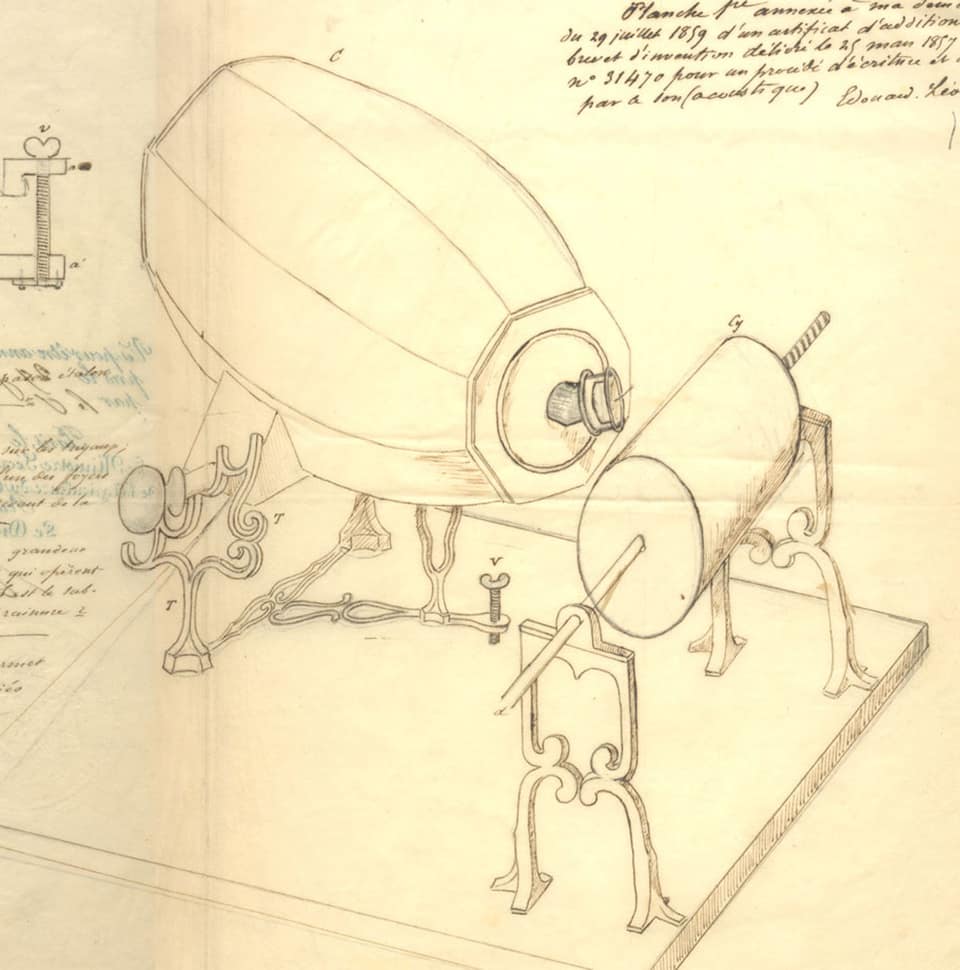

Édouard-Léon Scott de Martinville, 1859 (INPI), domaine public, via Wikimedia CommonsPDMOriginal record
Data saver is on. Images load only when you ask. You can change this in Settings at any time.
From the archivist
He did not want to hear it again. Édouard-Léon Scott de Martinville, a Paris typographer and proofreader, wanted to see a voice: to make speech write itself on paper.
His machine was a barrel-shaped horn closed at its narrow end by a membrane. A fine stylus, fixed to the membrane, rested against a cylinder wrapped in paper blackened in the smoke of an oil lamp. When someone sang into the horn and the handle was turned, the stylus scratched a trembling line through the soot. Scott called these tracings phonautograms, and he patented the process in 1857.
On 9 April 1860 a voice sang a few words of a folk song, Au clair de la lune, into the horn. The next year the sheet went to the Academy of Sciences, and there it stayed.
For almost a century and a half no one could listen to it: the line was a picture, not a groove. In 2008 researchers scanned the paper and let a computer follow the line. Out of the soot came a voice, faint and veiled in noise, singing slowly. It had never been meant to sound again.
Established
- On 26 January 1857 Édouard-Léon Scott de Martinville deposited a sealed description of his process with the Académie des sciences, and on 25 March 1857 he was granted French patent no. 31,470 for it (Benoit et al. 2009).
- In the phonautograph, sound gathered by a horn moved a membrane and a stylus, which traced the vibrations as a wavy line on paper blackened with lamp soot, wrapped round a hand-cranked cylinder; it was built to make sound visible and readable, not to play it back (Benoit et al. 2009; First Sounds).
- On 9 April 1860 Scott recorded the French folk song Au clair de la lune, and he deposited the tracing with the Académie des sciences in 1861; it is the earliest clearly recognisable record of a human voice yet recovered (First Sounds).
- In 2008 the First Sounds collaborative had Scott's tracings scanned in Paris and converted to sound with software developed at Lawrence Berkeley National Laboratory by Carl Haber and Earl Cornell; the result was first played in public in March 2008 (First Sounds).
- From 1860 Scott added to his tracings the trace of a tuning fork, which allows the uneven speed of the hand-turned cylinder to be corrected (First Sounds).
- In 2015 UNESCO inscribed Scott's phonautograms on the Memory of the World register (UNESCO).
Interpretation
The voice first heard in 2008 was high and thin, and was taken for that of a woman or a child, because the playback speed had been set by a tuning fork assumed to run at 500 Hz. In 2009, on hearing another tracing in which Scott apologises for his own words, the First Sounds team concluded that the fork ran at 250 Hz and that the recording should be played at half the speed; it is now generally taken to be a man, most probably Scott himself, singing slowly. Even so, the speed of a hand-cranked tracing can only be estimated, and the sound is a modern reconstruction from a picture. Calling Scott the inventor of sound recording depends on the definition: Thomas Edison's phonograph of 1877 was the first machine to record sound and play it back.
In 10,000 years
In 10,000 years, will the recordings of this civilization be recovered like this one, as lines on a page, by people who no longer own a machine to play them?
Sources (5)
- Benoit, S., Blouin, D., Dupont, J.-Y., Emptoz, G. Chronique d'une invention : le phonautographe d'Édouard-Léon Scott de Martinville (1817-1879) et les cercles parisiens de la science et de la technique. Documents pour l'histoire des techniques 17, 2009, p. 69-89. · journals.openedition.org
- UNESCO, Memory of the World. Humanity's first recordings of its own voice: the phonautograms of Édouard-Léon Scott de Martinville (c. 1853-1860), inscribed in 2015. · www.unesco.org
- First Sounds. The phonautograms of Édouard-Léon Scott de Martinville (the 1860 Au clair de la lune and its sound files). · www.firstsounds.org
- First Sounds. Earlier playback speeds of Scott's phonautograms (the 2008 interpretation and its correction in 2009). · www.firstsounds.org
- Feaster, P. (ed. and trans.). The phonautographic manuscripts of Édouard-Léon Scott de Martinville. FirstSounds.org, 2009. · www.firstsounds.org
Related fragments
1876
The telephone: a patent and a sentence
Boston, Massachusetts, United States · Americas
1977
The Golden Record
Voyager 1 · Voyager 2 · Americas
1826 to 1827
The first photograph from a camera: the view from the window at Le Gras
Saint-Loup-de-Varennes, Saône-et-Loire, France · Europe