Mendel's peas: experiments on plant hybrids
Before Mendel's experiments, heredity was usually pictured as a blending of the parents; after his paper was brought back to light in 1900, traits could be counted as separate units passed on intact from one generation to the next, and genetics began.
- Dated
- Place
- St Thomas's Abbey, Old Brno, Brno, Czech Republic · Gregor Johann Mendel, Augustinian friar of St Thomas's Abbey in Brünn (Brno), Moravia, then in the Austrian Empire, and the Natural Science Society of Brünn
- Coordinates
- 49° 11′ N · 16° 36′ E (approximate)
- Remains
- Intact
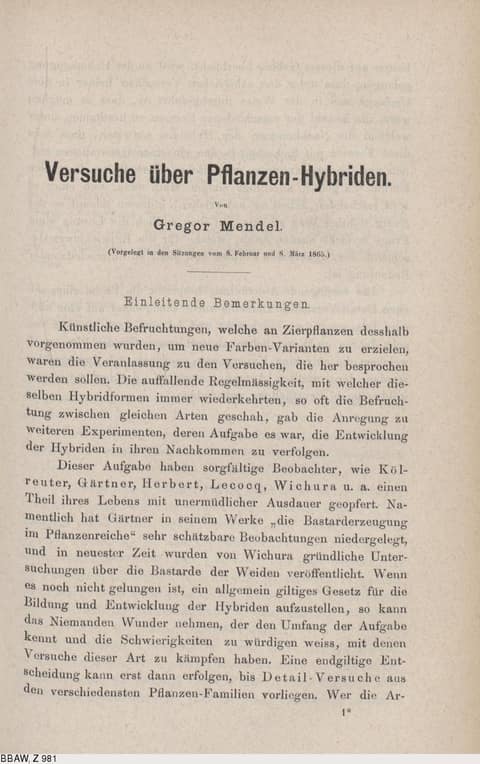

Gregor Mendel, 1866 (exemplaire BBAW, Deutsches Textarchiv), domaine public, via Wikimedia CommonsPDMOriginal record
Data saver is on. Images load only when you ask. You can change this in Settings at any time.
From the archivist
Behind the walls of an abbey in Moravia, a friar sowed peas. He grew them in rows, and with fine forceps he opened the unripe flowers, took out their stamens and dusted each one with pollen from another plant.
For eight summers Gregor Mendel counted. Round seeds and wrinkled ones, yellow and green, tall stems and short. In the first generation of hybrids one form vanished; in the next it returned, in about a quarter of the plants, again and again, as if something whole had been hidden and handed on.
He read his results to a local society of naturalists on two winter evenings in 1865, and they were printed the following year. Copies went out to libraries across Europe. Almost no one understood what they held. Mendel became abbot, took up the business of his house, and died in 1884.
Sixteen years later, three botanists working apart reached the same ratios and came upon his paper. What the archive keeps here is its first page, with the plain title he gave it: experiments on plant hybrids.
Established
- Between 1856 and 1863 Gregor Mendel grew and crossed garden peas, Pisum sativum, in the garden of the Augustinian abbey of St Thomas in Brünn, now Brno (Vyskot and Široký 2022).
- He followed seven characters, each in two contrasting forms, such as round or wrinkled seeds and yellow or green seeds; in the hybrids one form alone appeared, and in the next generation the other came back in about one plant in four, for example 5,474 round seeds to 1,850 wrinkled (Mendel 1866).
- He presented his results at the meetings of the Natural Science Society of Brünn on 8 February and 8 March 1865, and they were printed as Versuche über Pflanzen-Hybriden in the Society's proceedings for 1865, issued in 1866 (Mendel 1866; Vyskot and Široký 2022).
- The paper drew little attention until 1900, when three botanists, Hugo de Vries, Carl Correns and Erich von Tschermak, reported similar results and brought it back to light (Vyskot and Široký 2022).
- Mendel became abbot in 1868; his handwritten manuscript of the paper, twelve double sheets, is still kept at the abbey (St Thomas's Abbey, Old Brno).
- In 1936 the statistician Ronald Fisher argued that Mendel's figures agreed with his expected ratios more closely than chance should allow (Fisher 1936).
Interpretation
Fisher did not accuse Mendel of fraud; he suggested that the data had been adjusted, perhaps by an assistant who knew what was expected. The question has been argued ever since. Later authors, among them Hartl and Fairbanks in 2007, found no evidence of deliberate falsification and traced much of the excess of agreement to Fisher's own assumptions about how Mendel worked, or to honest choices in counting; others think that some unconscious selection remains possible, and the question is not wholly closed. Why the paper was neglected for thirty-four years, and whether Mendel himself meant to found a theory of heredity or to study hybrids, are also debated, as is how independent each of the three rediscoveries of 1900 really was.
In 10,000 years
In 10,000 years, when living things may be written as easily as they are read, will anyone remember that the first letters were counted in rows of peas in a monastery garden?
Sources (5)
- Mendel, G. Versuche über Pflanzen-Hybriden. Verhandlungen des naturforschenden Vereines in Brünn 4 (1865), Abhandlungen, p. 3-47, published 1866; digitised by the Deutsches Textarchiv. · www.deutschestextarchiv.de
- Vyskot, B., Široký, J. Bicentennial of Gregor Johann Mendel's birth: Mendel's work still addresses geneticists in 2022. Frontiers in Plant Science 13, 2022, 969745. · pmc.ncbi.nlm.nih.gov
- Fisher, R. A. Has Mendel's work been rediscovered? Annals of Science 1 (2), 1936, p. 115-137. · doi.org
- Hartl, D. L., Fairbanks, D. J. Mud sticks: on the alleged falsification of Mendel's data. Genetics 175 (3), 2007, p. 975-979. · www.genetics.org
- Augustinian Abbey of St Thomas, Old Brno. The manuscript of Mendel's work Versuche über Pflanzen-Hybriden. · www.mendel-genetics.cz
Related fragments
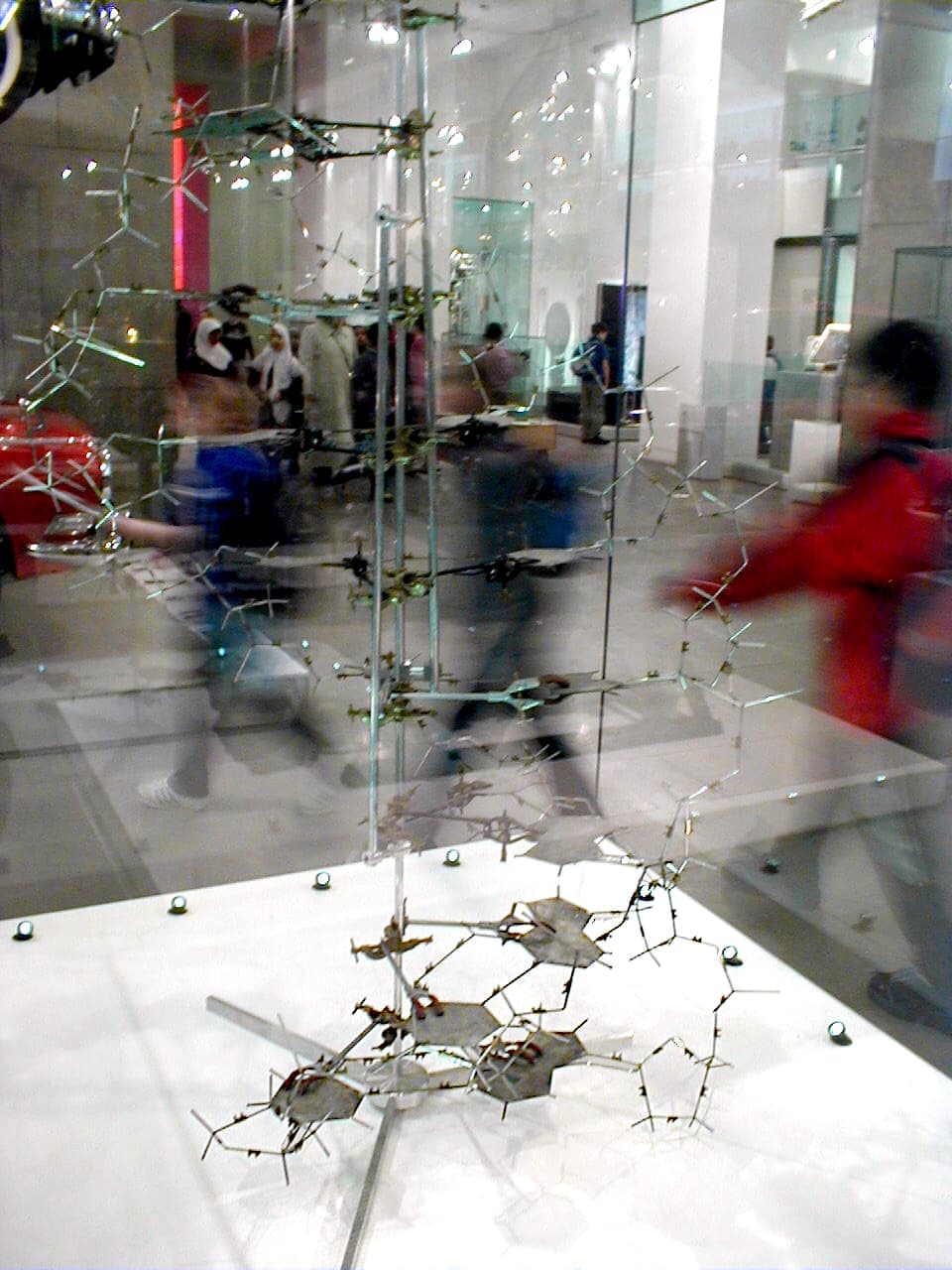
1953
The double helix: the structure of DNA
Cambridge, United Kingdom · Europe
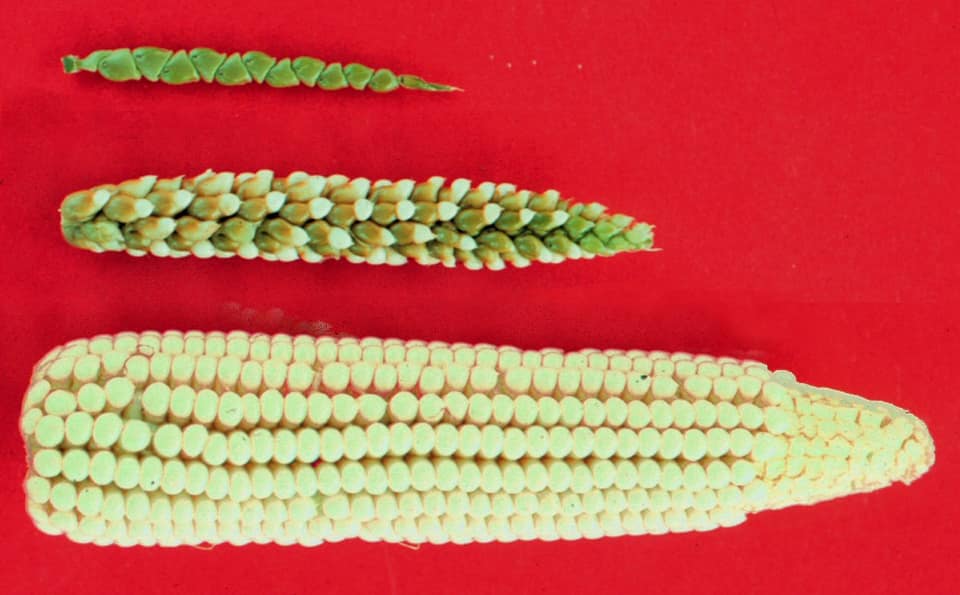
c. 7000 BCE
Maize, from teosinte
Near Iguala, Guerrero, Mexico · Americas