Bikini: a home left for the good of mankind
- Dated
- Place
- Bikini Atoll, Republic of the Marshall Islands · The people of Bikini Atoll, Marshall Islands
- Coordinates
- 11° 37′ N · 165° 33′ E (approximate)
- Remains
- Fragmentary
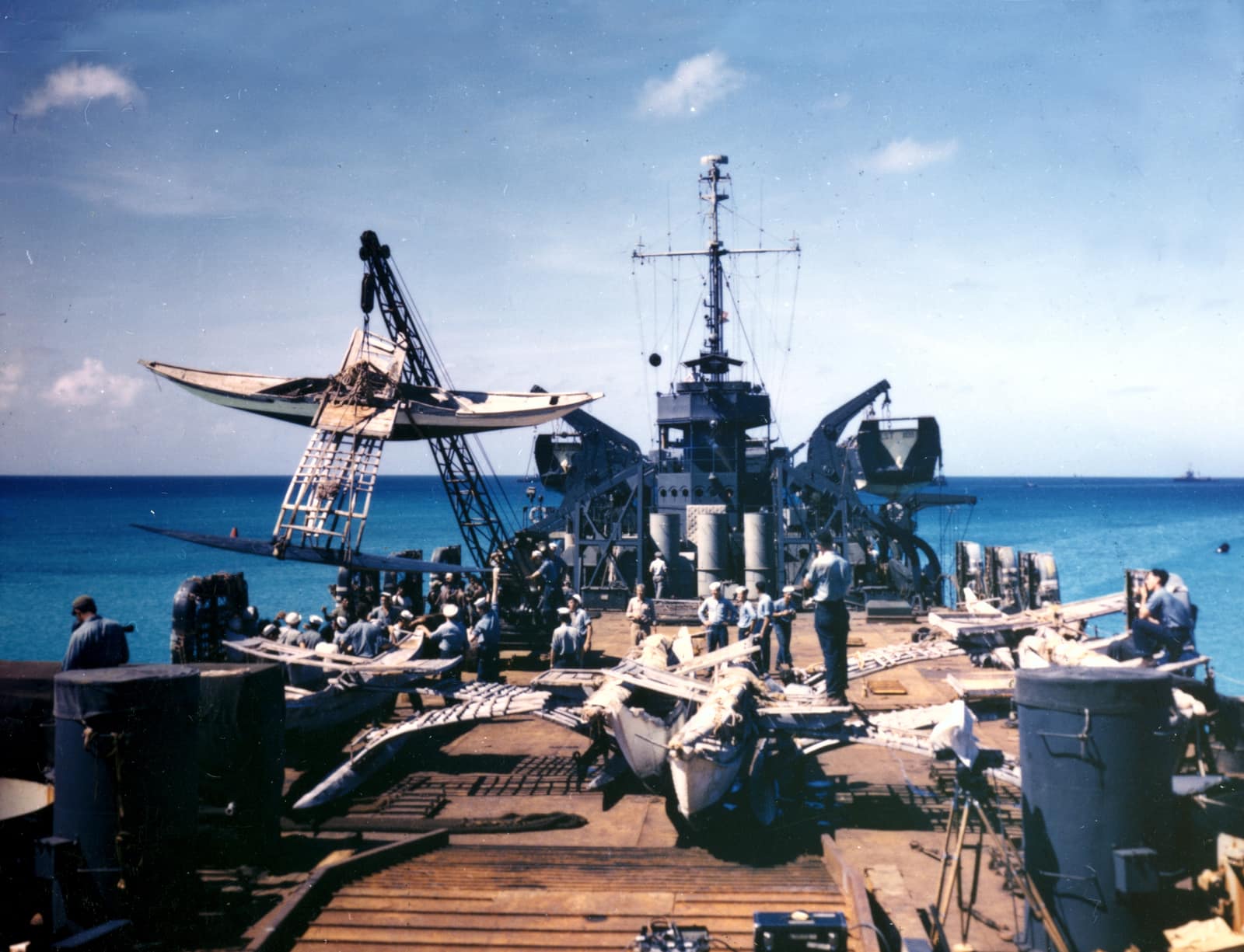
U.S. Department of Defense, March 1946, U.S. National Archives (NAID 146763094), public domainPDMOriginal record
Data saver is on. Images load only when you ask. You can change this in Settings at any time.
From the archivist
On a Sunday early in 1946, an American naval officer came to Bikini and asked its people to leave their atoll for a while, so that his country could test atomic bombs for the good of mankind. The people met. Then Juda, their leader, gave the answer: they would go, believing that everything is in the hands of God.
They took what they could carry. They cut pandanus leaves from their own trees to thatch the houses they would build on the next atoll, and they watched their outrigger canoes lifted by crane onto the deck of a navy ship.
Rongerik could not feed them. Within two years they were hungry, and they were moved again, then again, to Kili, an island with no lagoon, where fishing people were told to become farmers.
In the 1970s some families went home, to cleared ground and replanted fruit trees. Then what they ate there was found in their bodies, and in 1978 they were taken away a second time.
Children born in exile have grown old. In 2010 Bikini was inscribed on the World Heritage List, for the bombs. Its people still cannot live there.
Established
- On a Sunday afternoon early in 1946, Commodore Ben Wyatt, military governor of the Marshall Islands, asked the people of Bikini whether they would leave their atoll temporarily so that the United States could test atomic bombs for 'the good of mankind and to end all wars'; Juda, their leader, announced that they would go 'believing that everything is in the hands of God' (National Museum of American History).
- Before the first test, the 167 Bikinians living on Bikini Island were moved to Rongerik Atoll, about 200 km to the east, from 7 March 1946; their outrigger canoes were loaded aboard the landing ship LST-1108 (IAEA 1998; U.S. National Archives).
- After months of food shortage on Rongerik they were moved in March 1948 to Kwajalein, and in November 1948 to Kili, a single island without a lagoon, where people who lived by fishing were expected to farm (IAEA 1998; United States, A/HRC/21/48/Add.2).
- In 1968 the atoll was declared safe; families returned from 1972 and some 139 Bikinians eventually resettled. In 1977 and 1978 the caesium-137 in their bodies rose sharply, attributed to food grown on the island, and in 1978 they were moved away again, most of them to Ejit Island in Majuro (IAEA 1998; United States, A/HRC/21/48/Add.2).
- Three islands of the atoll were vaporised by the tests (United States, A/HRC/21/48/Add.2). In 2016, external gamma radiation on Bikini Island still exceeded the standard agreed between the United States and the Marshall Islands, and resettlement had not been realised (Bordner et al. 2016).
- Bikini Atoll Nuclear Test Site was inscribed on the World Heritage List in 2010, the first site in the Marshall Islands (UNESCO).
Interpretation
Figures differ between sources. UNESCO counts 67 nuclear tests from 1946 to 1958, which is the total for Bikini and Enewetak together; the IAEA counts sixteen tests at Bikini, and other accounts give twenty-three. The official pictorial record of 1946 gives 161 people moved on the day, against 167 in most accounts. Whether the people of Bikini could truly refuse in 1946 is debated; the words 'temporarily' and 'for the good of mankind' are those of the request as recorded by the Smithsonian from the LIFE report of the time.
Looking ahead
What will be the last thing we carry out of a home we cannot return to?
Sources (6)
- UNESCO World Heritage Centre. Bikini Atoll Nuclear Test Site (inscribed 2010), property description. · whc.unesco.org
- Stegnar, P. Assessing radiological conditions at Bikini Atoll and the prospects for resettlement. IAEA Bulletin 40 (4), 1998, p. 15-17. · www.iaea.org
- United Nations Human Rights Council. Report of the Special Rapporteur on hazardous substances and wastes, Mission to the Marshall Islands: comments by the State (United States of America), A/HRC/21/48/Add.2, 2012. · digitallibrary.un.org
- Bordner, A. S., Crosswell, D. A., Katz, A. O., Shah, J. T., Zhang, C. R., Nikolic-Hughes, I., Hughes, E. W., Ruderman, M. A. Measurement of background gamma radiation in the northern Marshall Islands. Proceedings of the National Academy of Sciences 113 (25), 2016, p. 6833-6838. · k1project.columbia.edu
- National Museum of American History, Smithsonian Institution. Carl Mydans, Commodore Ben H. Wyatt addressing the Bikini Island natives, 1946, photograph 2005.0228.109 (record, CC0 metadata). · www.si.edu
- U.S. National Archives and Records Administration. Project 18, Operation Crossroads (Bikini) Test Activities: Bikini outrigger swung aboard LST for transport to Rongerik, photograph 374-ANT-18-CR-402-007 (NAID 146763094). · catalog.archives.gov
Related fragments
1945
Trinity: the first nuclear explosion
Trinity Site, White Sands Missile Range, New Mexico, United States · Americas
1945
The Hiroshima Peace Memorial (Genbaku Dome)
Hiroshima Peace Memorial Park, Hiroshima, Japan · Asia

1920 to 1929
A map of the swell: Marshall Islands stick charts
Majuro, Marshall Islands · Oceania