Webb's First Deep Field
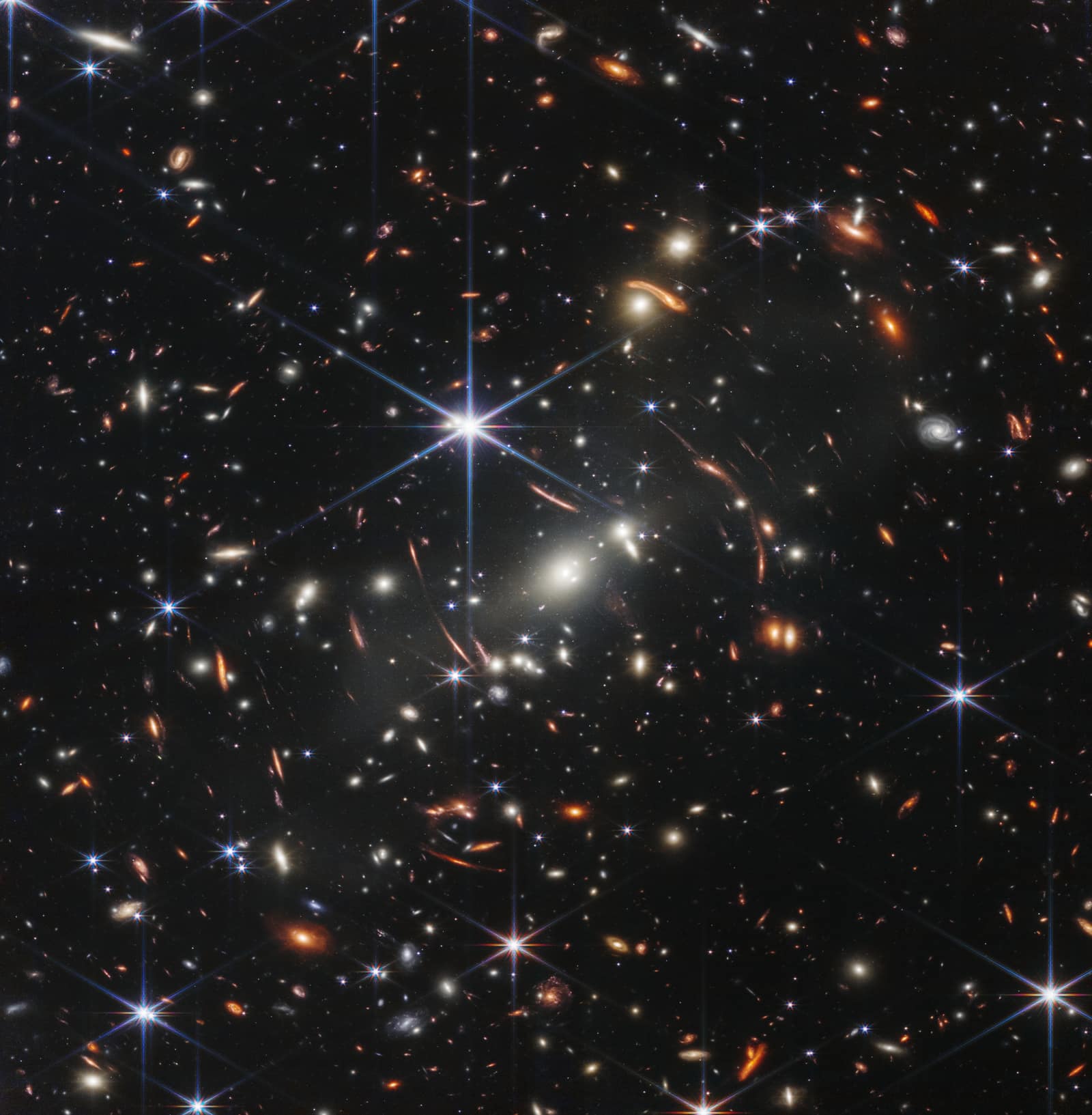
Before July 2022 the deepest infrared views of the distant universe had taken the Hubble Space Telescope weeks of exposure; after it, a new telescope went deeper in 12.5 hours and showed thousands of galaxies in a patch of sky the size of a grain of sand held at arm's length.
- Dated
- Place
- Orbit around the Sun and Earth's second Lagrange point, looking towards the galaxy cluster SMACS 0723 in the southern constellation Volans · The James Webb Space Telescope, built and operated by NASA with the European Space Agency and the Canadian Space Agency; images processed at the Space Telescope Science Institute, Baltimore
- Remains
- Digital

NASA, ESA, CSA, and STScIPDMOriginal record
Data saver is on. Images load only when you ask. You can change this in Settings at any time.
From the archivist
The telescope was launched on Christmas Day 2021, folded like a flower inside the nose of a rocket, from the coast of South America. For a month it unfolded itself on the way out: a sunshield the size of a tennis court, a mirror of gold-coated segments. Then it settled far beyond the Moon, in the cold, with its back to the Sun.
The first image this civilization chose to show was of almost nothing: a speck of the southern sky no bigger than a grain of sand held out at arm's length. The camera looked at it for twelve and a half hours.
What came back was crowded. Thousands of galaxies, white, yellow, orange. Near the centre, a cluster so heavy that it bends the light passing behind it, so that farther galaxies appear stretched into thin, curved arcs.
None of it shows the present. The cluster is seen as it was 4.6 billion years ago, before the Earth had formed. In one small smudge, an instrument on board caught light that had been travelling for 13.1 billion years.
A president unveiled the picture in a room in Washington. The next day, the rest followed.
Established
- The James Webb Space Telescope, a partnership of NASA, the European Space Agency and the Canadian Space Agency, was launched on an Ariane 5 rocket from Europe's Spaceport in Kourou, French Guiana, on 25 December 2021 (ESA).
- During its first month in space it unfolded its sunshield, roughly the size of a tennis court, and its 6.5 m primary mirror of 18 gold-coated beryllium segments, and on 24 January 2022 it reached its orbit around the second Lagrange point, about 1.5 million km from Earth (NASA).
- On 11 July 2022, at a public event at the White House, President Joe Biden released its first full-colour image, Webb's First Deep Field, centred on the galaxy cluster SMACS 0723; the rest of the first images and spectra, including the Carina Nebula, Stephan's Quintet, the Southern Ring Nebula and the planet WASP-96 b, followed on 12 July (NASA; Pontoppidan et al. 2022).
- The deep field was taken with Webb's Near-Infrared Camera; it combines images at different wavelengths totalling 12.5 hours, and reaches deeper in the infrared than the Hubble Space Telescope's deepest fields, which took weeks (NASA).
- It shows the cluster SMACS 0723 as it appeared 4.6 billion years ago; the mass of the cluster acts as a gravitational lens that magnifies more distant galaxies behind it, and the patch of sky covered is about the size of a grain of sand held at arm's length (NASA).
- In the same observations, Webb's Near-Infrared Spectrograph recorded light from one galaxy that had travelled for 13.1 billion years before reaching the telescope (NASA).
Interpretation
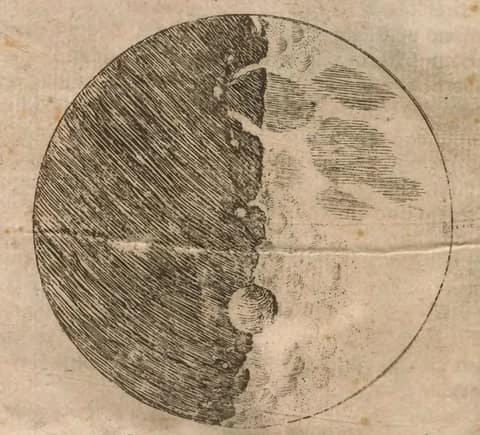
The image was an early release intended to show the public that the telescope was ready for science, not a finished scientific result, and the distances of most of the galaxies in it had yet to be measured. Its makers presented it as the opening of a new age of astronomy; whether it will be remembered as a turning point or as the first frame of a long series is for later archivists to judge. It stands beside Galileo's first telescopic observations, which also showed more than anyone had seen before in a small piece of sky.
In 10,000 years
The archive cannot yet say how history will judge this picture; in 10,000 years, will the light it caught, already 13 billion years old, seem any older?
Sources (5)
- NASA. President Biden reveals first image from NASA's Webb Telescope, news release, 11 July 2022. · www.nasa.gov
- NASA. NASA's Webb delivers deepest infrared image of universe yet, 12 July 2022. · science.nasa.gov
- European Space Agency. Webb liftoff on Ariane 5 to unlock secrets of the Universe, 25 December 2021. · www.esa.int
- NASA Webb blog. Orbital insertion burn a success, Webb arrives at L2, 24 January 2022. · science.nasa.gov
- Pontoppidan, K. M., Barrientes, J., Blome, C., et al. The JWST Early Release Observations. The Astrophysical Journal Letters 936, L14, 2022. · doi.org
Related fragments
1610
Sidereus Nuncius (Galileo, 1610)
Venice, Italy · Europe
1968
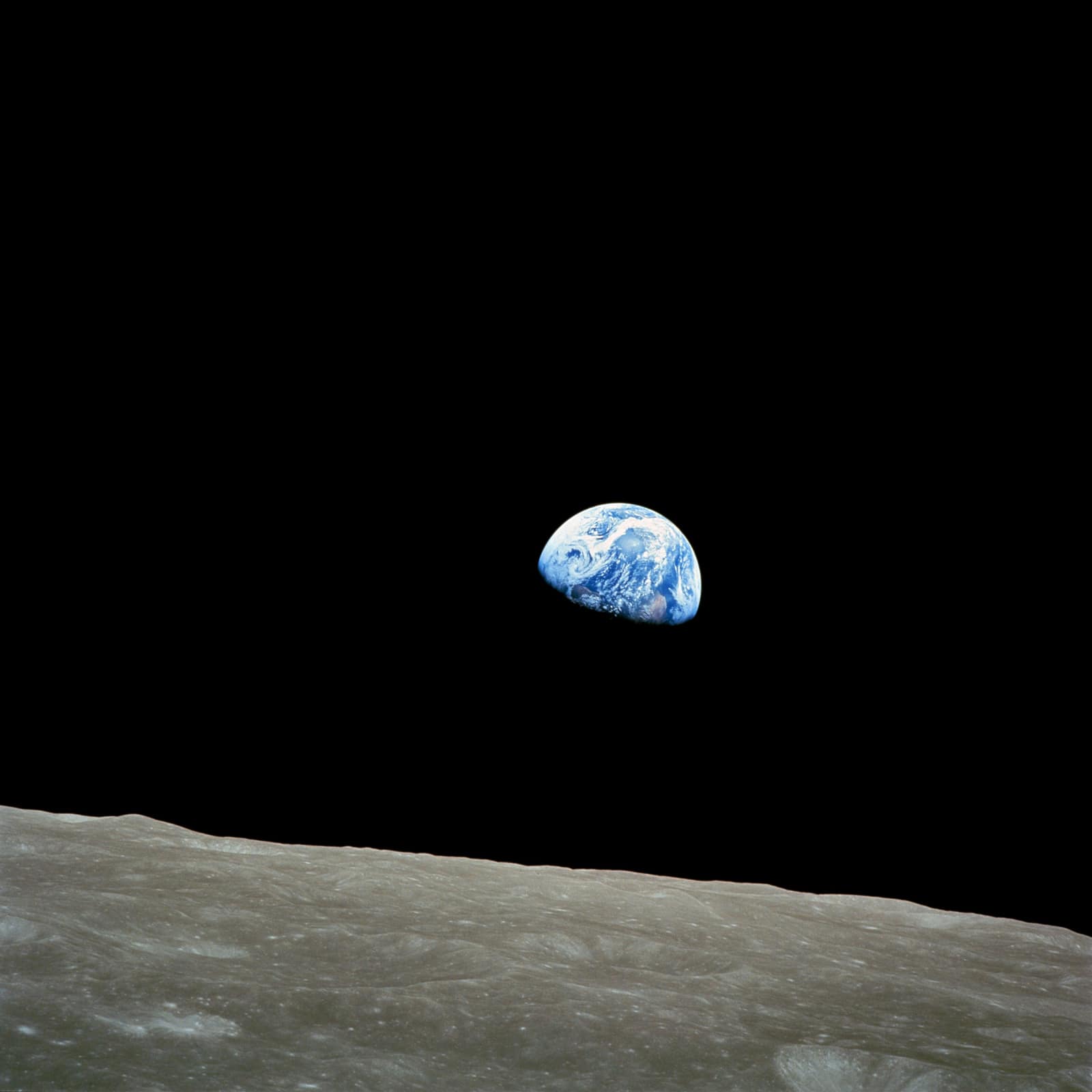
Earthrise
Lunar orbit, above the eastern limb of the Moon's far side · Americas
1977
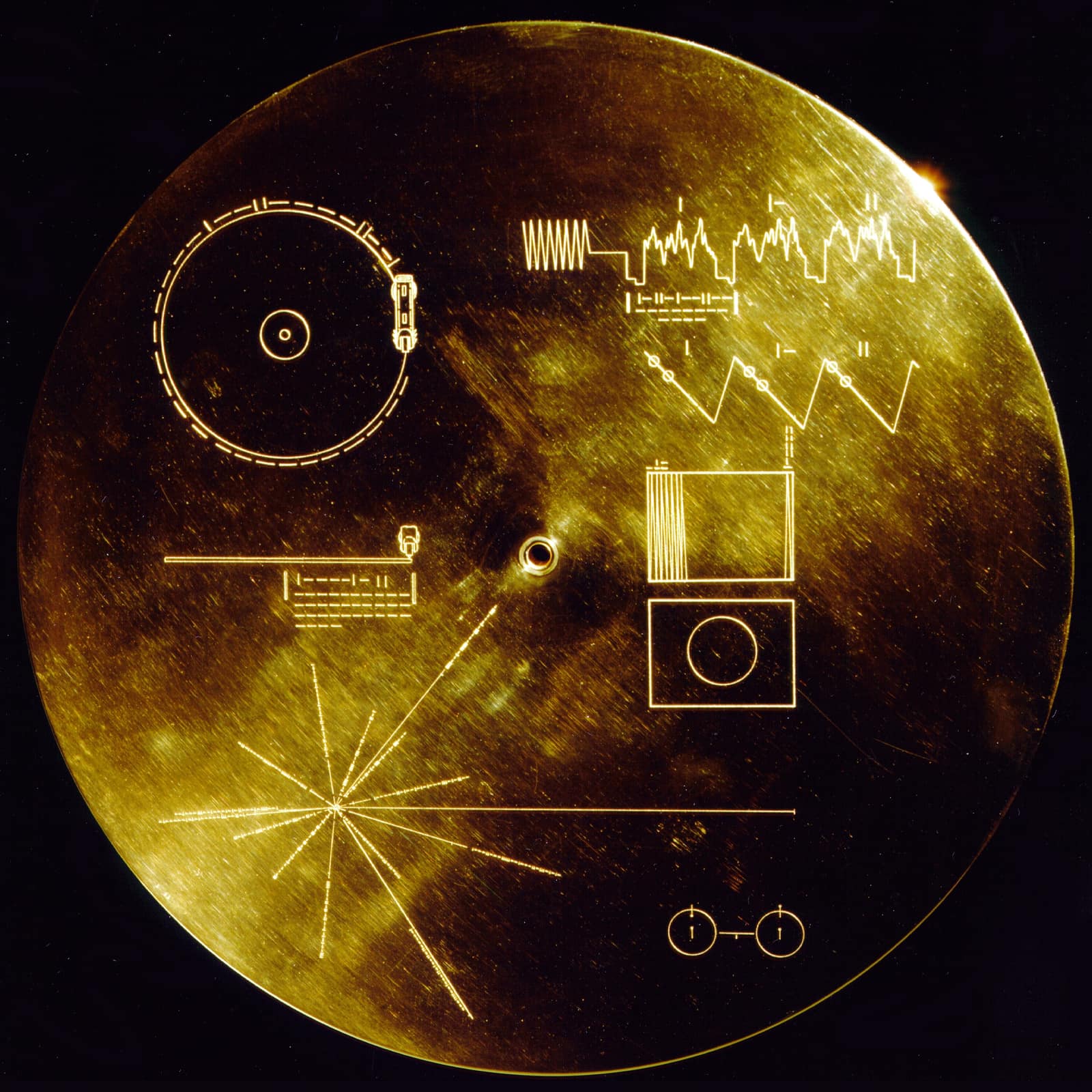
The Golden Record
Voyager 1 · Voyager 2 · Americas