Cool fire: Aboriginal burning that cares for Country
- Dated
- Place
- Around Parnngurr, Western Desert, Western Australia, Australia · Aboriginal and Torres Strait Islander peoples of Australia; here the Martu of the Western Desert and the Bininj/Mungguy of Kakadu
- Coordinates
- 22° 49′ S · 122° 36′ E (approximate)
- Remains
- Intact
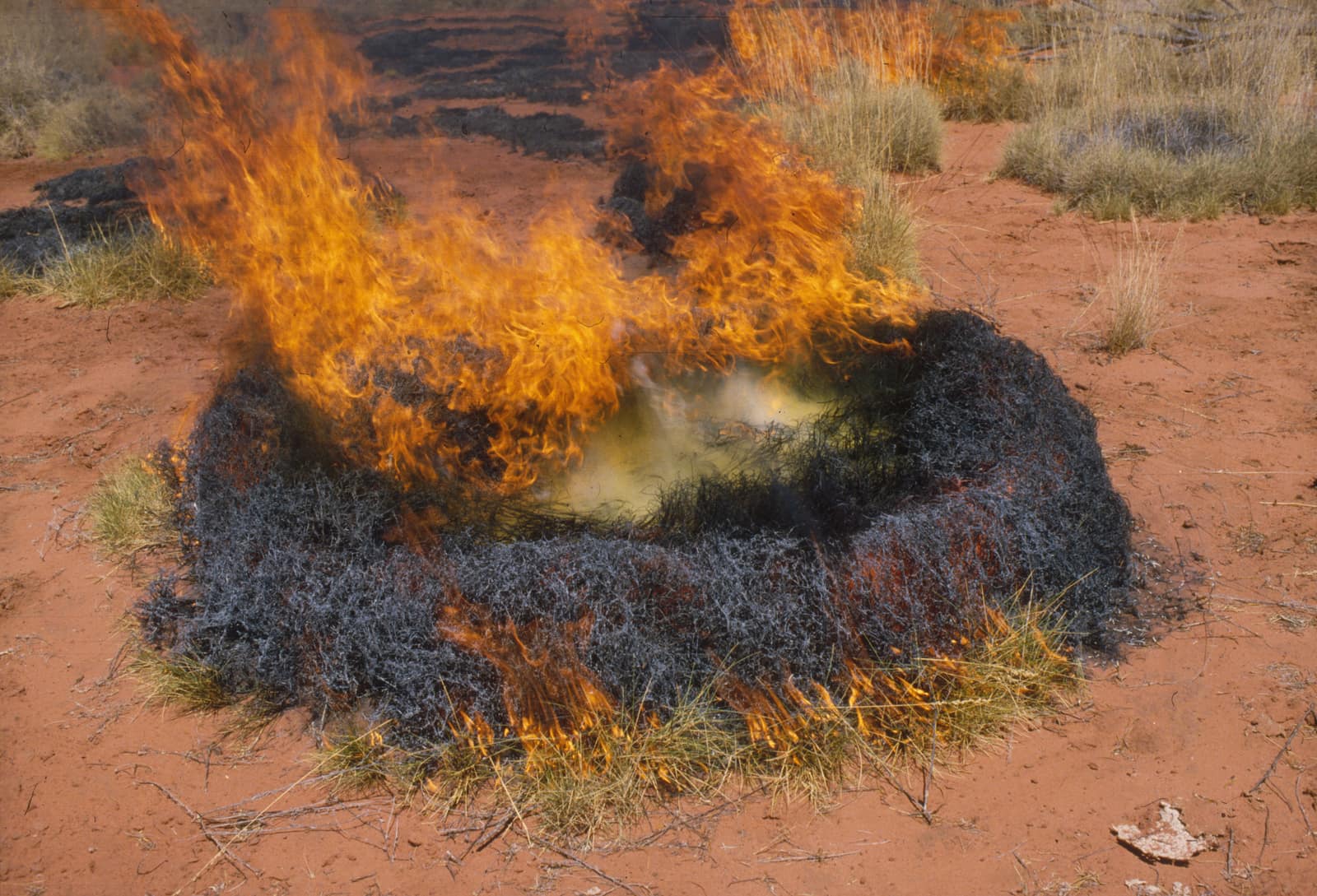
Robert Kerton, CSIRO, CC BY 3.0, via Wikimedia CommonsCC-BY-3.0Original record
Data saver is on. Images load only when you ask. You can change this in Settings at any time.
From the archivist
In the cool months, in the Western Desert, Martu women went out for goanna. They set fire to the old spinifex, the tussocks grown high and tangled, and walked behind the low line of flame. Where the ground had been opened, they could see the burrows, and they dug.
These fires were small, a few hectares at most. Burned ground beside unburned, young growth beside old, they left the desert patched in different ages, like a cloth mended many times. Over many hunts, the women brought home more from burned ground, and came back empty-handed less often.
Far to the north, in Kakadu, Bininj/Mungguy light their fires as the wet season ends, when the country begins to dry and the days turn cooler. A cool fire creeps through the grass all day and goes out by itself in the evening chill. What it has eaten cannot feed a great blaze later in the year.
Where colonisation stopped such fires, shrubs filled the open woodlands of the southeast, and the fires that came were of another kind.
The fire sticks have been taken up again. This civilisation has not vanished, and its fires are still lit, small, in the cool of the year.
Established
- The Martu are Indigenous owners of some 150,000 km² of Australia's Western Desert; in the 1980s, after returning from missions and pastoral stations, they established permanent outstations on their Country, among them Parnngurr (Bliege Bird et al. 2008).
- Most Martu fires are lit in winter, from April to October, in mature spinifex on the sandplain, and most of the burning serves women's hunts for sand monitor lizards (Varanus gouldii); hunters follow the fire line and dig occupied burrows out of the freshly burned ground (Bliege Bird et al. 2008).
- A hunting fire typically burns a tract of 1 to 10 hectares. On fresh burns, harvests and hourly returns were higher, and the share of failed hunts fell from 22 to 4 per cent (Bliege Bird et al. 2008).
- Landscapes burned by people held smaller and more numerous patches of different ages than landscapes burned by lightning, a mean of about 58 against 189 hectares (Bliege Bird et al. 2008).
- In Kakadu, Bininj/Mungguy light small, cool, patchy grass fires from about April to July; a cool fire on a winter's day burns slowly through the grass and goes out in the evening when the temperature drops (Parks Australia 2023).
- Before British colonisation the forests and woodlands of southeastern Australia held fewer shrubs and more grass; the disruption of Indigenous burning changed fuels and, with a changing climate, left the region open to fires of unprecedented extent (Mariani et al. 2022).
Interpretation
The phrase 'fire-stick farming' was coined by the archaeologist Rhys Jones in 1969; 'cool burning' and 'cultural burning' are terms used today by Aboriginal fire practitioners and agencies, and Traditional Owners stress that burning belongs to particular Country and the people of that Country, not to a technique that can be moved. How far back landscape burning goes, over the tens of thousands of years that people have lived in Australia, and how much it shaped the continent's vegetation, are still debated by scientists. The study of Martu hunting measures the effect of the fires on hunting and habitat; it does not speak for the meaning the Martu give to them.
Looking ahead
Will a later age remember that some of us learned to live with fire by asking it to be small?
Sources (4)
- Bliege Bird, R., Bird, D. W., Codding, B. F., Parker, C. H., Jones, J. H. The 'fire stick farming' hypothesis: Australian Aboriginal foraging strategies, biodiversity, and anthropogenic fire mosaics. Proceedings of the National Academy of Sciences 105 (39), 2008, p. 14796-14801. · pmc.ncbi.nlm.nih.gov
- Mariani, M., Connor, S. E., Theuerkauf, M., Herbert, A., Kuneš, P., Bowman, D., Fletcher, M. S., Head, L., Kershaw, A. P., Haberle, S. G., Stevenson, J., Adeleye, M., Cadd, H., Hopf, F., Briles, C. Disruption of cultural burning promotes shrub encroachment and unprecedented wildfires. Frontiers in Ecology and the Environment 20 (5), 2022, p. 292-300. · researchportalplus.anu.edu.au
- Parks Australia, Kakadu National Park. Kakadu cultural burns, 9 March 2023. · kakadu.gov.au
- Jones, R. Fire-stick farming. Australian Natural History 16, 1969, p. 224-228 (cited through Bliege Bird et al. 2008; not consulted directly).
Related fragments
c. 1 million years ago
Early fire at Wonderwerk Cave
Between Danielskuil and Kuruman, Northern Cape, South Africa · Africa
c. 780,000 years ago
The hearths of Gesher Benot Ya'aqov
Banks of the Jordan River near the Bnot Ya'akov Bridge, northern Israel · Asia
before 4600 BCE
The eel traps of Budj Bim
Tae Rak (Lake Condah), Kurtonitj and Tyrendarra, south-western Victoria, Australia · Oceania
c. 23,000 years ago
The footprints of the Willandra Lakes
Willandra Lakes Region World Heritage Area, New South Wales, Australia (exact site not disclosed) · Oceania