Stonehenge, stones from three horizons
- Dated
- Place
- Stonehenge, near Amesbury, Wiltshire, England, United Kingdom · Neolithic and early Bronze Age communities of Britain, who brought stone from the Marlborough Downs, west Wales and north-east Scotland
- Coordinates
- 51° 11′ N · 1° 50′ W (approximate)
- Remains
- Fragmentary
This fragment shows an object held as sacred.
It is shown here as the institution that holds it presents it. Some communities connected to it ask that it be viewed with care. You may choose to see the image, or read the record without it.
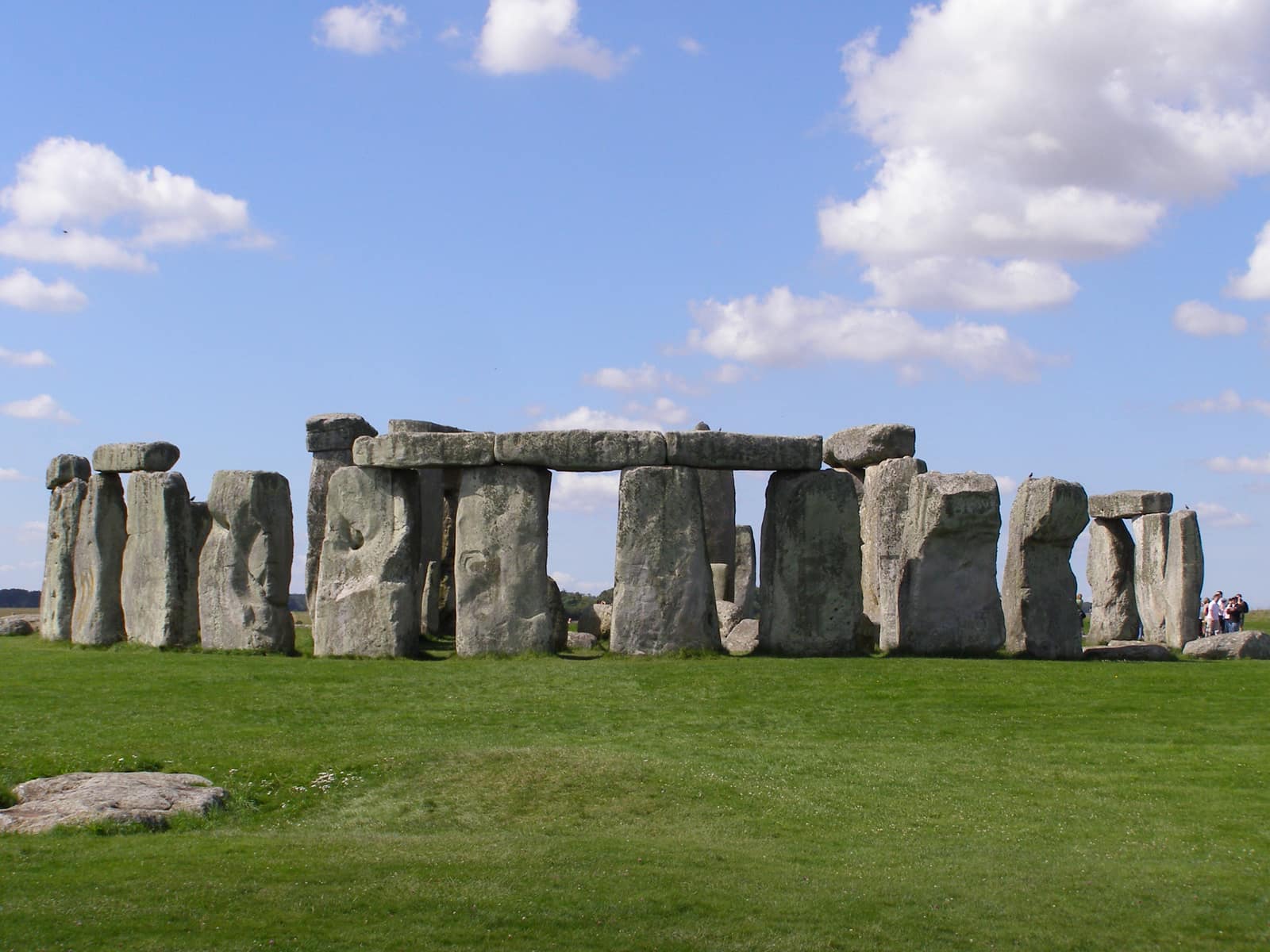

Image veiled by default
garethwiscombe, CC BY 2.0, via Wikimedia CommonsCC-BY-2.0Original record
Data saver is on. Images load only when you ask. You can change this in Settings at any time.
From the archivist
First there was only a ring dug into the chalk with the antlers of red deer, and the ashes of the dead placed around it.
Five centuries later the people of this island began to bring the stones. The great grey blocks came from a wood a day's march to the north. The smaller ones, bluish, came from the hills of west Wales, beyond rivers and mountains. One, the stone at the centre, came from the far north of the island, from the edge of the northern sea, farther than any other stone in the circle.
They shaped them with hammerstones, cut joints into them as a carpenter would into timber, raised them with ropes and levers, and laid lintels across the tops.
The circle was aligned on the turning of the year. On the longest day the sun rises at its gate; on the shortest, it sets between its two tallest stones.
Established
- About 3000 BCE a circular ditch with an inner and an outer bank, some 100 metres across, was dug on Salisbury Plain with antler picks; inside the bank lay a ring of 56 pits, the Aubrey Holes (English Heritage).
- About 64 cremation burials have been found and perhaps 150 people were buried there, making it the largest known late Neolithic cemetery in the British Isles (English Heritage).
- About 2500 BCE the stones were set up: large sarsens in an outer circle of probably 30 uprights and an inner horseshoe of five trilithons, with smaller bluestones between them, joined by mortise and tenon and tongue and groove joints borrowed from woodworking (English Heritage).
- In 2020 a geochemical study found that 50 of the 52 surviving sarsens came from a common source at West Woods, about 25 km to the north (Nash et al. 2020); the bluestones, of 2 to 5 tonnes each, came from the Preseli Hills in south-west Wales, more than 200 km away (English Heritage).
- In 2024 mineral grains from the Altar Stone, a shaped block of about 6 tonnes, were matched to the Old Red Sandstone of the Orcadian Basin in north-east Scotland, at least 750 km away (Clarke et al. 2024).
- At midsummer the sun rises in the north-east close to the Heel Stone; at midwinter it sets in the south-west between the two tallest trilithons (English Heritage).
Interpretation
Why Stonehenge was built remains open: a monument to the dead, a place of healing, a calendar of the solstices, a symbol of union between distant peoples have all been proposed, and none excludes the others. The solstice alignment is measured; whether the builders gave more weight to the midwinter sunset than to the midsummer sunrise is argued. How the stones travelled is inferred, not observed: the authors of the 2024 study suggest the Altar Stone came by sea, since the land route was long and blocked by mountains, and the exact outcrop in Scotland has not been found. Some geologists still question the Scottish origin.
In 10,000 years
In 10,000 years, will the sun still rise over the Heel Stone for someone who knows why it was placed there?
Sources (5)
- English Heritage. History of Stonehenge; Description of Stonehenge. · www.english-heritage.org.uk
- English Heritage. Building Stonehenge. · www.english-heritage.org.uk
- Nash, D. J., et al. Origins of the sarsen megaliths at Stonehenge. Science Advances 6 (31), eabc0133, 2020. · doi.org
- Clarke, A. J. I., Kirkland, C. L., Bevins, R. E., Pearce, N. J. G., Glorie, S., Ixer, R. A. A Scottish provenance for the Altar Stone of Stonehenge. Nature 632, 2024, p. 570-575. · doi.org
- UNESCO World Heritage Centre. Stonehenge, Avebury and Associated Sites (inscribed 1986). · whc.unesco.org
Related fragments
9600 to 8200 BCE
Göbekli Tepe
Near Şanlıurfa, Türkiye · Asia
c. 2560 BCE
The Great Pyramid of Giza
Giza, Greater Cairo, Egypt · Africa
1420 to 1532
Machu Picchu, the mountain estate of an Inca ruler
Historic Sanctuary of Machu Picchu, Urubamba province, Cusco region, Peru · Americas