Sputnik 1, the first artificial satellite
Before 4 October 1957 nothing made by human hands had ever circled the Earth; after it, one did, and the space age, with its satellites for weather, navigation and communication, began.
- Dated
- Place
- Baikonur Cosmodrome, Kazakhstan · Soviet engineers of the design bureau OKB-1, led by Sergei Korolev, and the launch crews of a test range in the Kazakh steppe
- Coordinates
- 45° 55′ N · 63° 21′ E (approximate)
- Remains
- Lost
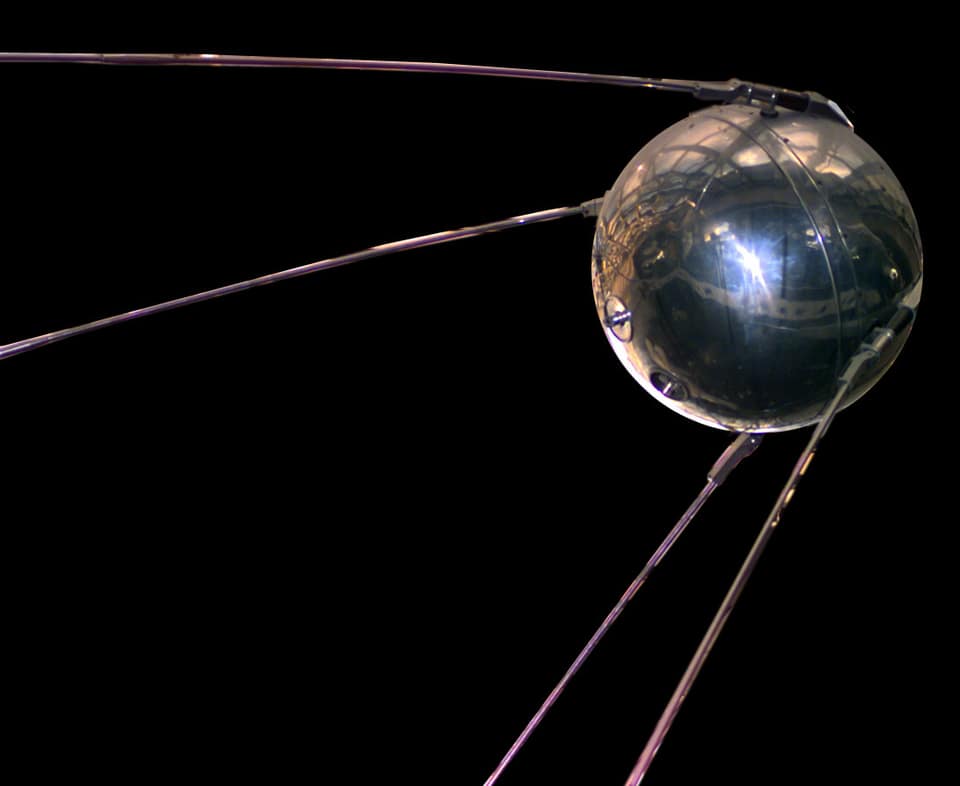

NSSDC, NASAPDMOriginal record
Data saver is on. Images load only when you ask. You can change this in Settings at any time.
From the archivist
It was a ball of polished metal, not much larger than a child could hold in both arms, with four whip antennas trailing behind it. Inside there were batteries, a radio, and little else.
On 4 October 1957, from the steppe of Kazakhstan, a rocket built to carry a warhead lifted it instead into orbit. It passed over the continents, again and again, about every hour and a half. It did nothing but call: a short beep, a pause, a short beep. Radio amateurs on several continents tuned in and heard it. People went out at night to look for the rocket's body tumbling along the same path, bright enough to see.
After three weeks the batteries were spent and the calling stopped. The sphere went on circling in silence until January, then fell into the air and burned.
It was the first thing this civilization ever made that did not come back down at once. Everything since, the weather images, the navigation signals, the voices carried across oceans, travels along the road it opened.
Established
- On 4 October 1957 the Soviet Union placed Sputnik 1 in orbit, launched from a site now known as the Baikonur Cosmodrome in Soviet Kazakhstan on a modified R-7 rocket; the effort was led by the chief designer Sergei Korolev (NASA).
- The satellite was a sphere 58 cm across weighing 83.6 kg, and circled the Earth in about 98 minutes (Library of Congress); NASA gives about 90 minutes.
- It carried only a radio transmitter, whose regular beeps could be picked up by receivers on the ground; its batteries ran out on 26 October 1957, and it re-entered the atmosphere on 4 January 1958 (NASA).
- In the United States the launch led to Congressional hearings and to the law that created NASA, which opened on 1 October 1958 (NASA).
- The agency later called DARPA was created in response to Sputnik; its research network, ARPANET, became one of the foundations of the Internet (DARPA).
Interpretation
Sputnik is usually said to have begun the space race, but the rivalry, and the rocket that launched it, came from the arms race: the R-7 had been designed to carry a nuclear warhead across continents. How much alarm it caused in the West, and how much that alarm was amplified for political ends, is discussed by historians. Its passage over so many nations also helped settle, without a treaty, that orbit lay beyond national airspace.
In 10,000 years
In 10,000 years, when orbits are crowded with our machines, will anyone remember the first one, and the sound it made?
Sources (3)
- NASA History Office. 65 Years Ago: Sputnik Ushers in the Space Age, 2022. · www.nasa.gov
- Library of Congress. Sputnik and the Space Race: 1957 and Beyond (research guide). · guides.loc.gov
- Defense Advanced Research Projects Agency. About DARPA: innovation at DARPA. · www.darpa.mil
Related fragments
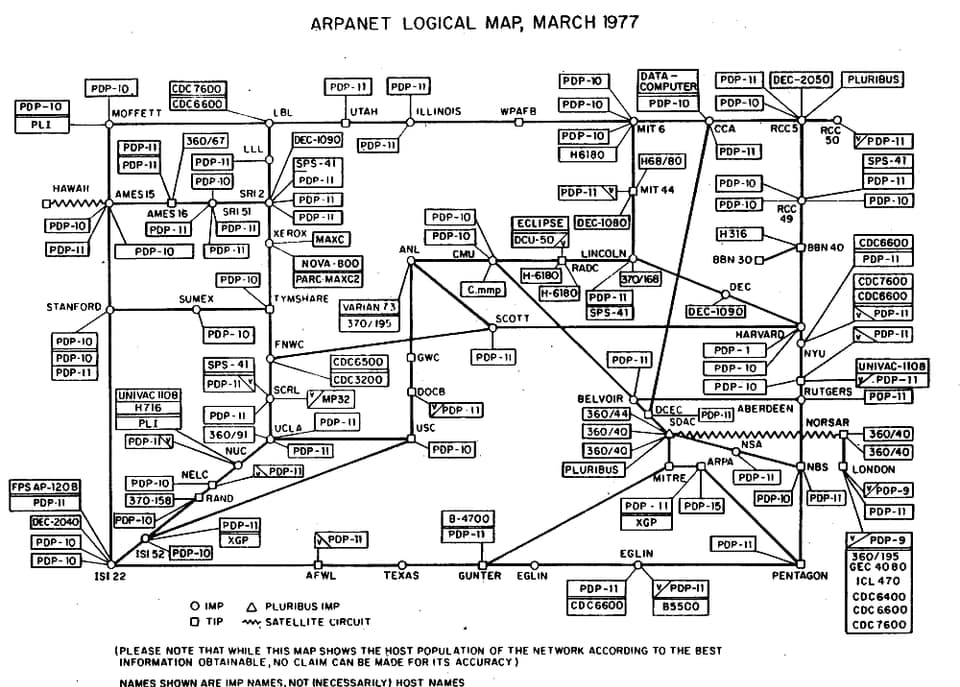
1969 to 1990
A map of a new network: ARPANET
Los Angeles, California, United States · Americas
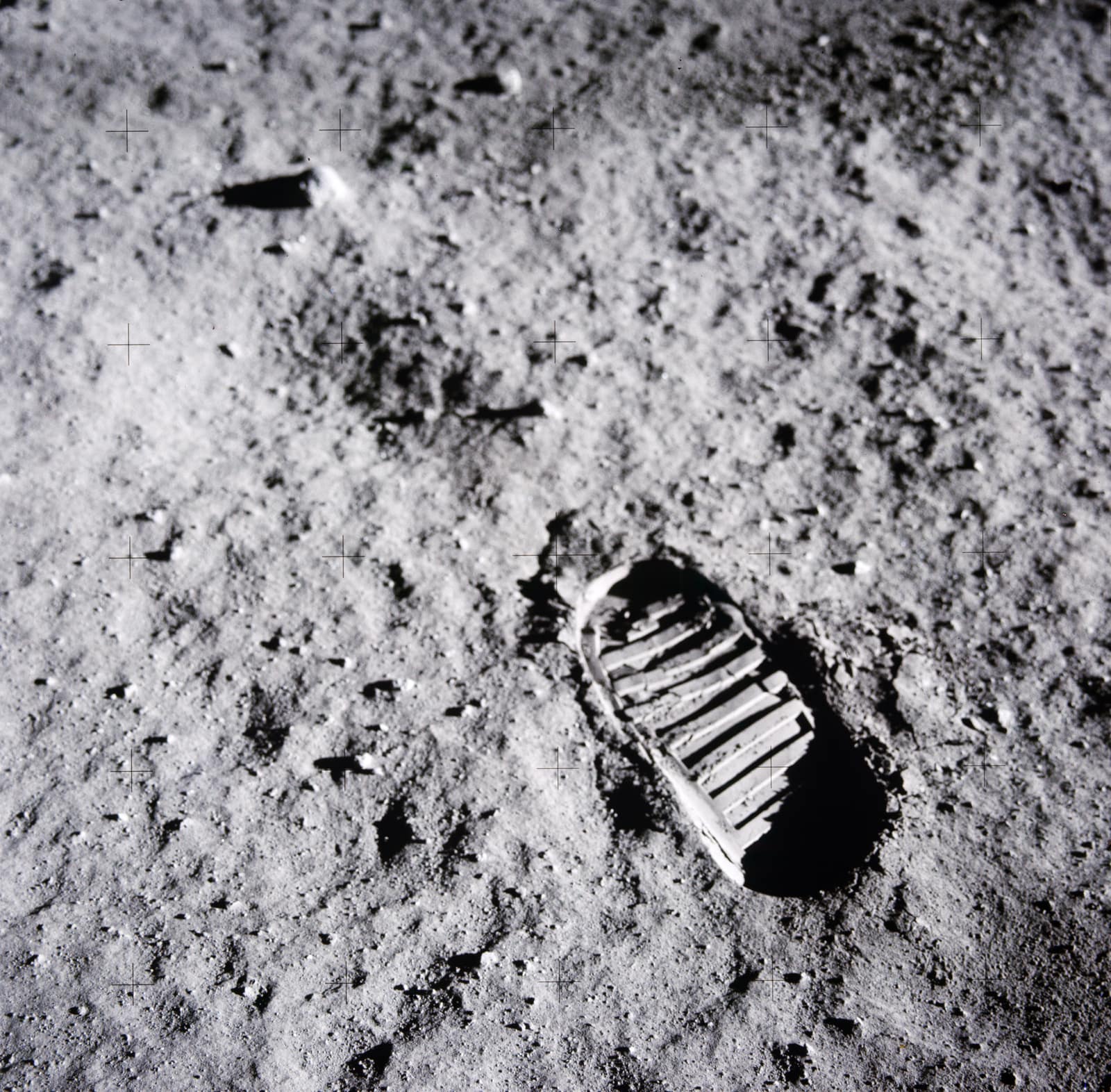
1969
The first footprints on the Moon
Tranquility Base, Sea of Tranquility, the Moon · Americas
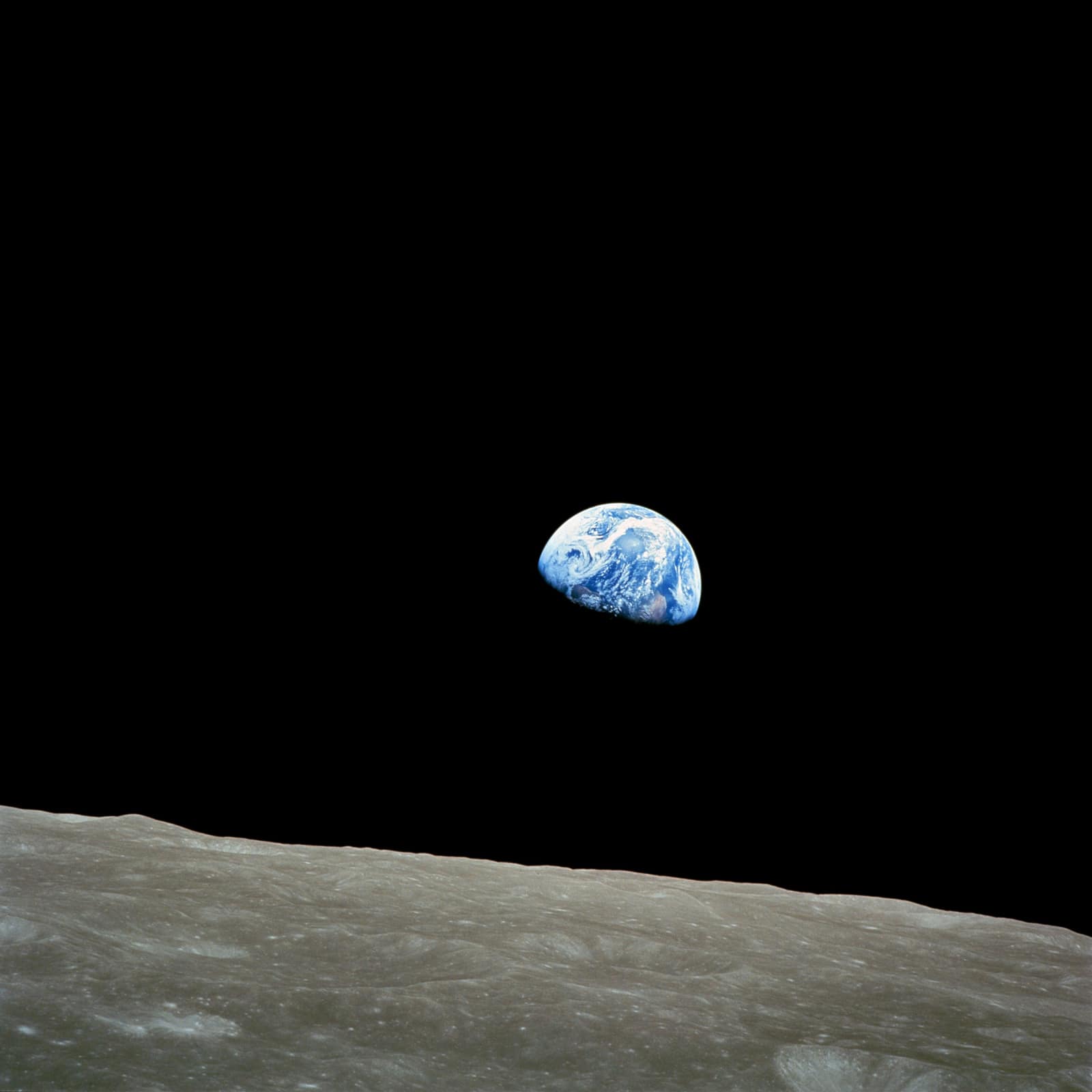
1968
Earthrise
Lunar orbit, above the eastern limb of the Moon's far side · Americas