A ngatu for a first birthday, and for a farewell
- Dated
- Place
- Ha'alaufuli, Vava'u, Tonga · Tongan women who beat, paste and paint barkcloth, Vava'u
- Coordinates
- 18° 38′ S · 173° 57′ W (approximate)
- Remains
- Fragmentary
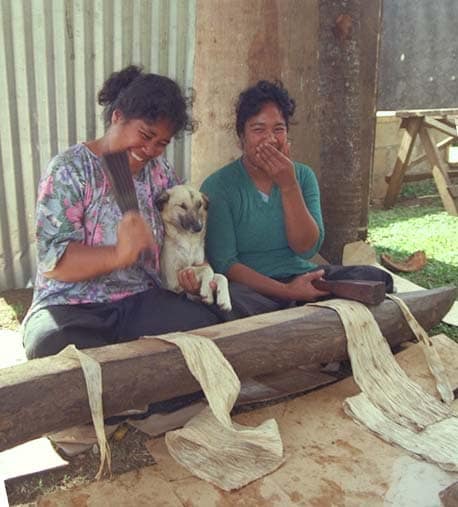
Photo James Foster (Tauʻolunga), 1987, public domain, via Wikimedia CommonsPDMOriginal record
Data saver is on. Images load only when you ask. You can change this in Settings at any time.
From the archivist
In Tonga, ngatu was women's work, and it was rarely done alone. The inner bark of the paper mulberry was beaten thin with wooden mallets, and then women sat along both sides of a long board, passing the pale strips across to one another, pasting edge to edge until the cloth ran for metres.
Around 2010, in Ha'alaufuli, on the island of Vava'u, Ma'ata Tavake Savou made a ngatu for her grandson's first birthday. Her patterns came from a pack of playing cards: kings and queens. The cloth was given to the boy's other grandmother, Shirl Strom, in Wellington, who was not Tongan. In Tonga, that is what ngatu is for. It is given when a child is born, when two people marry, when someone dies. The dead are laid on it, and then wrapped in it.
Shirl Strom died in 2011. At her funeral the ngatu was divided. Half was placed in the casket with her. The other half went to a friend, who later gave it to the national museum, to remember both women.
A cloth made for a beginning was cut in two at an ending, and kept by both.
Established
- Ngatu is the Tongan name for tapa, cloth made from the inner bark of the paper mulberry (hiapo). Men tend the trees while they grow; once the bark is harvested, only women turn it into ngatu (Te Papa).
- The inner bark is beaten into wide sheets. In a koka'anga, the ngatu-making work party, at least twelve women sit on both sides of a long board (papa) of about one metre by five, pass the beaten strips across to one another and paste them together over pattern boards (kupesi); a ngatu measures at least fifty langanga, units of about 45 to 60 cm (Te Papa).
- Ngatu circulates as a gift at births, weddings, funerals and other occasions; at funerals the body is laid on ngatu and then wrapped in it (Te Papa).
- This ngatu was made around 2010 by Ma'ata Tavake Savou of Ha'alaufuli, Vava'u, for her grandson's first birthday and given to his paternal grandmother, Shirl Strom, of Wellington; its motifs are adapted from playing cards, kings and queens of diamonds and of clubs (Te Papa, FE012792).
- When Shirl Strom died in 2011, the cloth was divided at her funeral: half was placed in the casket, and the other half, 95 by 222 cm, was given to Te Papa in 2013 (Te Papa, FE012792).
Interpretation
Te Papa records the cloth under the name of Ma'ata Tavake Savou; whether others beat or pasted it with her, as in a koka'anga, is not recorded. Ping-Ann Addo argues that the barkcloth and fine mats Tongan women make and give, at home and in the diaspora, are a form of women's wealth (koloa) that holds scattered families and a nation together; that reading is an interpretation, debated in the anthropology of exchange. The Tongan inscription painted on half of the cloth is not translated here.
Looking ahead
A hundred years from now, which of the things we make with our hands will still be given, rather than bought?
Sources (5)
- Museum of New Zealand Te Papa Tongarewa. Ngatu (tapa cloth), Ma'ata Tavake Savou, circa 2010, FE012792, gift of Trish McBride, 2013 (collection record). · collections.tepapa.govt.nz
- Museum of New Zealand Te Papa Tongarewa. Ngatu, tapa (Collections Online topic, first published in Tai Awatea, 2007). · collections.tepapa.govt.nz
- Museum of New Zealand Te Papa Tongarewa. Koka'anga, the ngatu-making work party (Collections Online topic). · collections.tepapa.govt.nz
- Addo, P.-A. Creating a Nation with Cloth: Women, Wealth, and Tradition in the Tongan Diaspora. ASAO Studies in Pacific Anthropology 4. New York and Oxford, Berghahn Books, 2013. · www.berghahnbooks.com
- Addo, P.-A. Geographies of textile authenticity: marking Tongan temporal and social relationships in diasporic cultural production. Pacific Studies 40 (1-2), 2017. · digitalcollections.byuh.edu
Related fragments
200 BCE to 105 CE
Paper: a sheet of pounded rags and bark
Luoyang, Henan, China · Asia
1586
Won-i's mother: a letter to a husband in his grave
Jeongsang-dong, Andong, North Gyeongsang Province, South Korea · Asia
c. 1000 BCE
Lapita pottery
Teouma, Efate, Shefa Province, Vanuatu · Oceania