Journey · 1 of 2
Writing on every continent
Bone, clay, stone, cords, paper, metal type, sticks and cables. Ten fragments, five continents: how people made knowledge outlast their voices, and what counts as writing at all.
- Duration
- About 30 minutes
- Steps
- 10 fragments · 5 continents
- Audience
- For the classroom
- Languages
- English and French
No sign-in and nothing to fill in: a journey collects nothing from students.
The steps
10 steps
- 1The Ishango boneIshango, Virunga National Park, North Kivu, Democratic Republic of the Congo · Africa · c. 20,000 years ago
- 2The Epic of Gilgamesh (Flood Tablet)Mosul, Iraq · Asia · c. 650 BCE
- 3The Rosetta StoneRashid, Beheira, Egypt; now in London, United Kingdom · Africa · 196 BCE
- 4The khipuPeru · Americas · 1400 to 1800
- 5The Diamond Sutra of 868Mogao Caves, Dunhuang, Gansu, China · Asia · 868 CE
- 6The JikjiCheongju, North Chungcheong, Republic of Korea; the book is in Paris · Asia · 1377 CE
- 7The Gutenberg BibleMainz, Rhineland-Palatinate, Germany · Europe · c. 1455 CE
- 8The Timbuktu manuscriptsTimbuktu, Mali · Africa · after 1200 CE
- 9A map of the swell: Marshall Islands stick chartsMajuro, Marshall Islands · Oceania · 1920 to 1929
- 10A map of a new network: ARPANETLos Angeles, California, United States · Americas · 1969 to 1990
JhowieNitnek, CC BY-SA 4.0, via Wikimedia CommonsCC-BY-SA-4.0Original record

1 Africa · c. 20,000 years ago
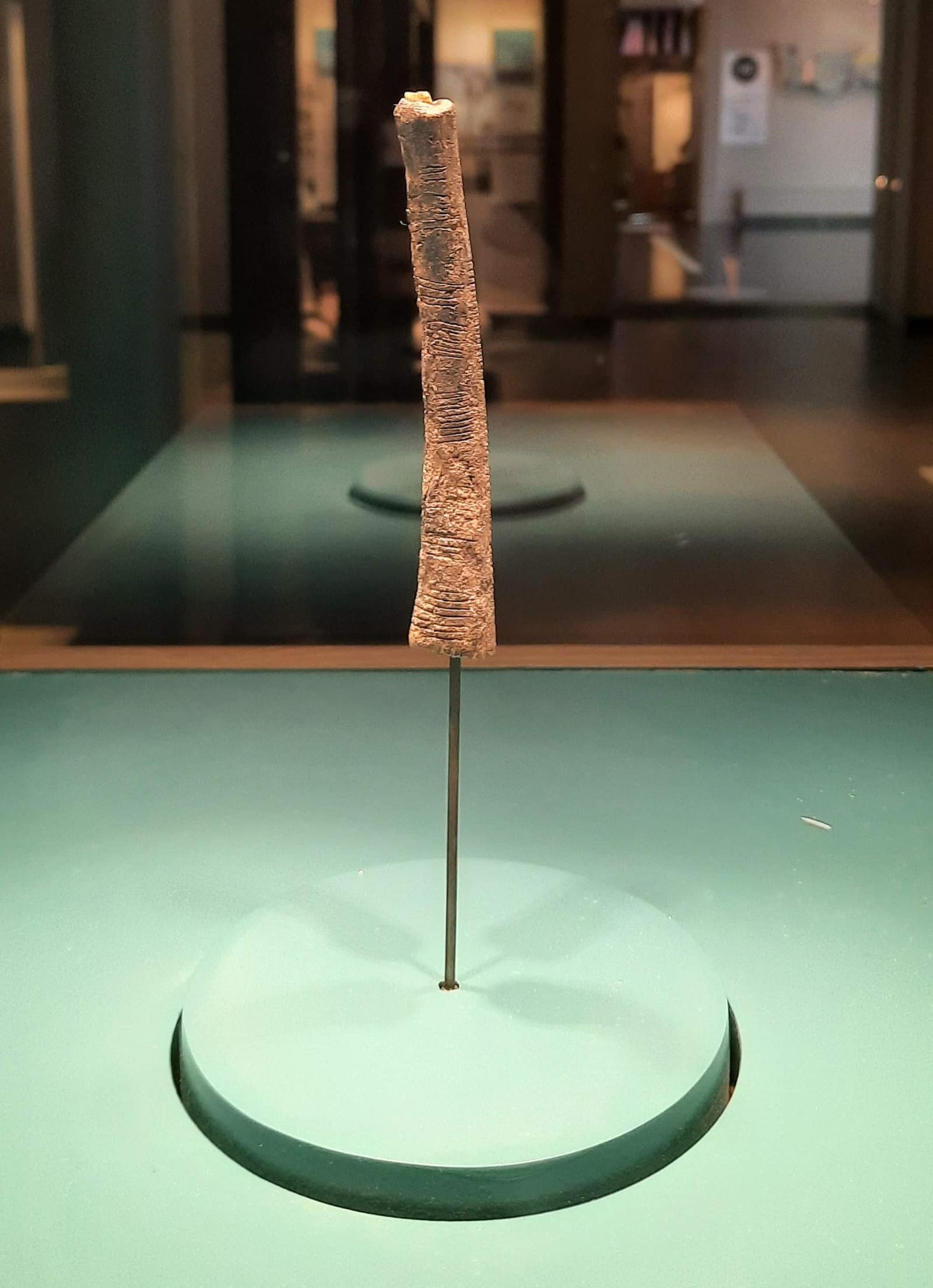
The Ishango bone
- Dated
- c. 20,000 years ago
- Place
- Ishango, Virunga National Park, North Kivu, Democratic Republic of the Congo
- Remains
- Fragmentary
This civilization lived by the water. On the shore of Lake Edward, some twenty thousand years ago, people fished, gathered, and made harpoons of bone. One of them took a thin piece of bone, set a chip of quartz at its end, and began to cut.
The cuts are small and deliberate. They run in three columns along the shaft, gathered in groups, as if the hand had paused between each set and started again. Someone was keeping something: a count, a sequence, a record of days. We do not know which. The order of the groups looks intended, and that is almost all that can be said with certainty.
On the way to step 2
Before any script, a hand cut groups of notches into a bone. No one knows what they counted. In Mesopotamia, much later, scribes pressed wedges into wet clay and wrote down whole stories.
Osama Shukir Muhammed Amin FRCP(Glasg), CC BY-SA 4.0, via Wikimedia CommonsCC-BY-SA-4.0Original record

2 Asia · c. 650 BCE
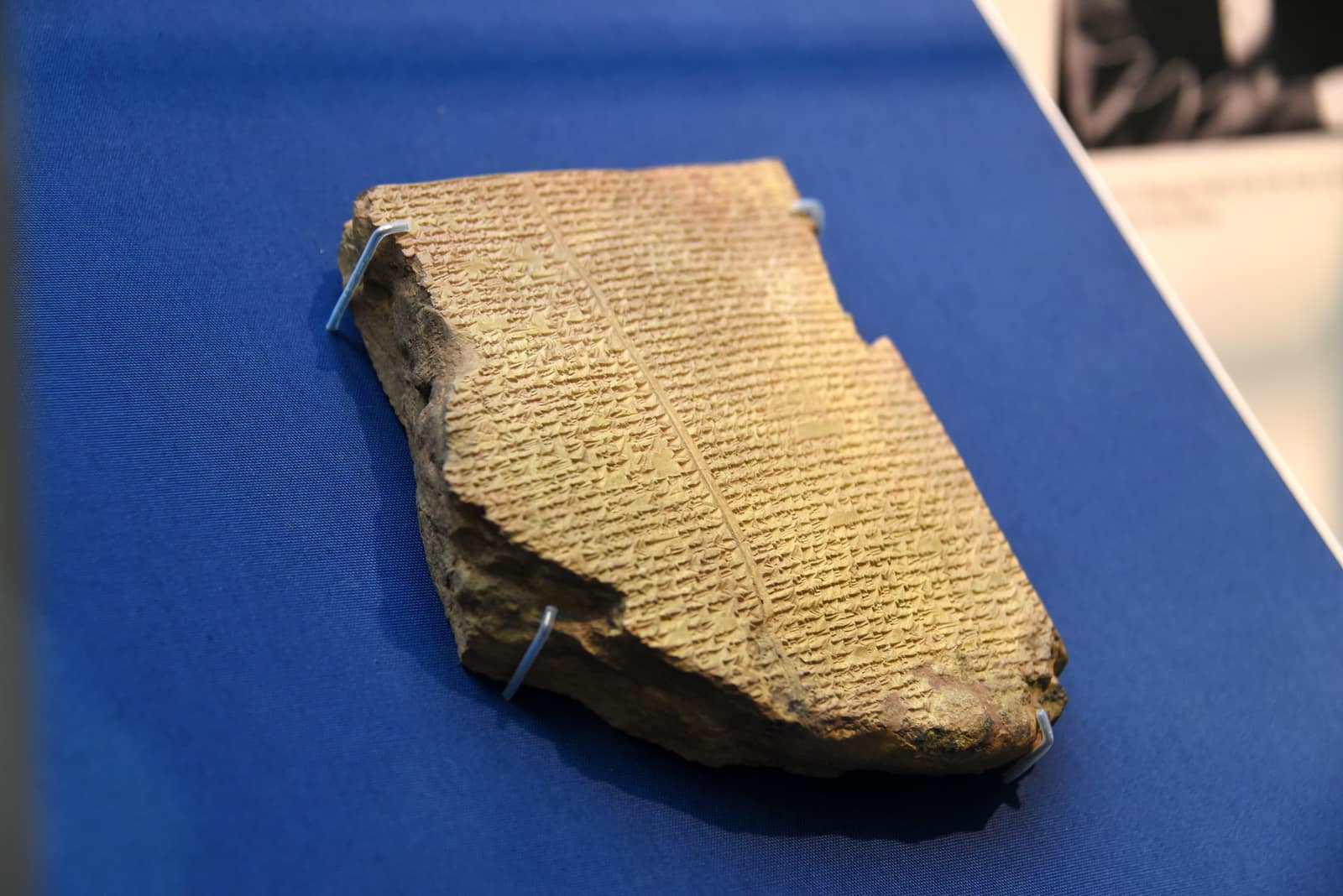
The Epic of Gilgamesh (Flood Tablet)
- Dated
- c. 650 BCE
- Place
- Mosul, Iraq
- Remains
- Fragmentary
A man is told in a dream to tear down his house and build a boat. He does it. He loads it with silver and gold, with his family and kin, with the animals of the field and with craftsmen. The storm comes; for six days and seven nights the wind and the flood flatten the land. Even the gods cower like dogs.
When the waters sink, the boat comes to rest on a mountain. He sends out a dove; it comes back. A swallow; it comes back. A raven; it does not return.
On the way to step 3
Clay tablets kept the story of a king who searched for a life without end. In Egypt, one decree was carved three times on the same stone, in three scripts, so that everyone could read it.
© Hans Hillewaert, CC BY-SA 4.0, via Wikimedia CommonsCC-BY-SA-4.0Original record

3 Africa · 196 BCE
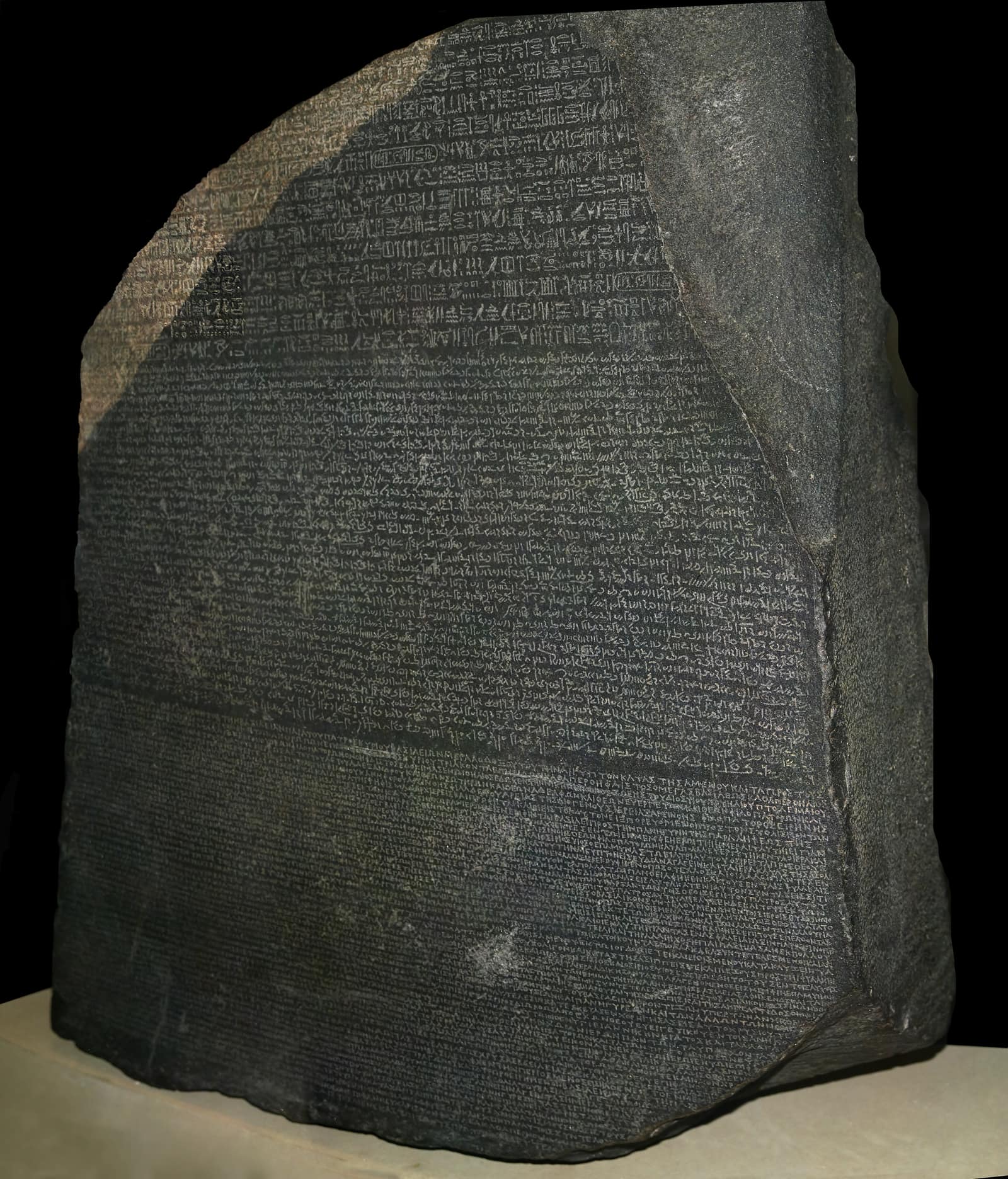
The Rosetta Stone
- Dated
- 196 BCE
- Place
- Rashid, Beheira, Egypt; now in London, United Kingdom
- Remains
- Fragmentary
The priests who met at Memphis in the spring of 196 BCE did not mean to write a key. They meant to honour a young king, Ptolemy V, and so they ordered their decree carved in the temples of Egypt in three scripts: the sacred hieroglyphs of the gods, demotic for everyday writing, and Greek for the rulers who had come from Macedonia.
For centuries one of those stones, already broken, lay built into a wall. In 1799 French soldiers, repairing a fort near the town the Europeans called Rosetta, pulled it out. Two years later, after the French defeat, it passed to the British and was shipped to London.
On the way to step 4
Three scripts side by side later let scholars read the hieroglyphs again. In the Andes, the Inca kept their records without any script at all, in knots tied on cords.
Daderot, CC0, via Wikimedia CommonsCC0-1.0Original record
_composed_of_two_main_cords_with_subsidiary_and_tertiary_cords,_Inca,_Peru,_Late_Horizon,_1476-1534_AD,_cotton,_plant_fiber,_indigo_dye_-_Dallas_Museum_of_Art_-_DSC04703.jpg)
4 Americas · 1400 to 1800
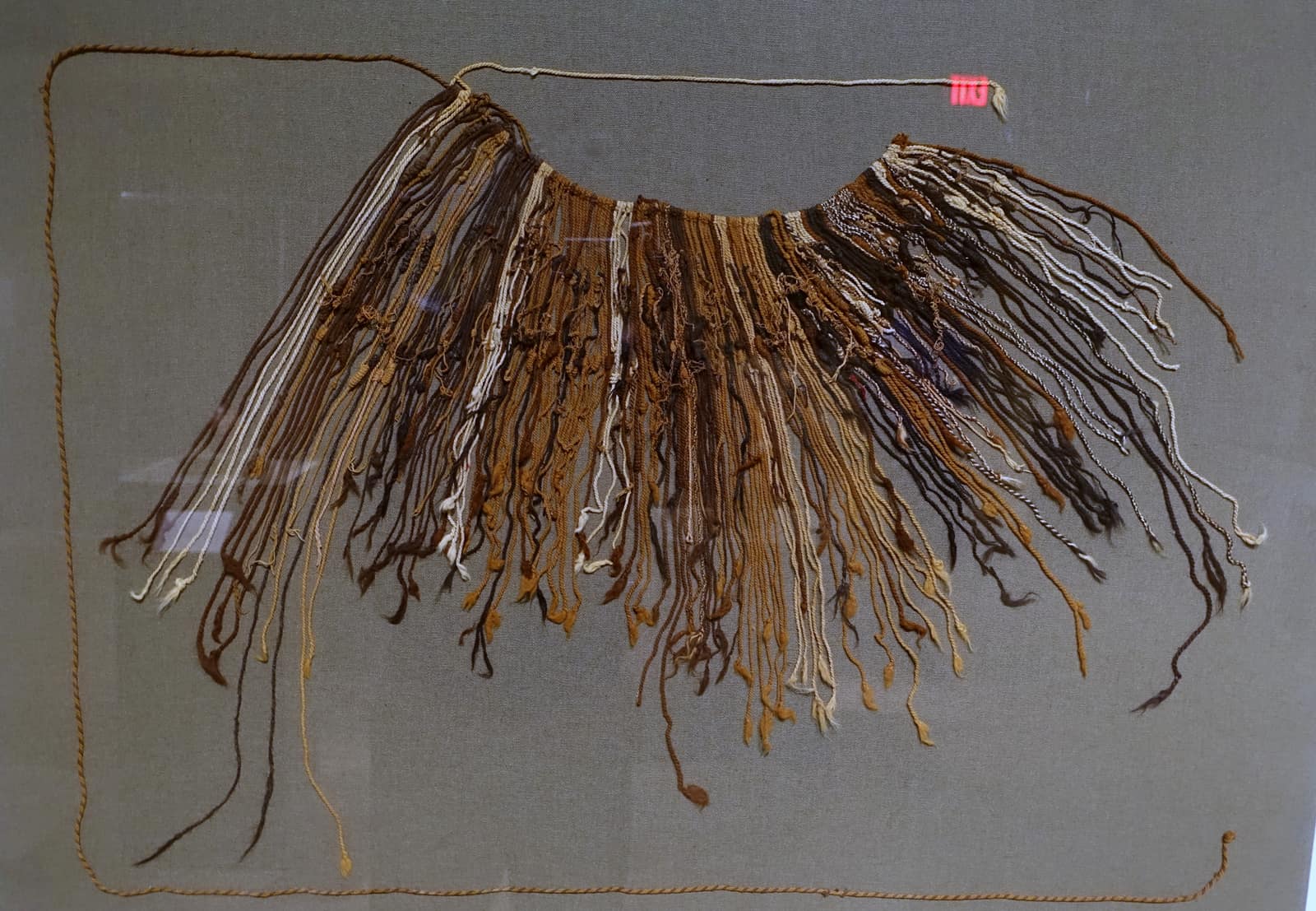
The khipu
- Dated
- 1400 to 1800
- Place
- Peru
- Remains
- Fragmentary
This civilization kept its archives in its hands. A cord of cotton or llama wool was hung with dozens, sometimes hundreds, of other cords, dyed and twisted, and on each cord knots were tied at chosen heights. A knot near the bottom counted ones; higher up, tens, then hundreds. A skilled keeper could run the strands through their fingers and give back a census, a harvest, a debt.
The Inka state governed millions of people across the Andes without letters as others knew them. Messengers ran with khipus along its roads. Spanish officials, arriving in the sixteenth century, watched keepers read them aloud, and sometimes used them in court; later, many were burned as suspect.
On the way to step 5
A knot can hold a number, and perhaps more. In Tang China, carved woodblocks let one text be printed again and again, and a single scroll kept the day it was made.
British Library, Or.8210/P.2 (CC0), via Wikimedia CommonsCC0-1.0Original record
,_frontispiece_and_text_-_BL_Or._8210-P.2.jpg)
5 Asia · 868 CE
The Diamond Sutra of 868
- Dated
- 868 CE
- Place
- Mogao Caves, Dunhuang, Gansu, China
- Remains
- Intact
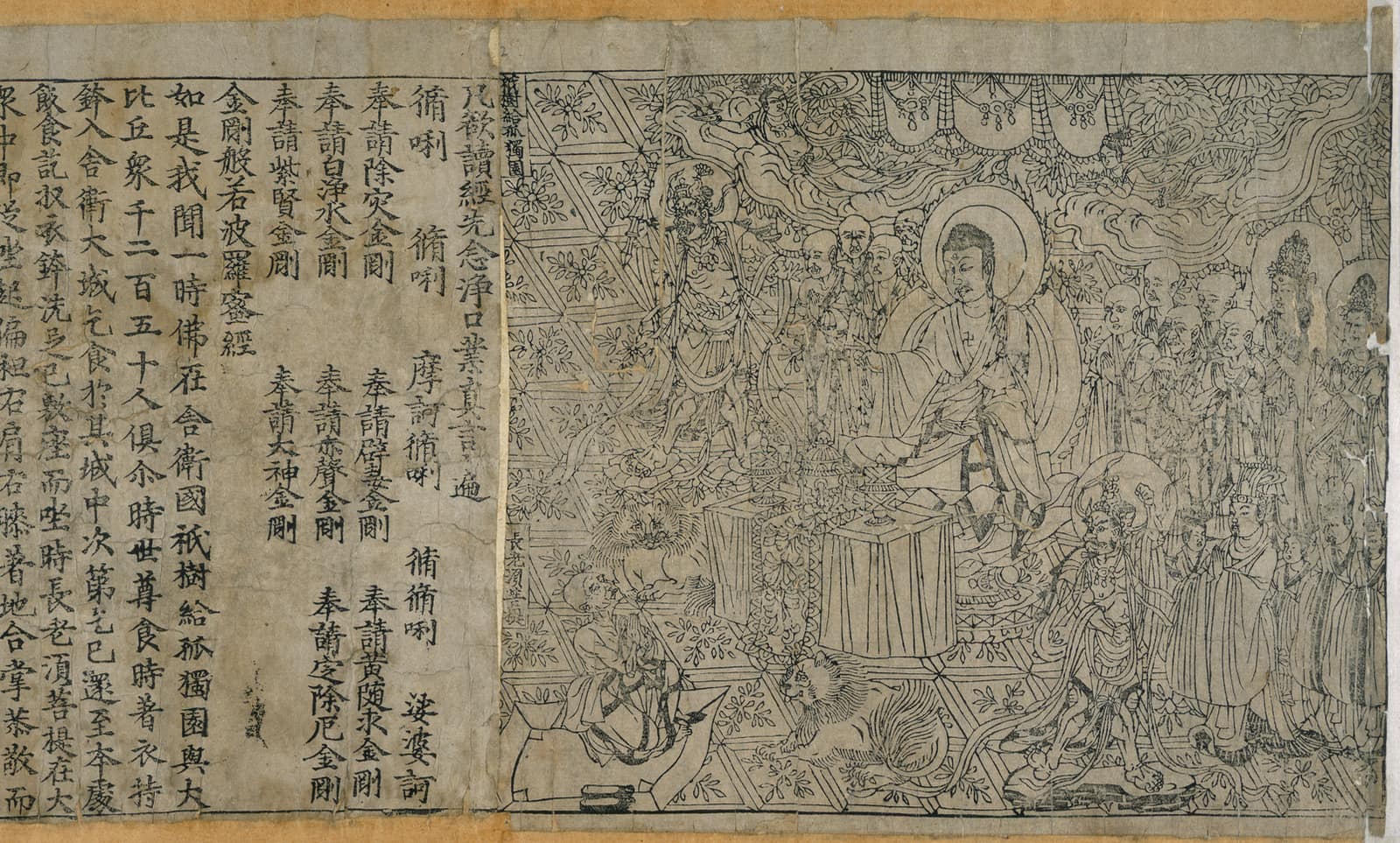
In the spring of 868, a man named Wang Jie paid for a text to be carved into wooden blocks, inked and pressed onto paper, so that it could be given away. He did it, the last lines say, on behalf of his two parents. The text was the Diamond Sutra, a Buddhist teaching on the passing nature of all appearances.
At its head, the carver cut an image: the Buddha seated behind an altar under a canopy, speaking to an old disciple kneeling on a mat, surrounded by monks, guardians and a lion. Every line of that crowd was cut away from the wood with a blade, in reverse.
On the way to step 6
Woodblocks carved a whole page at once. In Korea, printers cast separate characters in metal, so that a page could be composed, printed and taken apart again.
Zythème, CC0, via Wikimedia CommonsCC0-1.0Original record

6 Asia · 1377 CE
The Jikji
- Dated
- 1377 CE
- Place
- Cheongju, North Chungcheong, Republic of Korea; the book is in Paris
- Remains
- Fragmentary
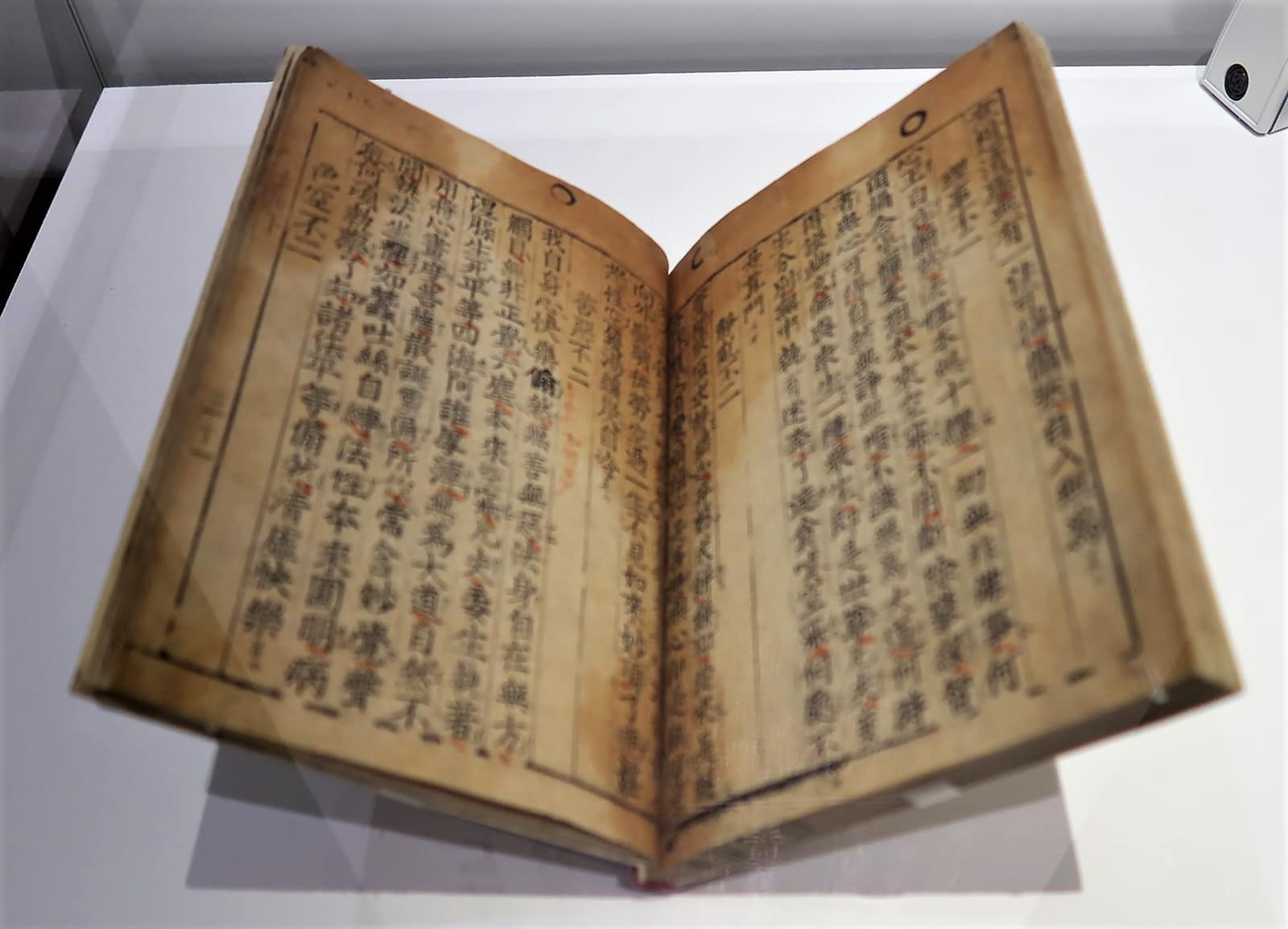
Each character was cast. The printers of Heungdeok temple shaped the signs one by one, poured molten metal into moulds, and set the small blocks in a frame, line after line, to print a book of their teacher's selected sayings. Then they took the frame apart and used the characters again for other pages.
It shows. Some characters lean a little; some are inked more heavily or more faintly than their neighbours; the lines do not always run straight. These are the marks of separate pieces of type, not of a carved wooden block.
On the way to step 7
Movable metal type was invented again in Europe, independently as far as we know. In Mainz, a workshop printed a Bible with type, ink and a press, and books began to multiply.
NYC Wanderer (Kevin Eng), CC BY-SA 2.0, via Wikimedia CommonsCC-BY-SA-2.0Original record

7 Europe · c. 1455 CE
The Gutenberg Bible
- Dated
- c. 1455 CE
- Place
- Mainz, Rhineland-Palatinate, Germany
- Remains
- Fragmentary
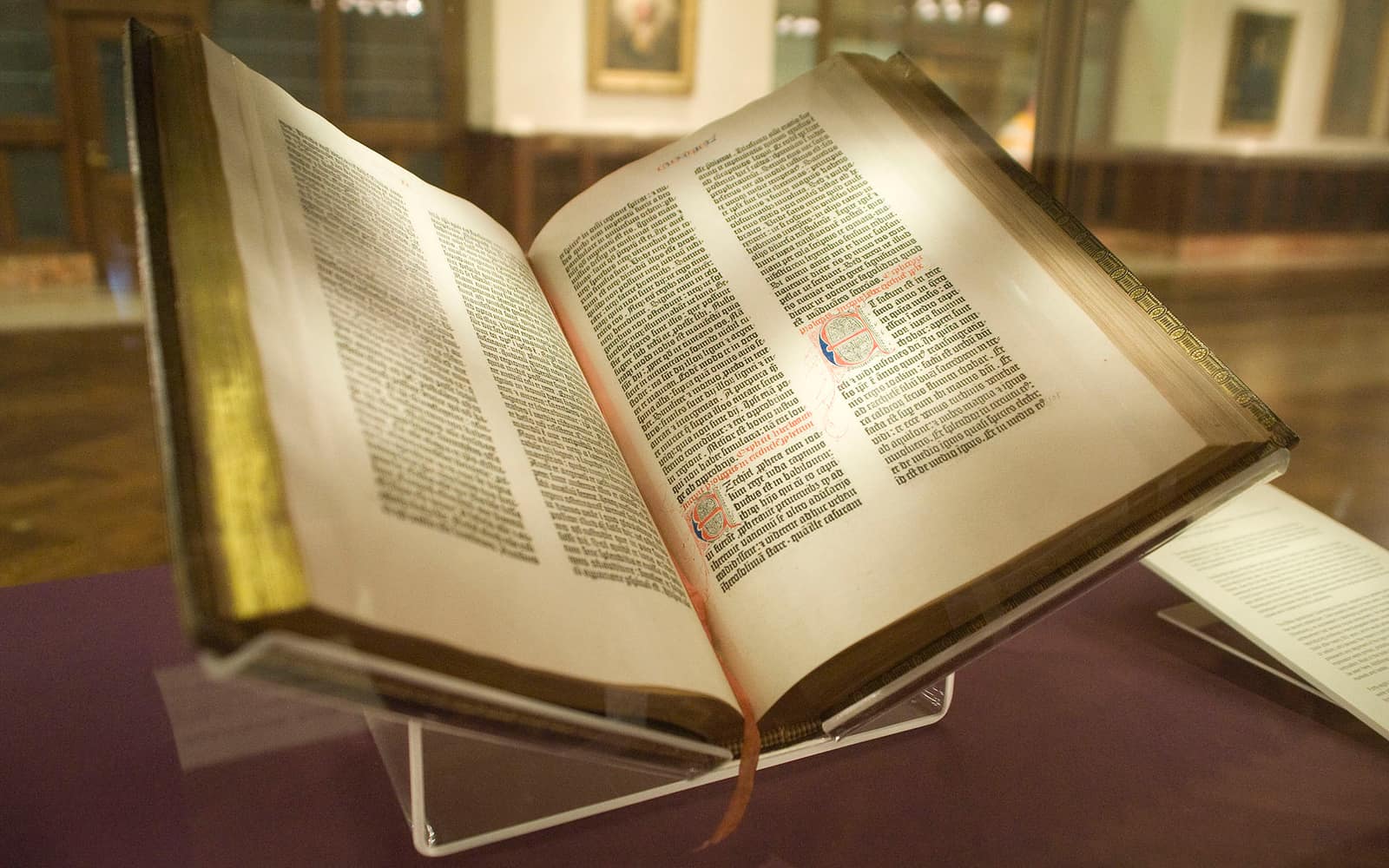
Before this, every book in Europe was written by a hand. Then, in a workshop in Mainz, a man of the city trained in metalwork found a way to make the hand repeat itself.
Johannes Gutenberg cast letters one by one in metal from a small mould, set them in lines, inked them with a sticky black made with oil, and pressed paper and vellum against them with a screw, like a wine press. The text he chose was the Latin Bible that the churches of Europe read aloud. Two columns to a page, forty two lines to most columns, some 1,280 pages in two volumes.
On the way to step 8
Printed books spread across Europe. In West Africa, scholars and copyists went on filling family libraries by hand, with manuscripts in Arabic and in African languages written in Arabic script.
Mark Fischer, CC BY-SA 2.0, via Wikimedia Commons (Flickr: fischerfotos)CC-BY-SA-2.0Original record
.jpg)
8 Africa · after 1200 CE
The Timbuktu manuscripts
- Dated
- after 1200 CE
- Place
- Timbuktu, Mali
- Remains
- Fragmentary
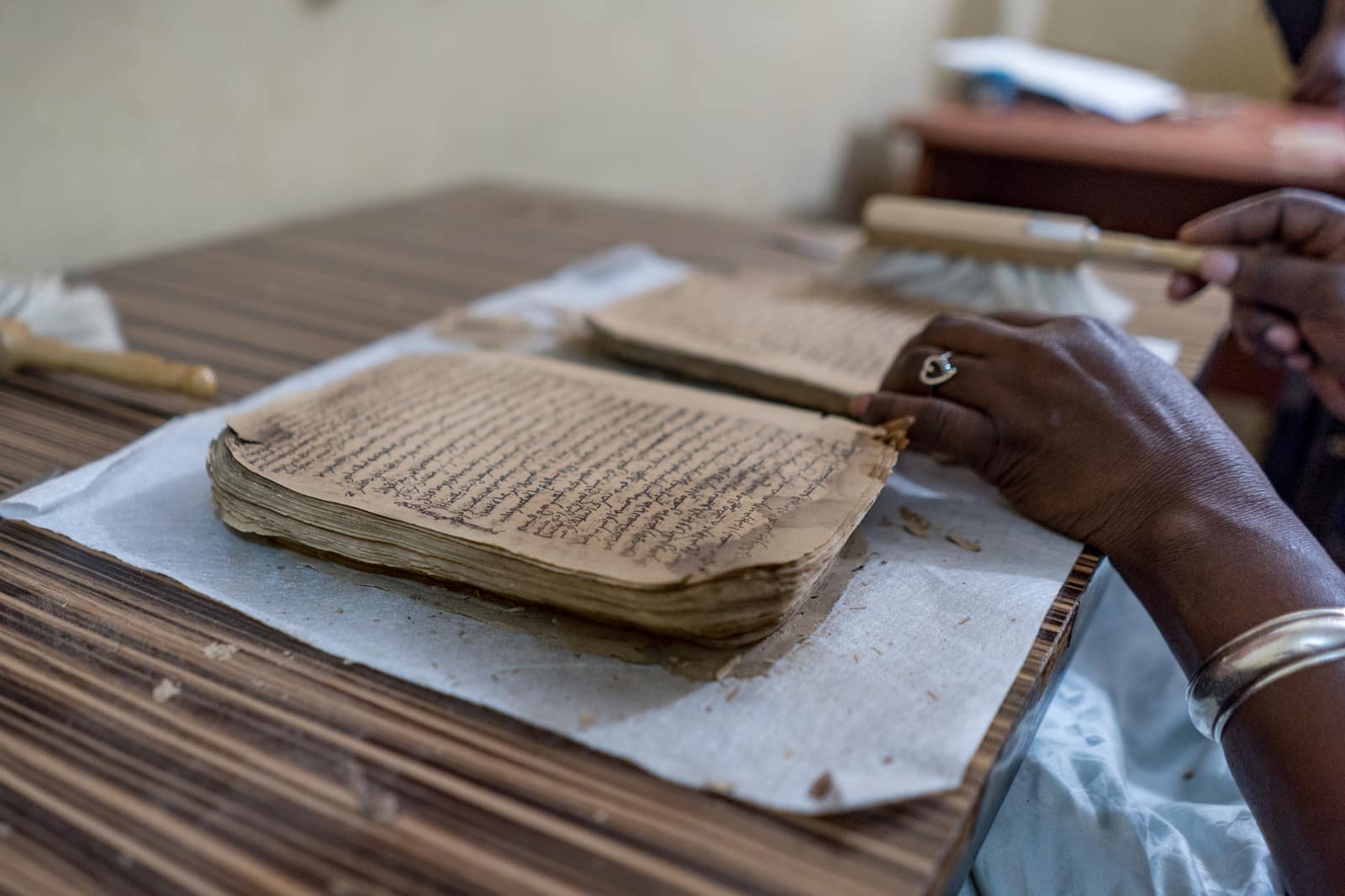
This civilization wrote at the edge of a desert. Timbuktu stood where the caravans from the Sahara met the boats of the Niger, and with salt, gold and cloth came paper and books. Families copied them, bought them, annotated their margins, and passed them down.
The pages speak of everything. How to read the stars to know the seasons. How to divide an inheritance. How to treat a fever with plants and minerals. How to add and multiply. How the soul draws nearer to God. Some are in Arabic, others in African languages written in Arabic letters. Kept in chests and in family rooms, they survived heat, dust and termites for centuries.
On the way to step 9
These libraries kept knowledge on paper, and their custodians saved it again in 2012 and 2013. In the Marshall Islands, navigators kept theirs without writing, in lattices of sticks and shells.
Library of Congress, Geography and Map DivisionPDMOriginal record

9 Oceania · 1920 to 1929
A map of the swell: Marshall Islands stick charts
- Dated
- 1920 to 1929
- Place
- Majuro, Marshall Islands
- Remains
- Intact
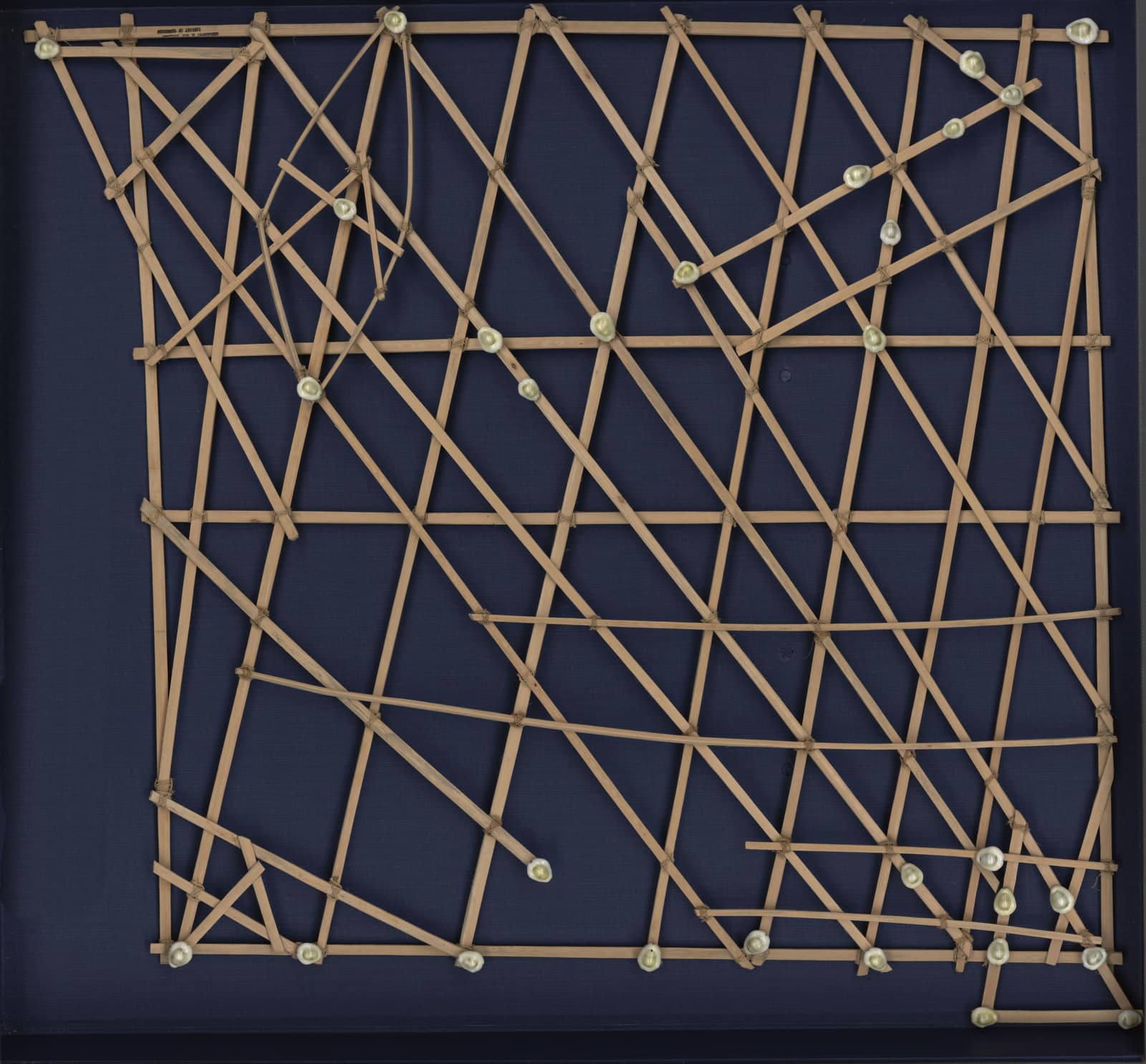
This civilization lived on atolls so low that a coconut palm showed above the horizon only some twenty kilometres out to sea. Its navigators did not look for land; they felt for it. A swell rolling in from the east bent around an island, struck its reef and sent back a fainter wave, and a canoe crossing these meetings of water rocked in a way the body learned to recognise.
What is kept here is how that recognition was taught. Thin sticks lashed with fibre: the straight ones for currents and regular waves, the curved ones for the great ocean swells, and small shells tied on for the atolls. It was never taken to sea. A learner studied it ashore, committed it to memory, then left it behind. The chart travelled inside the navigator.
On the way to step 10
A chart of swells is a way of writing the sea. In 1969, in California, two letters travelled from one computer to another before the system crashed: l and o.
ARPANET Logical Map, March 1977, via the Computer History MuseumPDMOriginal record

10 Americas · 1969 to 1990
A map of a new network: ARPANET
- Dated
- 1969 to 1990
- Place
- Los Angeles, California, United States
- Remains
- Fragmentary
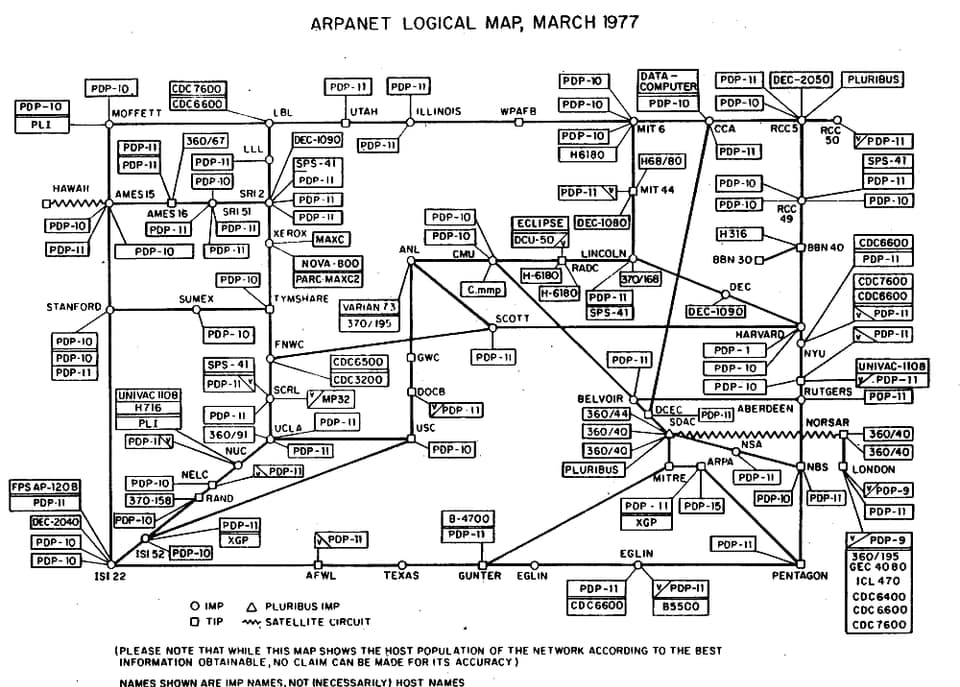
On the evening of 29 October 1969, in a room at the University of California, Los Angeles, a student named Charley Kline began to type the word login to a computer at the Stanford Research Institute, several hundred kilometres to the north. He sent the l, and the other end confirmed it. He sent the o. Then the distant machine crashed. The first message that this civilization passed across its new network was therefore two letters: lo. About an hour later the whole word went through.
The map kept here was drawn in March 1977. Its lines no longer join four sites but dozens: universities, government laboratories, military bases, a satellite link to Hawaii, another across the Atlantic to Norway and on to London. Each small circle marked a switching machine, each box the computers attached to it. A note at the foot of the sheet admits that no claim can be made for its accuracy. The network was changing faster than anyone could draw it.
End of the journey
From notches on a bone to packets on a network, every continent found ways to make words and knowledge outlast a single voice. What will our own writing look like in 10,000 years?